
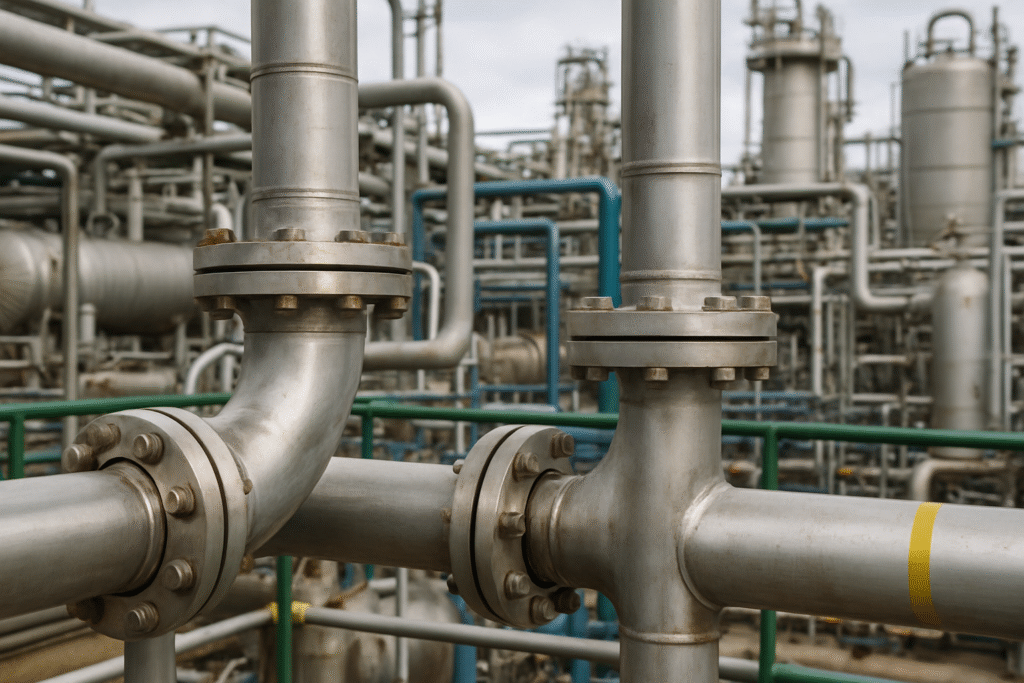
스위블 플랜지 작동 방식? 장점에 대한 데이터 기반 가이드, 표준, 및 선택
스위블 플랜지 시장은 성장하는 산업용 배관 부문에 속합니다.. 그랜드뷰 리서치에 따르면 (2024), 전 세계 산업용 플랜지 시장의 가치는 다음과 같습니다. $5.8 10억 2023 도달할 것으로 예상됩니다. $7.2 10억 단위로 2030. For engineers asking how a swivel flange works, the critical answer is simple: it helps bolt hole alignment during installation, not continuous rotation in service.
That distinction matters in Energy, 난바다 쪽으로 부는, 석유화학, and maintenance projects. It affects gasket integrity, 볼트 예압, installation time, and the risk of forcing misalignment into a piping system.
Swivel Flange Market Context, Buyer Demand, and Why the Design Matters
IBISWorld에 따르면 (2024), 아시아 태평양 계정은 이상입니다. 45% 글로벌 플랜지 생산량의, 중국이 가장 큰 제조사이기 때문에. 그러므로, procurement teams increasingly compare not only price, but also forging quality, 가공 공차, 검사 기록, 수출 규정 준수.
스태티스타에 따르면 (2024), 석유 및 가스 산업은 대략적으로 35% 글로벌 플랜지 소비량. 결과적으로, specialized products such as swivel ring assemblies remain highly relevant in offshore tie-ins, subsea piping, brownfield revamps, and cramped retrofit work.
A swivel flange is not a rotary union. 대신에, it is a two-part or multi-part flange assembly in which the ring can rotate around the hub before final bolting.
Once technicians tighten the bolts to the specified sequence and preload, the connection behaves like a conventional static bolted flange joint. 하지만, many buyers still confuse it with a live rotating joint, which can create design errors.
This is why the phrase 스위블 플랜지 작동 방식? keeps appearing in technical searches. Buyers want to know whether the flange solves alignment problems, piping stress issues, or dynamic rotation needs.
실제로, it solves assembly alignment. It does not replace a dedicated swivel joint when the process line must rotate during operation.
모르도르 정보국에 따르면 (2024), global energy infrastructure investments continue to support demand for pressure-containing piping components in upstream, 내의 한복판, 및 공정 부문. 게다가, installation efficiency has become a key procurement metric because shutdown windows are shorter and labor costs are higher.
배관 엔지니어 Mark Ellison으로서, Chartered Mechanical Engineer, 주: “A swivel flange is an installation efficiency device first and a pressure boundary component second. If you misunderstand that order, you can specify the wrong product for the wrong duty.”
조달팀용, that means evaluating the product as both a mechanical interface and a project execution tool. The correct swivel flange can reduce rework, prevent pipe twisting, and help crews meet bolt-up schedules.
Manufacturers also vary widely in execution. 와 함께 ISO 9001:2015 및 PED 2014/68/EU 인증, SASA FLANGE supports export-oriented projects that require dimensional accuracy, 추적성, and controlled materials.
추가적으로, buyers now request broader documentation. EN 10204 3.1 재료 인증서, PMI, 차원 보고서, hydrostatic testing records, and NDE summaries often influence vendor selection as much as unit price.
그런 이유로, experienced sourcing teams review supply capability early. They also check whether the supplier can manufacture stainless steel, 탄소강, and alloy grades under ASME, DIN, JIS, 고스트, EN 시스템.
SASA FLANGE manufactures flanges and pipe fittings in 304, 316, 316엘, 904엘, 2205, 2507, A105, A182, 인코넬, 모넬, 하스텔로이, 그리고 티타늄. 고급 CNC 가공 및 포괄적인 품질 테스트를 통해 뒷받침됨, 회사는 석유를 제공합니다 & 가스, 석유화학, 힘, 선박, 수처리, and Construction projects in 50+ 국가.
스위블 플랜지 작동 방식: Design Principles, Mechanism, and Advantages
The core mechanism is straightforward. A swivel flange usually includes a hub, often weld neck style, and a separate forged ring that rotates for bolt hole alignment before tightening.
In many designs, a retainer feature keeps the ring engaged with the hub. The ring rotates 360 degrees during assembly, which lets installers align bolt holes without turning the connected pipe, hose, or spool.
According to ASME flange practice and bolted joint guidance, correct alignment reduces the risk of uneven gasket compression and poor preload distribution (ASME, 2023). 그러므로, the swivel feature improves assembly control rather than pressure rating by itself.
박사로서. Laura Chen, Materials and Piping Specialist, 주: “The real benefit of a swivel flange is stress avoidance during fit-up. When crews stop forcing alignment, leakage risk often drops because the gasket sees a more uniform seating load.”
That explains its value in offshore tie-ins and maintenance turnarounds. 그런 경우에는, technicians may not be able to rotate the mating spool due to nearby structures, welding constraints, or attached equipment.
Swivel flange assemblies are common in weld neck formats because those designs better handle cyclic loading and piping stress. 하지만, slip-on styles also appear in lower severity services where cost and ease of fabrication matter more.
- Typical components: forged hub, rotating ring, retaining feature, gasket interface, bolting set
- Typical face types: RF 플랜지, FF flange, RTJ 플랜지
- Typical standards reviewed: ASME B16.5, ASME B16.47, ASME B16.20, ASME PCC-1
- Typical material families: 탄소강, 304/316 스테인레스, 듀플렉스, 니켈 합금
시장 조사 미래에 따르면 (2024), industrial maintenance spending in process industries continues to rise as aging assets require more replacement and retrofit work. 결과적으로, products that reduce fit-up time and field modification costs gain more attention from EPC contractors.
The major 장점 of a swivel flange are practical. It simplifies bolt hole orientation, reduces forced piping strain, lowers the chance of gasket damage during rushed installation, and supports safer assembly in congested layouts.
하지만, it does not forgive poor bolting practice. If crews insert the gasket too early and then rotate the Ring across the seating surface, they can scratch, shift, or contaminate the gasket interface.
비슷하게, if they forget to place the rotating ring before welding the hub, the entire assembly may become unusable. These are common site errors in Beginner’s installation teams and mixed contractor crews.
A disciplined installation sequence works best. First align the rotating ring with guide studs, then verify flange face condition, then place the gasket, and finally tighten the bolts in a controlled cross pattern.
ASME PCC-1 remains the most widely referenced bolted flange assembly guidance for this step. It emphasizes proper lubrication, torque sequence, 다중 패스, and preload consistency (ASME PCC-1, 2022).
The design also differs from a lap joint arrangement. A lap joint flange rotates around a stub end, while a swivel flange typically uses a hub-and-ring configuration optimized for alignment and service-specific pressure containment.
For higher performance applications, engineers should confirm several details before ordering:
- 압력 등급, 클래스와 같은 150, 300, 600, 900, 1500, 또는 2500
- Applicable dimensional system, ~와 같은 ASME B16.5 또는 ASME B16.47
- 직면 유형 및 개스킷 호환성
- Corrosion allowance and metallurgy for the service fluid
- Weld prep, 벽 두께, and schedule compatibility
- 임사체험, PMI, 그리고 EN 10204 3.1 documentation requirements
According to NACE material selection guidance for corrosive environments, metallurgy and service chemistry must always be checked together (NACE, 2023). 그러므로, 에이 316 or 316L solution may suit many environments, but sour service, 염화물, or elevated temperatures may require duplex or nickel alloy grades.
For customized projects, SASA FLANGE 1/2부터 사용자 정의 크기 제공" 60까지" 경쟁력 있는 공장 직거래 가격으로. The company also supports material options in 304, 316, 904엘, 2205, 2507, and high-performance alloys for technically demanding flange and fitting packages.
Swivel Flange Standards, 규정 준수, 및 검사 요구 사항
Engineers should validate a swivel flange against the same core pressure boundary rules used for conventional flanges. The swivel function changes installation flexibility, but it does not remove the need for compliance with dimensional, 재료, and bolting standards.
The main standards referenced in most specifications include ASME B16.5 NPS용 1/2 ~을 통해 24, ASME B16.47 더 큰 직경의 경우, 그리고 ASME B16.20 for metallic gaskets. 게다가, ASME PCC-1 guides field assembly practices.
Material standards usually come from ASTM. 일반적인 예는 다음과 같습니다 ASTM A105 for carbon steel forgings and ASTM A182 for stainless and alloy steel flanges.
European projects may also require EN 1092 dimensions and PED conformity. Marine and offshore buyers may ask for DNV, 노르웨이, or client-specific ITP requirements.
- ASME B16.5: 치수, 공차, 교련, 압력 온도 등급
- ASME B16.47: 대직경 강철 플랜지
- ASME B16.20: 링 조인트, 나선형 상처, and jacketed gaskets
- ASME PCC-1: assembly of bolted flange joints
- ASTM A105 / A182: forging material specifications
- EN 1092: European flange dimensions and ratings
- PED 2014/68/EU: pressure equipment regulatory compliance
There is also a compliance difference between product type and documentation depth. Commodity flanges may ship with basic mill paperwork, while project-grade swivel flange orders often require heat traceability, PMI, 경도 검사, 페라이트 검사, or impact test records.
ISO 제조 품질 지침에 따름, traceability and controlled inspection improve consistency and nonconformance response time (ISO, 2023). 그러므로, procurement teams should define inspection and release requirements before production starts.
A practical comparison helps during specification reviews:
- Fixed flange: standard bolted connection, no rotational alignment feature
- Swivel flange: rotational bolt hole alignment before tightening
- 랩 조인트 플랜지: rotating backing flange used with stub end
- Swivel joint: intended for dynamic rotation in service, not equivalent to a swivel flange
Face type also matters. RF systems typically pair with spiral wound or soft gaskets, FF systems are common in lower pressure or nonmetallic flange arrangements, and RTJ systems serve high-pressure services where ring-type joints are specified.
Each face needs a matching gasket and surface finish. Otherwise, even a correctly aligned swivel flange can leak.
Engineers should also review material compatibility against temperature and media. 예를 들어, duplex and super duplex grades may outperform standard austenitic stainless steel in chloride-bearing environments, while nickel alloys may be required for severe corrosion or high-temperature duties.
와 함께 ISO 9001:2015, PED 2014/68/EU, 그리고 광고 2000 인증, SASA FLANGE supports projects that demand controlled manufacturing and export documentation. Buyers can review product scope through the product portfolio and align specifications with applicable standards early in the RFQ stage.
For authoritative standards reference, engineers can also review the official ASME resources at ASME.org. That is especially useful when reconciling dimensional classes, gasket interfaces, and bolting procedures across mixed project specifications.
신청안내: 기름, 가스, 화학적인, 힘, 선박, and Custom Selection Criteria
A swivel flange delivers the greatest value where field alignment is difficult. That includes offshore tie-ins, modular skid hookups, 해양 배관, plant revamps, and spool replacements in restricted spaces.
기름에 & 가스, crews often connect fabricated spools in locations where pipe rotation is impossible. 그러므로, a swivel assembly can reduce fit-up stress and shorten shutdown duration.
In petrochemical units, old piping rarely matches current dimensions perfectly. A swivel flange helps align bolting without forcing connected equipment nozzles out of position.
발전에 있어서, alignment control matters around turbines, 슬리퍼, and heat recovery systems. Excessive installation stress can transfer into nozzles, 지원하다, and vibration-sensitive assets.
In shipbuilding and marine systems, compact layouts and onboard movement create difficult assembly conditions. A rotating ring arrangement can improve access and reduce labor during installation and replacement work.
Selection should always start with service conditions, not just availability. A low-cost flange that lacks the right material, 깃 달기, or documentation can create far higher total project cost later.
- Confirm design pressure and temperature range
- Match ASME, DIN, JIS, 고스트, or EN dimensional system
- Select the correct class rating and facing type
- Verify gasket compatibility and surface finish
- Check corrosion resistance for process media
- Review welding details, 일정, and wall thickness
- Define testing, 임사체험, PMI, 및 문서 패키지
- Confirm replacement interchangeability for maintenance stock
예를 들어, 클래스 150 swivel flange may suit many utility or lower pressure process lines. 하지만, offshore hydrocarbon systems may require higher classes, RTJ facings, and stricter inspection controls.
비슷하게, 에이 304 stainless option may be acceptable for general service. 대조적으로, 316엘, 2205, 2507, or nickel alloys may be necessary when chlorides, sour conditions, or aggressive chemicals are present.
According to ASTM and corrosion engineering practice, material choice should consider chloride content, pH, 온도, 속도, and cyclic service exposure (ASTM, 2023). 결과적으로, selection by name alone is not enough.
Procurement managers also ask about replacement strategy. If an existing swivel flange must match legacy dimensions, 교련, 얼굴 마무리, 야금학, custom manufacturing may be the only practical route.
This is where supplier flexibility becomes important. SASA FLANGE supports custom manufacturing for flanges and fittings in stainless steel, 탄소강, 합금강, and high-performance corrosion-resistant grades.
고급 CNC 가공 및 포괄적인 품질 테스트를 통해 뒷받침됨, the company can support standard and project-specific requirements. That includes custom dimensions, 특수재료, and documentation aligned with EPC and end-user specifications.
For buyers sourcing complete packages, combining swivel flange supply with elbows, 티셔츠, 감속기, 모자, and mating flanges can improve schedule control. It also reduces mismatch risk across the piping BOM.
Future Outlook for Swivel Flange Demand and Strategic Procurement Recommendations
The long-term demand outlook remains positive. 그랜드뷰 리서치에 따르면 (2024), the broader flange market is expected to grow from $5.8 10억 2023 에게 $7.2 10억 단위로 2030.
That growth will not be uniform across all product types. 하지만, installation-focused components such as swivel flange assemblies should benefit from offshore upgrades, 개조 프로젝트, modular construction, and maintenance-driven replacement demand.
스태티스타에 따르면 (2024), oil and gas already represents about 35% of flange consumption. 그러므로, 상류, LNG, 정련소, and subsea investments will continue to influence specification trends, especially in higher-grade materials and stricter QA documentation.
Engineers should respond with a more disciplined selection process. 첫 번째, define whether the application needs alignment assistance or actual rotational service, because that choice separates a swivel flange from a swivel joint.
다음, lock in standards, 수업, 얼굴형, and metallurgy early. Then specify bolting, 개스킷 유형, 검사 범위, and certification requirements before placing the PO.
Procurement teams should also compare total installed cost rather than piece price alone. A precisely machined swivel Ring that saves field hours and avoids leakage can deliver better project economics than a cheaper but poorly controlled alternative.
마지막으로, work with manufacturers that understand both engineering detail and export execution. 필요한 프로젝트의 경우 ISO 9001:2015, 소아과, EN 10204 3.1, or custom alloy capability, early technical review with SASA FLANGE can simplify sourcing and reduce commercial risk.
자주 묻는 질문
What is a swivel flange?
●A swivel flange is a flange assembly with a rotating ring that allows 360-degree bolt hole alignment before final tightening, and this feature supports faster installation in constrained piping layouts.
●그랜드뷰 리서치에 따르면 (2024), 세계 산업용 플랜지 시장 진출 $5.8 10억 2023, which shows why specialized flange types remain important in installation-driven sectors.
●Unlike a rotary union or live swivel joint, a swivel flange does not provide continuous rotation during operation after bolts are tightened.
●It usually includes a hub, a forged rotating ring, and a retaining feature, and common design references include ASME B16.5, ASME B16.47, ASME B16.20, and ASME PCC-1.
●For offshore tie-ins, retrofit work, and piping that cannot be twisted during fit-up, specifying a qualified swivel flange from an experienced manufacturer such as SASA FLANGE helps improve alignment accuracy and documentation control.
What is the difference between a fixed flange and a swivel flange?
●A fixed flange has bolt holes in a fixed orientation, while a swivel flange uses a rotating ring so installers can align the bolt pattern without rotating the connected pipe or spool.
●스태티스타에 따르면 (2024), 석유와 가스는 대략적으로 35% 글로벌 플랜지 소비량, and this makes alignment efficiency especially valuable in offshore and shutdown work.
●조립 후, both types act as static bolted flange joints, but only the swivel flange provides alignment flexibility before preload is applied.
●Engineers should still verify the same technical factors for both designs, including class rating, 얼굴형, 개스킷 호환성, ASTM 재료 등급, and bolting practice under ASME PCC-1.
●If your project faces nozzle restrictions, spool misalignment, or tight maintenance windows, a swivel flange can reduce forced stress and rework compared with a conventional fixed flange.
What is a pivoting flange?
●A pivoting flange is an informal term often used to describe a flange with a movable or rotating element, and in industrial piping it usually refers to a swivel flange or rotating ring flange.
●IBISWorld에 따르면 (2024), 아시아 태평양 계정은 이상입니다. 45% 글로벌 플랜지 생산량의, so buyers frequently see different naming conventions from different suppliers and regions.
●The critical technical point is that the pivoting action is normally used during installation for bolt alignment rather than for dynamic motion in service.
●To avoid specification errors, engineers should request the exact construction details, such as weld neck swivel flange, slip-on swivel flange, 얼굴형, 재료 등급, and applicable ASME or EN standard.
●When RFQs clearly define dimensions, 수업, 야금, 및 검사 요구 사항, procurement teams avoid receiving a rotating product that does not match the intended service condition.
What is a flange that rotates?
●A flange that rotates is typically a swivel flange, a lap joint backing flange, or a dynamic swivel joint, and each one serves a different mechanical purpose.
●According to ASME bolted joint practice (ASME, 2023), flange assembly quality depends on alignment, 개스킷 좌석, and uniform preload, which is why rotation during installation can be useful.
●A swivel flange rotates only before bolting to align holes, a lap joint backing flange rotates around a stub end, and a swivel joint is designed for motion during operation.
●Confusing these products can lead to leakage, fatigue issues, or the wrong purchase decision, especially in Energy, 선박, and process plant projects.
●For replacement or new-build applications, always match the rotating product type to the actual duty rather than relying on informal shop-floor terminology.
How does a swivel flange work?
●A swivel flange works by allowing its outer ring to rotate around the hub so technicians can align bolt holes before gasket insertion and final bolt tightening.
●According to ASME PCC-1 (2022), controlled bolting sequence and preload are essential for leak-resistant flange joints, so the alignment feature improves assembly but does not replace correct bolt-up procedure.
●Once the bolts are tightened, the flange behaves like a standard static flange connection and no longer functions as an operating rotary joint.
●Installers usually use guide studs, inspect the sealing face, place the correct gasket, and then tighten in a cross pattern over multiple passes.
●For high-reliability service, engineers should specify not only the swivel mechanism but also the correct class, 얼굴형, ASTM 재료 등급, and inspection documents.
What are the common problems with swivel flange assembly?
●Common swivel flange assembly problems include forgetting to install the rotating ring before welding, rotating the ring after gasket placement, and applying uneven bolt preload during final tightening.
●According to process maintenance studies summarized by Market Research Future (2024), retrofit and aging asset work continue to increase, which raises the importance of preventing avoidable fit-up errors in field assembly.
●These mistakes can damage gasket seating surfaces, create misalignment stress, and produce leakage even when the flange material and class rating are correct.
●Technicians should verify ring freedom of movement, face cleanliness, guide stud positioning, 개스킷 유형, bolt lubrication, and torque sequence under ASME PCC-1 before commissioning.
●For projects requiring tight tolerances, 추적성, and custom metallurgy, sourcing from established manufacturers like SASA FLANGE improves consistency and reduces installation risk.
관련 게시물

오리피스 플랜지 정의, 세부 정보 및 ASME B16.36 플랜지 개요: 시장 데이터, 선택 가이드 및 규정 준수 통찰력
전 세계 산업용 플랜지 시장의 가치는 다음과 같습니다. $5.8 10억…
