
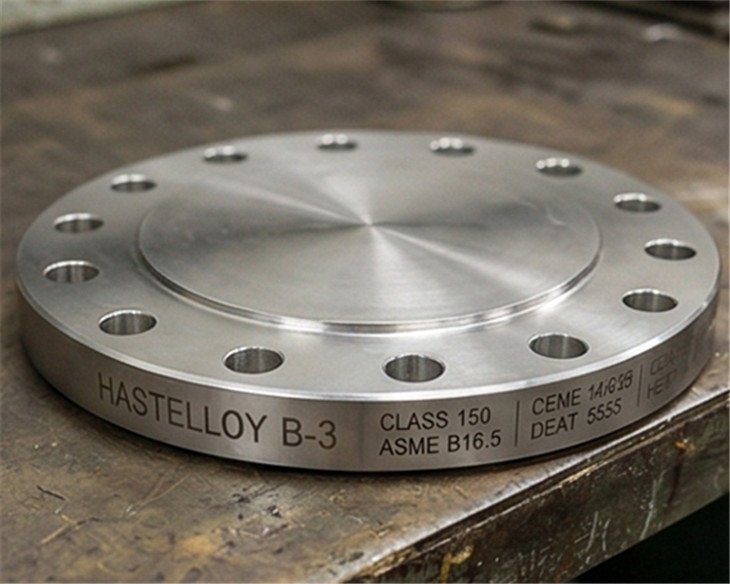
Yüksek Basınçlı Hizmet için Alaşımlı Çelik ve Karbon Çelik Flanşlar
Doğrudan cevap
High pressure alone does not automatically require alloy steel. Carbon steel may be suitable when its material-specific ASME rating and service limits meet the design. Alloy steel is selected when temperature strength, oxidation behaviour or another grade-specific property is required. Basınç, sıcaklık, orta, line class and fabrication requirements must be evaluated together.
Temel çıkarımlar
- Pressure class is not a material grade and does not select the metallurgy.
- Low-alloy chrome-moly steel is not equivalent to stainless steel corrosion resistance.
- Lifecycle cost includes welding, ısıl işlem, denetleme, lead time and maintenance—not only forging price.
Carbon steel remains appropriate in many pressure systems
ASTM A105 carbon-steel flanges are widely used because they are available, weldable under established procedures and cost-effective. When design temperature, basınç, toughness and corrosion conditions are within the approved line class, carbon steel can be the technically correct choice.
For low-temperature, ekşi, severe cyclic or highly corrosive service, additional requirements or another material specification may be necessary.
Why chrome-moly alloy steel is selected
Grades such as F11, F22 and F91 are evaluated for elevated-temperature strength and oxidation behaviour. Their benefit appears within an engineered alloy system and a suitable fabrication route. They also introduce stricter heat-treatment, consumable and PWHT controls.
Alloy content does not guarantee resistance to wet process corrosion. The corrosion study must address the actual medium, water content, kirleticiler, shutdown conditions and external environment.
A practical selection matrix
| Factor | Carbon steel | Chrome-moly alloy steel |
|---|---|---|
| General availability | Usually broad | Grade and condition dependent |
| Elevated-temperature capability | Code-limited | Often the primary selection driver |
| imalat | Established controls | More grade-specific heat-treatment controls |
| Wet corrosion | Requires evaluation/protection | Still requires evaluation/protection |
| Total cost | Lower material cost in many sizes | Higher material and quality-control cost |
Questions to resolve before specifying the flange
- What pressure and temperature apply simultaneously?
- Which material group and pressure-temperature table governs?
- Is creep, oxidation, low-temperature toughness or corrosion the controlling damage mechanism?
- Can the fabricator perform the required welding and heat treatment?
- Are matching pipe, bağlantı parçaları, valves and bolting available?
- What inspection and documentation does the owner require?
Sık sorulan sorular
Are alloy steel flanges more corrosion-resistant?
Not necessarily. Chrome-moly low-alloy grades are primarily selected for temperature-related properties. Stainless and nickel alloys form different corrosion-resistant material families.
Can carbon steel be used for Class 1500?
A carbon-steel flange may be available in a high class, but the permitted pressure at design temperature and all service limits must be checked for the exact material and standard.
Is alloy steel always more expensive overall?
Material and fabrication costs are often higher, but lifecycle economics depend on reliability, çalışma sıcaklığı, maintenance and the cost of failure.
Referans verilen birincil standartlar
- ASTM A105/A105M-26 — Carbon Steel Forgings for Piping Applications
- ASTM A182/A182M-26 — Dövme veya Haddelenmiş Alaşımlı ve Paslanmaz Çelik Boru Bileşenleri
- ASME B16.5-2025 — Boru Flanşları ve Flanşlı Bağlantı Parçaları, NPS'ler 1/2 NPS aracılığıyla 24
Her zaman satın alma siparişinde belirtilen basımı doğrulayın ve tasarım ve kabul için tam kontrollü standardı edinin..
Alaşımlı çelik flanş teklifi isteyin
Malzeme notunu gönder, standart, NPS'ler, basınç sınıfı, flanş tipi, karşı karşıya, boru programı, miktar ve muayene gereksinimleri. SASA FLANGE Teklif vermeden önce teknik açıklamayı inceleyeceğiz.
İlgili Mesajlar
C-2000 ve C22 Flanşları: Malzeme Seçimi ve RFQ Kontrolleri
C-2000 ve C22 flanş malzemesi kimliklerini karşılaştırın, hizmet koşulları, dövme…
Dövme Alaşımlı Çelik Flanşlar için NDT Muayene Yöntemleri
Dövme alaşım için tahribatsız muayene yöntemlerine ilişkin alıcı odaklı bir kılavuz…

F11 için Sertlik Testi Gereksinimleri, F22 ve F91 Flanşları
Sertlik testlerini belirlemek ve yorumlamak için pratik bir kılavuz…
ASTM A182 Flanş İşaretleri Nasıl Okunur?
ASTM A182 ve ASME B16.5'in yorumlanmasına yönelik alan kılavuzu…