
Aşınmaya Dirençli En İyi Boru Flanşı Malzemeleri
Hızlı Yanıt
There is no single “best” abrasion-resistant pipe flange material. Öncelikle boru deliğinde aşınma olup olmadığını belirleyin, bir astar geçişinde, or on the flange sealing area. Then check corrosion chemistry, solids concentration and particle size, hız, basınç, sıcaklık, flanş standardı, facing and documentation. A wear-resistant pipe grade or liner must not be treated automatically as an acceptable pressure-flange material.
Compare material and liner options
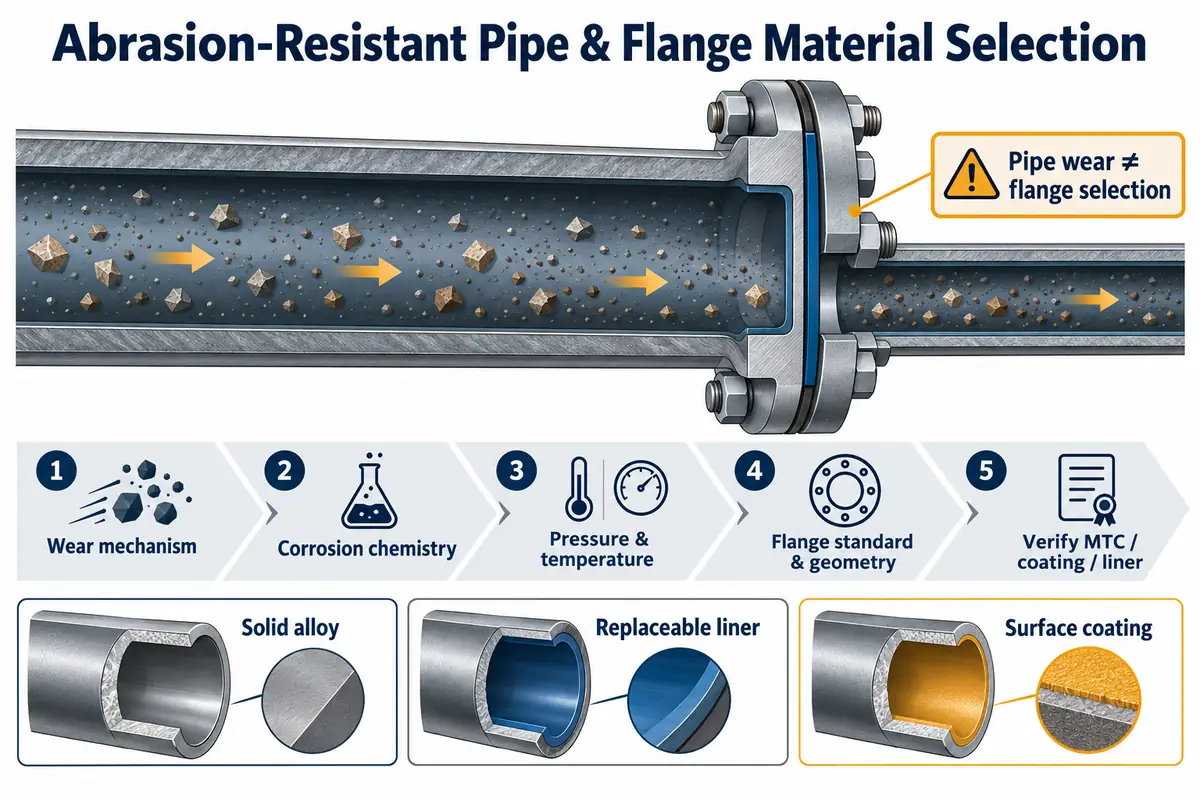
Why “Abrasion-Resistant Pipe” and “Flange Material” Are Different Decisions
Searches for abrasion-resistant pipe usually focus on pipe wall loss, replaceable liners or wear-resistant tube products. A flange joint adds other requirements: pressure boundary integrity, bolt loading, conta oturma yeri, karşı karşıya kalma durumu, weldability and dimensional compatibility. The pipe, liner and flange can therefore use different materials when the design documents and joining method permit it.
Malzeme, Liner and Coating Options
| Option family | Where it can help | What must be verified |
|---|---|---|
| Abrasion-resistant cast iron or wear plate | Severe particle wear in liners, inserts and replaceable wear components. | Do not assume ASTM A532 cast iron or a wear-plate grade is a pressure-flange material. Confirm the pressure-boundary design, attachment method, impact risk and inspectability. |
| Heat-treated alloy or martensitic stainless steel | Engineered wear parts that need more toughness than brittle liners. | Seviye, ısıl işlem, hardness range, weld procedure and the applicable flange/material standard. |
| Duplex or super duplex stainless steel | Erosion-corrosion where water, chlorides or corrosive chemicals carry solids. | Exact UNS grade, çözelti tavlanmış durum, korozyon sınırları, welding controls and MTC values. Higher strength alone does not prove wear life. |
| Nikel alaşımı | Corrosive or hot particle-bearing service where corrosion is a major part of material loss. | Process chemistry, sıcaklık, weld qualification and whether a separate wear liner is still required. Nickel alloy is not automatically the most abrasion-resistant choice. |
| Seramik, carbide, rubber or polymer liner/coating | Local protection of the flow path or a replaceable wear surface. | Bonding method, edge and flange transition details, sıcaklık ve basınç sınırları, permeability, gasket contact area and repair plan. |
A Five-Step Selection Method
1. Define the wear mechanism
Record the solids, particle shape and size, konsantrasyon, akış hızı, angle of impact and whether wear is sliding, impact-dominated or erosion-corrosion. A material that performs well in low-angle sliding abrasion may not be suitable for repeated impact.
2. Separate corrosion loss from mechanical wear
Klorürler, asitler, alkalis and temperature can remove protective films and accelerate erosion-corrosion. Duplex stainless steels can be useful when particle wear and corrosion occur together; nickel alloys are selected primarily for demanding corrosion or temperature conditions, not simply because particles are present.
3. Locate the wear zone
Confirm whether material loss is in the straight pipe, elbow, liner termination, flange bore, gasket seating area or downstream turbulence zone. Protecting the pipe bore while leaving an abrupt liner step at the flange can move the wear problem rather than solve it.
4. Keep the flange specification complete
Specify NPS/DN, basınç sınıfı veya PN, flanş tipi, karşı karşıya, delik veya boru programı, malzeme özellikleri, corrosion allowance and any liner/coating. The pressure-temperature rating and bolting/gasket design must be checked as a complete joint.
5. Define acceptance evidence
Request the MTC for the pressure-boundary material and separate records for coating or liner type, thickness or application procedure when applicable. Add dimensional, visual and NDE requirements that match the purchase specification rather than relying on a generic “abrasion resistant” label.
Published Product Pages for Material Review
These links lead to actual SASAFLANGE product pages. They are starting points for a quotation review, not proof that a grade is suitable for every abrasive service.
Yaygın Spesifikasyon Hataları
- Calling for “abrasion-resistant steel” without naming the flange standard or pressure class.
- Assuming pipe and flange must use the same wear material.
- Ignoring the liner termination, gasket seating width or bolt-load effect.
- Using hardness alone as a wear-life guarantee.
- Combining dissimilar metals without reviewing galvanic corrosion and electrical isolation.
- Requesting a coating without stating its permitted area, preparation, inspection and repair method.
SSS
Is abrasion-resistant steel pipe automatically compatible with standard flanges?
HAYIR. The pipe or liner may be optimized for wear while the flange must satisfy a separate pressure-boundary and dimensional standard. The transition and joining details need engineering review.
Are duplex flanges always more wear resistant than carbon steel flanges?
Not in every wear mode. Duplex grades can be advantageous in erosion-corrosion because they combine corrosion resistance, strength and useful surface hardness, but particle impact, velocity and joint geometry still control service performance.
Should a coating cover the gasket seating surface?
Only when the approved joint design and coating procedure explicitly allow it. Coating thickness, compressibility, adhesion and surface finish can affect gasket seating and bolt load.
Technical Basis
- ASTM A532/A532M — abrasion-resistant cast irons and their intended wear applications.
- Outokumpu Forta duplex datasheet — corrosion, strength and erosion-corrosion context.
- Özel Metaller INCONEL alaşımı 625 bülten — corrosion and high-temperature properties.
- SSAB wear-steel product program — pipe, tube and wear-liner context.
RFQ Checklist for Abrasive Service
For a focused quotation review, provide the transported media, solids percentage and particle size, akış hızı, kimya, basınç, sıcaklık, NPS/DN, flange standard and class/PN, flanş tipi ve kaplama, pipe schedule or bore, liner/coating requirement, miktar, drawings and required certificates.
Send Your Abrasive-Service Flange RFQ
We will review the supplied service data against the available product range. Final material suitability remains subject to the project specification and engineering approval.
İlgili Mesajlar
Flanş Yüzü Kaplaması: Eşmerkezli ve Spiral Tırtıkların Açıklaması
Eşmerkezli ve spiral tırtılların her ikisi de işlenmiş flanş yüzeyidir…
Dubleks 2205 316L Flanşlara Karşı: Hangi Malzemeyi Seçmelisiniz?
Hızlı cevap: Dubleks 2205 flanşlar genellikle daha güçlü adaydır…

Orifis Flanşı Tanımı, Ayrıntılar ve ASME B16.36 Flanşlara Genel Bakış: Piyasa Verileri, Seçim Kılavuzu ve Uyumluluk Bilgileri
Küresel endüstriyel flanş pazarı şu şekilde değerlendi: $5.8 milyar…

Siyah Bertaraf Flanşı Pazar Rehberi: Malzemeler, 3.5″ Uyumluluk, Mutfak Lavabo Flanşları için B2B Kaynak Verileri
Mutfak armatürü alıcıları nedeniyle siyah atık flanş talebi artıyor…
Hayır Yorumlar