
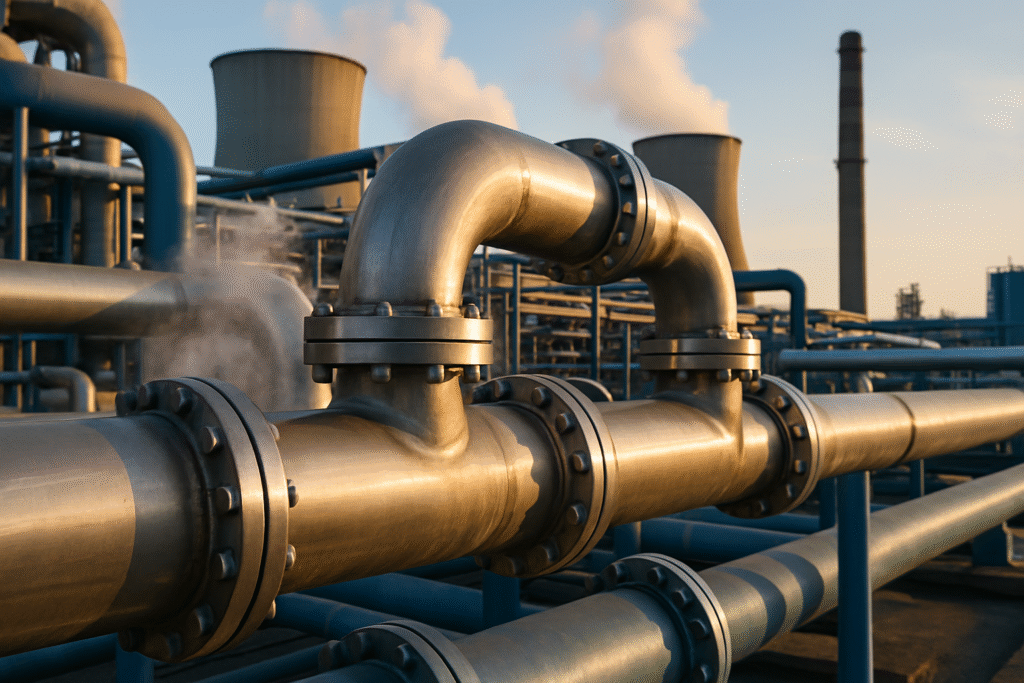
Guía del mercado de bridas para tubos de acero inoxidable: $5.8B Datos de la industria, Estándares ANSI, y conocimientos de selección
El brida de tubería de acero inoxidable market sits at the center of modern process piping, donde el tiempo de actividad, resistencia a la corrosión, y el cumplimiento del código afectan directamente el costo del proyecto. Según la investigación de Grand View (2024), El mercado mundial de bridas industriales se valoró en $5.8 mil millones en 2023 y se prevé que alcance $7.2 mil millones por 2030.
Para equipos de adquisiciones e ingenieros, que el crecimiento refleja una realidad práctica. Stainless Steel Flanges remain a preferred solution for critical Pipe systems in oil and gas, procesamiento químico, servicio marítimo, y generación de energía.
Tendencias de la demanda global que dan forma a la adquisición de bridas para tuberías de acero inoxidable
Según IBISWorld (2024), Asia-Pacífico representa más de 45% de la producción mundial de bridas, siendo China el mayor fabricante. Por lo tanto, buyers increasingly evaluate not only price, pero también trazabilidad, calidad de mecanizado, documentacion de exportacion, y confiabilidad en la entrega.
Según Statista (2024), La industria del petróleo y el gas representa aproximadamente 35% del consumo global de bridas. That concentration makes ANSI and ASME compliance essential, especially for upstream skids, unidades de refinería, LNG modules, and high-pressure utility lines.
In contrast to basic catalog pages, serious B2B buyers need more than a parts list. They need material compatibility, pressure-temperature logic, face type selection, alcance de la inspección, and confidence in mill test documentation.
Según la inteligencia de Mordor (2024), industrial infrastructure investment in water treatment and energy transition projects continues to support demand for corrosion-resistant piping components. Además, duplex and high-alloy grades are gaining share where chloride exposure and sour service conditions reduce the life of standard carbon steel.
As piping engineer Michael R. Stevens, educación física, estados: “A flange is not just a connector; it is a controlled sealing interface, and the wrong material or facing can compromise the whole system.” That point explains why experienced EPC buyers review ASTM grade, acabado de revestimiento, compatibilidad de atornillado, and gasket performance together.
Por esta razón, the most requested Stainless, Acero, Flanges often include weld neck, deslizarse, ciego, soldadura de encaje, junta de regazo, y diseños roscados. Sin embargo, la elección correcta depende de la clase de presión, ciclo térmico, tolerancia a la corrosión, y acceso de mantenimiento.
Según Market Research Future (2024), global process industry modernization is increasing demand for standardized flanged connections in modular fabrication. Como resultado, suppliers that can deliver both common sizes and project-specific machining hold a strong advantage.
SASA FLANGE serves this market with stainless steel flanges, bridas de acero al carbono, bridas de aleación, and pipe fittings for customers in more than 50 países. Con ISO 9001:2015 y certificaciones PED 2014/68/UE, the company supports projects that require documented quality systems and export-ready compliance records.
Manufacturing capability also matters when schedules tighten. Respaldado por mecanizado CNC avanzado y pruebas de calidad integrales, SASA FLANGE ofrece tamaños personalizados desde 1/2" a 60" across grades such as 304, 316, 316l, 904l, 2205, 2507, A105, A182, Inconel, Monel, Hastelloy, y titanio.
Además, buyers increasingly expect a supplier to support both standard and special applications. That includes ANSI B16.5, ANSI B16.47, DIN, JIS, GOST, y ES 1092 dimensiones, as well as EN 10204 3.1 documentation for controlled projects.
The competitive takeaway is clear. A modern flange supplier must combine stock depth, technical advising, certified production, and responsive logistics rather than relying only on keyword-heavy product listings.
Technical Selection Factors for Stainless Steel Pipe Flange Performance
A stainless steel pipe flange must match the service fluid, presión de diseño, temperatura de funcionamiento, revestimiento de brida, y método de unión. Por lo tanto, engineers typically begin with the piping class, then confirm material grade, Dimensiones ASME, tipo de junta, y requisitos de atornillado.
De acuerdo a ASME B16.5, Las clasificaciones de presión y temperatura varían según el grupo y la clase de materiales., not by class number alone (ASME, 2020). En la práctica, a 600# flange in ASTM A182 F316 does not carry the same assumptions as a carbon steel counterpart in a different temperature range.
Como Dr.. Elena Morris, científico de materiales, estados: “316L remains a strong general-purpose choice, but chloride concentration, pH swings, and crevice conditions can quickly justify duplex or super austenitic upgrades.” That is why material selection must reflect actual service chemistry, not only nominal media names.
En muchos proyectos, engineers compare the following flange types before finalizing the bill of materials:
- Brida de cuello soldado for severe service, carga cíclica, and high-integrity butt weld transitions.
- Brida deslizante for lower-pressure systems where fabrication speed and cost matter.
- Brida ciega for line ends, isolation points, and hydrotest closures.
- Brida de soldadura for small-bore high-pressure systems.
- Brida roscada for installations where welding is impractical or hazardous.
- Brida articular for systems requiring frequent dismantling or costly alloy stub ends.
For smaller bore utility lines, a Threaded stainless steel pipe flange can reduce field welding and simplify replacement work. Sin embargo, it is usually reserved for limited service ranges because threaded joints are less suitable for severe vibration and repeated thermal cycling.
Face type is equally important. Raised Face remains common in refinery and chemical service, while Ring Type Joint is preferred where high pressure and sealing integrity demand metal-to-metal gasket seating.
Common specification checkpoints include:
- ASTM A182 F304, F304L, F316, F316L, F51, F53, and specialty nickel alloys.
- ANSI / ASME B16.5 dimensions for NPS 1/2 a través de 24.
- ANSI B16.47 for larger diameter flanges.
- Facing options such as RF, FF, RTJ, Lengua y ranura, and Male-Female.
- Classes including 150, 300, 600#, 900, 1500, y 2500.
- Testing and documents such as PMI, hydrotest support records, dureza, ferrito, y EN 10204 3.1.
Según las especificaciones de materiales ASTM., forged stainless flanges for pressure service are commonly produced under ASTM A182 requisitos (ASTM, 2024). Además, chemical composition control and heat treatment records help confirm corrosion resistance and mechanical reliability in critical services.
For buyers focused on 304 y 316 inventory, the commercial distinction is straightforward. Calificación 304 offers strong general corrosion resistance and competitive cost, mientras 316 and 316L add molybdenum for improved resistance in chloride-bearing environments.
Sin embargo, not every corrosive service should default to 316L. In seawater splash zones, sistemas amargos, or aggressive chlorides, 2205 dúplex, 2507 súper dúplex, 904l, or nickel alloys may provide a lower total life-cycle cost despite higher purchase prices.
According to NACE guidance for corrosive oilfield environments, material selection must reflect sulfide stress cracking and chloride conditions where applicable (NACE, 2023). Como resultado, flange choice should align with the full piping material class rather than an isolated component substitution.
Dimension control also affects installation efficiency. A poor hub bore match, incorrect bolt circle, or rough serration finish can delay turnarounds and increase gasket failure risk.
This is where manufacturing discipline matters. SASA FLANGE supplies Stainless Steel Flanges and fittings produced to ANSI B16.5, ANSI B16.47, ASME B16.9, DIN, JIS, GOST, y ES 1092, helping procurement teams consolidate sourcing under one qualified supplier.
Según los principios de gestión de calidad ISO., repeatability in inspection, trazabilidad, and document control reduces supplier-related nonconformance risk (ISO, 2015). Por lo tanto, buyers should ask for dimensional inspection reports, certificados de prueba de materiales, and marking standards before placing project orders.
Another practical issue is size availability. A catalog may show common 2 pulgada, 4 pulgada, o 6 inch Stainless Steel Flanges, yet project success often depends on reducing flanges, orificios especiales, drilled blanks, or nonstandard combinations that support skids and packaged equipment.
As industrial analyst Peter Lang notes: “The winning flange supplier is often the one that solves exceptions fast, not the one that lists the most generic SKUs.” That insight is especially relevant for EPC procurement, where schedule pressure rewards technical responsiveness.
Por lo tanto, the best sourcing strategy balances stock with customization. Buyers should confirm machining tolerances, números de calor, third-party inspection options, and lead times before approving a purchase order for any stainless steel pipe flange package.
ASME, ASTM, DIN, y normas EN que rigen las bridas de acero inoxidable
Los estándares definen la intercambiabilidad, integridad de la presión, y expectativas de inspección. sin ellos, even premium-looking flanges can create bolt-up problems, fuga, or rejected packages at site.
The most referenced codes and standards for Stainless Steel Flanges include ASME B16.5, ASME B16.47, ASTM A182, ASME B16.9, DIN, y ES 1092. Además, European projects may require PED 2014/68/EU compliance and supporting declarations.
Key standard relationships are summarized below:
- ASME B16.5: Covers dimensions, tolerancias, materials groups, clasificaciones de presión-temperatura, calificación, and testing for NPS 1/2 a 24.
- ASME B16.47: Covers large-diameter steel flanges beyond standard B16.5 ranges.
- ASTM A182: Cubre bridas de tubos de acero inoxidable y aleación forjada o laminada., guarniciones, valvulas, y piezas para servicio de alta temperatura.
- ASME B16.9: Covers factory-made wrought butt welding fittings such as elbows, camisetas, reductores, y gorras.
- EN 1092: Provides European flange dimensions and pressure designations.
- DIN: Includes German dimensional systems still referenced in legacy and export projects.
Según el marco PED de la Comisión Europea, pressure equipment manufacturers must maintain conformity assessment procedures where required (DEP, 2014). Como consecuencia, documentation quality becomes as important as machining quality for exporters serving EU buyers.
En términos prácticos de contratación, buyers should compare more than just NPS and class. They should verify facing type, patrón de perforación, calendario de perforación, grado del material, edición estándar, calificación, and requested certificates.
A simple compliance checklist often includes:
- Correct standard: ANSI / ASME, DIN, JIS, GOST, o ES.
- Material: 304, 316, 316l, 904l, 2205, 2507, or alloy grade.
- Clase de presión: 150, 300, 600#, 900, 1500, o 2500.
- Frente a: RF, FF, RTJ, o revestimiento especial.
- Inspección: PMI, informe dimensional, surface finish check, and visual examination.
- Proceso de dar un título: ISO 9001:2015, DEP 2014/68/UE, ANUNCIO 2000, y EN 10204 3.1 como se especifica.
For sour service or offshore duty, additional client specifications may reference NACE MR0175, NORUEGA, or DNV rules depending on the installation. Por lo tanto, a supplier must understand project overlays beyond the base flange standard.
SASA FLANGE supports this requirement with documented quality systems and broad standards coverage. Con ISO 9001:2015, DEP 2014/68/UE, y anuncio 2000 cartas credenciales, the company aligns manufacturing and inspection with the expectations of international EPCs and industrial distributors.
Compliance also supports inventory accuracy. When flange marking clearly identifies grade, número de calor, tamaño, clase, y estándar, warehouse teams reduce picking errors and site teams accelerate receiving inspections.
According to DNV guidance for marine and offshore supply chains, traceability and documentation remain critical for pressure-containing components used in classified systems (DNV, 2023). Como resultado, buyers should favor manufacturers that can issue complete document packages rather than only commercial invoices and packing lists.
How to Select the Right Stainless Steel Pipe Flange for Oil, Gas, Químico, Fuerza, y Servicio Marítimo
Application context should drive every flange decision. The same 4 inch stainless steel pipe flange may perform well in one unit and fail early in another because chemistry, temperatura, and vibration differ.
En petróleo y gas, pressure class and corrosion risk usually lead the decision. Since the sector represents about 35% del consumo global de bridas, proven standards alignment and material traceability are especially important (Estadista, 2024).
Para servicio upstream y midstream, buyers often prioritize:
- Weld neck or RTJ designs for pressure integrity.
- NACE-aligned materials where sour service applies.
- PMI and third-party inspection for critical packages.
- Duplex or nickel alloys for chloride-rich and corrosive conditions.
En plantas de procesamiento petroquímico y químico., corrosion mechanism mapping matters more than initial unit price. Por lo tanto, 316l, 904l, Hastelloy, or Monel flanges may outperform standard grades where acids, disolventes, or chlorides attack less resistant alloys.
Power generation systems create a different selection profile. Temperatura alta, steam cycling, and maintenance planning often drive the use of forged flanges with stable metallurgy, accurate facing finish, and reliable bolting geometry.
For marine and shipbuilding, salt exposure changes the economics quickly. En estos casos, 316L may suit secondary systems, mientras 2205 o 2507 can be more suitable for splash zones, sistemas de lastre, y servicio severo de cloruro.
Water treatment buyers often seek a balance of corrosion resistance and budget control. As infrastructure upgrades expand globally, 304 y 316 Stainless Steel Flanges remain common, but designers still need to evaluate disinfectants, chloride levels, y exposición a grietas.
Procurement managers can use this practical shortlist when comparing suppliers:
- Can the supplier produce both standard and custom bore configurations?
- Son 304, 316, 904l, 2205, y 2507 available from one source?
- Can the supplier deliver elbows, camisetas, reductores, and caps with matching documentation?
- Son EN 10204 3.1 certificados, trazabilidad del calor, and marking included?
- Can they support urgent replacements and larger project releases?
This is where full-range manufacturing becomes valuable. SASA FLANGE supplies not only flanges, but also elbows, camisetas, reductores, y gorras, helping buyers standardize vendor control across multiple piping categories.
For custom packages, the company can support material combinations across Stainless, acero carbono, dúplex, aleación de níquel, y grados de titanio. Además, factory-direct production helps buyers manage budget targets without compromising on standards compliance.
When selecting a Threaded or Slip-On Flange for maintenance work, engineers should also review vibration, expansión térmica, and future disassembly needs. En contraste, major greenfield projects usually favor welded flange designs for stronger long-term reliability.
Por ejemplo, a general utility water line may use a 150-class 304 o 316 brida deslizante. Sin embargo, a 600# ANSI weld neck flange in F316L or duplex may be the better choice for a higher-pressure chemical transfer line.
Buyers should also consider commercial execution factors. MOQ flexibility, embalaje de exportación, lead time transparency, and after-sales response can materially affect total project cost even when flange prices appear similar.
For projects that require custom drilled blanks, revestimientos especiales, or mixed material packages, engineers can contacto SASA FLANGE early to confirm drawings, estándares, and delivery windows. That approach reduces revision cycles and improves bid accuracy.
Perspectivas futuras para bridas de acero inoxidable y recomendaciones de compra estratégica
Las perspectivas para la demanda de bridas de tubos de acero inoxidable siguen siendo positivas porque la energía, agua, químico, and marine investment continues across both developed and emerging markets. Según la investigación de Grand View (2024), the market is expected to expand from $5.8 mil millones en 2023 a $7.2 mil millones por 2030.
Al mismo tiempo, sourcing strategies are changing. Los compradores ahora esperan una documentación más rápida, mayor disponibilidad de aleaciones, and better technical support rather than viewing flanges as simple commodity items.
Según IBISWorld (2024), Asia-Pacific controls more than 45% de la producción mundial de bridas, y China sigue siendo la mayor base manufacturera. Por lo tanto, qualified Chinese manufacturers with strong export systems will continue to shape global supply, especially for standard ANSI and project-specific forged products.
Several trends will influence purchasing decisions over the next few years:
- Higher demand for duplex, súper dúplex, and nickel alloys in aggressive service.
- More stringent documentation and PED-related compliance checks.
- Greater preference for suppliers that provide flanges plus fittings in one order.
- Growing importance of CNC precision, PMI, and digital traceability.
- Faster turnaround expectations for MRO and shutdown orders.
Para equipos de adquisiciones, the strategic recommendation is straightforward. Standardize approved grades, estándares, and document requirements before RFQ release, then compare suppliers on total execution capability rather than price alone.
Para ingenieros, the priority should be service-based material selection. A low-cost Flange can become the highest-cost component if corrosion, fuga, or mismatch causes shutdowns and rework.
For distributors and OEMs, partnering with a manufacturer that offers custom machining, multi-standard production, and global shipping can strengthen margins and improve customer retention. That is especially true when demand includes everything from 2 inch ANSI blind flanges to larger forged weld neck assemblies.
Con sistemas certificados, wide material coverage, and experience serving Oil & Gas, Petroquímico, Fuerza, e industrias marinas, SASA FLANGE is positioned to support buyers seeking dependable stainless steel pipe flange supply. For current projects, reemplazos, or long-term sourcing programs, early technical discussion usually produces the best commercial outcome.
Preguntas frecuentes
¿Qué bridas están hechas de acero inoxidable??
●Stainless steel flanges are commonly manufactured in ASTM A182 grados como F304, F304L, F316, F316L, F904L, F51, and F53 for pressure piping systems.
●These grades are used to produce weld neck, deslizarse, ciego, soldadura de encaje, junta de regazo, and threaded flange designs for ANSI and ASME Pipe connections.
●For buyers needing corrosion resistance, trazabilidad, y EN 10204 3.1 documentos, trabajando con fabricantes establecidos como SASA FLANGE improves material and compliance control.
¿Cuáles son los tres tipos de bridas??
●The three most commonly specified flange categories in general industrial service are weld neck, deslizarse, and blind flanges because they cover most joining, acceso, and isolation needs.
●De acuerdo a ASME B16.5, each type follows defined dimensional and pressure-temperature requirements, which helps ensure interchangeability in ANSI systems.
●Engineers should select among them based on pressure class, vibración, acceso de mantenimiento, and whether the line requires frequent opening or permanent high-integrity service.
¿Para qué se utilizan las bridas de acero inoxidable??
●Stainless steel flanges connect Pipe sections, valvulas, zapatillas, instrumentos, and equipment nozzles in systems that require corrosion resistance, mantenibilidad, and leak-tight bolted joints.
●Según Statista (2024), El petróleo y el gas representan aproximadamente 35% del consumo global de bridas, while chemical, marina, tratamiento de agua, and power sectors also depend heavily on stainless assemblies.
●For applications involving chlorides, fluidos agresivos, o condiciones de lavado, buyers should match flange grade and gasket design to the actual service environment before ordering.
¿Cuál es el mejor material para bridas??
●The best flange material depends on media, temperatura, presión, y riesgo de corrosión, so no single alloy is ideal for every service condition.
●Calificación 304 suits many general environments, 316L improves chloride resistance, y 2205 o 2507 often perform better in severe marine or sour-duty applications.
●Procurement teams should review ASTM grade, clase ASME, and project chemistry together instead of choosing only by initial price or stock availability.
¿Qué tamaños están disponibles para productos de bridas de tuberías de acero inoxidable??
●Standard stainless steel pipe flange sizes usually range from 1/2 pulgada a 24 pulgada debajo ASME B16.5, with larger diameters available under ANSI B16.47 and project-specific standards.
●Commercial demand often centers on 2 pulgada, 4 pulgada, 6 pulgada, y 8 tamaños en pulgadas, while custom bored, reducing, and large-diameter flanges support skids, tanques, and process modules.
●Buyers should confirm NPS, horario aburrido, frente a, clase, and drilling pattern together because nominal size alone is not enough to guarantee fit-up.
How do I choose between a threaded and weld neck stainless steel pipe flange?
●A Threaded stainless steel pipe flange simplifies installation where welding is impractical, while a weld neck flange generally offers better fatigue strength and flow transition in demanding service.
●Threaded designs are often used on smaller bore lines, whereas weld neck flanges are preferred for cyclic loading, higher pressure, and elevated-temperature process systems such as 600# ANSI service.
●For replacement work or new project selection, buyers should compare vibration, requisitos de inspección, code rules, and future maintenance access before deciding.
Posts Relacionados
Acabado de la cara de la brida: Dentados concéntricos versus espirales explicados
Los dentados concéntricos y en espiral son acabados de cara de brida mecanizados.…
Dúplex 2205 frente a bridas 316L: ¿Qué material debería elegir??
respuesta rapida: Dúplex 2205 Las bridas suelen ser el candidato más fuerte.…

Definición de brida de orificio, Detalles y descripción general de bridas ASME B16.36: Datos de mercado, Guía de selección e información sobre cumplimiento
El mercado mundial de bridas industriales se valoró en $5.8 mil millones…

Guía del mercado de bridas de eliminación negras: Materiales, 3.5″ Compatibilidad, y datos de abastecimiento B2B para bridas de fregaderos de cocina
La demanda de bridas de eliminación negras está aumentando a medida que los compradores de accesorios de cocina…