
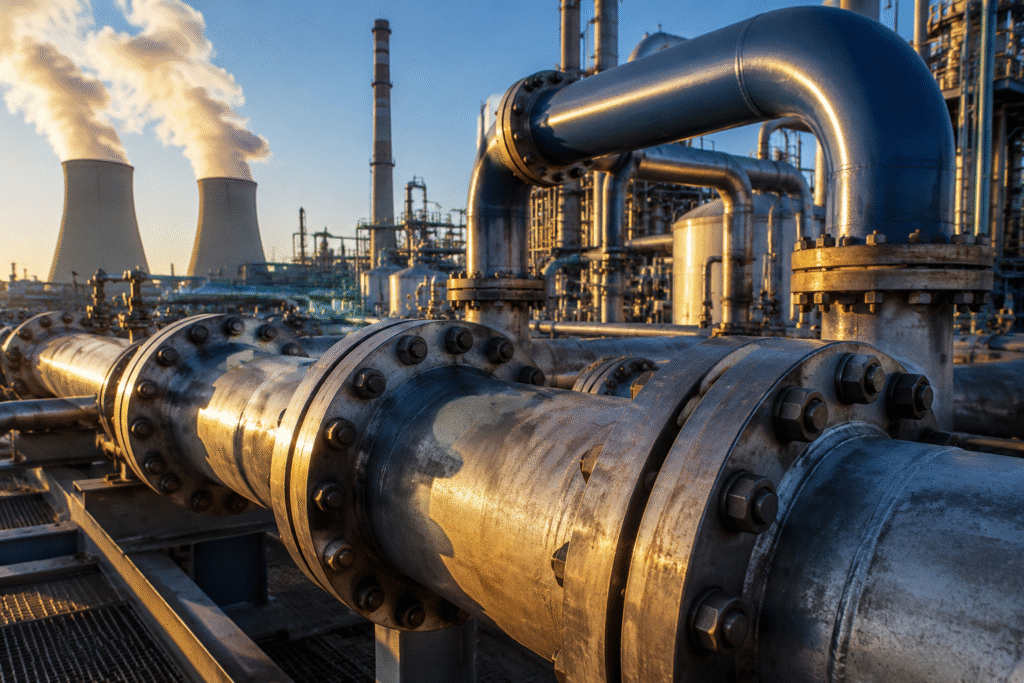
Guía de brida de tubería de acero inoxidable: 7 Ventajas respaldadas por datos, Tipos, Usos y criterios de selección
La demanda de bridas para tuberías de acero inoxidable continúa aumentando a medida que los operadores industriales priorizan la resistencia a la corrosión, valor del ciclo de vida, y cumplimiento en sistemas de tuberías críticas. Según la investigación de Grand View (2024), El mercado mundial de bridas industriales se valoró en $5.8 mil millones en 2023 y se prevé que alcance $7.2 mil millones por 2030, which makes material selection more strategic than ever.
Para ingenieros y equipos de adquisiciones, the intriguing value of stainless solutions is no longer hidden. The advantages of stainless steel pipe flange products now extend beyond durability into traceability, integridad de la presión, and long-term operating efficiency.
Why Stainless Steel Pipe Flange Demand Is Growing Across Industrial Markets
Industrial buyers are choosing stainless steel pipe flange products because plant uptime depends on leak-tight, juntas resistentes a la corrosión. Además, modern projects demand components that meet ASME, ASTM, DIN, and EN requirements without adding excessive maintenance risk.
Según IBISWorld (2024), Asia-Pacífico representa más de 45% de la producción mundial de bridas, siendo China el mayor fabricante. Por lo tanto, global sourcing strategies increasingly focus on qualified Chinese manufacturers that can combine scale, precisión de mecanizado, y control de documentación.
Según Statista (2024), La industria del petróleo y el gas representa aproximadamente 35% del consumo global de bridas. Como resultado, the market strongly favors materials such as 304, 316, 316l, 2205, y 2507 para servicio amargo, costa afuera, refinería, y aplicaciones de procesamiento químico.
Stainless grades remain attractive because they balance mechanical strength and corrosion resistance in chloride, húmedo, and high-purity environments. En contraste, lower-alloy materials may require more frequent coating, inspección, or replacement in aggressive service.
ASME B16.5 y ASME B16.47 govern key dimensional and pressure-temperature requirements for many industrial flanges, mientras ASTM A182 defines forged stainless and alloy flange material requirements (ASME, 2023; ASTM, 2023). Como consecuencia, buyers should evaluate both the material grade and the governing dimensional standard before placing an order.
The hidden procurement risk often lies in incomplete quality documentation rather than the flange itself. Por lo tanto, reputable suppliers should provide mill test reports, trazabilidad del calor, inspección dimensional, y EN 10204 3.1 documentation when required.
Como ingeniero de materiales Dr.. Helen Morris afirma: “Una brida no es sólo un conector; it is a pressure boundary component, so alloy selection and standard compliance directly influence reliability.” That insight is especially relevant in petrochemical, costa afuera, and power generation systems where flange failure can shut down an entire line.
SASA FLANGE serves industrial customers in Oil & Gas, Petroquímico, Generación de energía, Construcción naval, Tratamiento de agua, y Construcción. Con ISO 9001:2015 y certificaciones PED 2014/68/UE, the company supports global buyers seeking compliant stainless steel flanges and fittings from a factory-direct source.
Además, sourcing from an experienced manufacturer helps buyers align design intent with actual production capability. For more supplier details, los compradores pueden revisar company background and explore available categories at páginas de productos.
Tipos de bridas para tuberías de acero inoxidable, Materials and Hidden Advantages in Real Service
The versatility of a stainless steel pipe flange comes from the range of flange types, clases de presión, and metallurgy available for different services. Sin embargo, choosing correctly requires understanding how type, calificación, and application interact.
Según la inteligencia de Mordor (2024), industrial infrastructure upgrades in energy and water sectors are accelerating demand for corrosion-resistant piping components worldwide. Además, buyers increasingly request premium materials that reduce total cost of ownership rather than only minimizing purchase price.
Como consultor de tuberías Mark Ellison, educación física, estados: “The best flange selection starts with the process fluid, then temperature, then pressure class, and only after that with price.” This sequence helps engineers avoid short-term cost decisions that create long-term maintenance failures.
The most common stainless steel pipe flange materials include ASTM A182 F304, F304L, F316, F316L, F904L, F51, y F53. Además, specialized projects may specify Inconel, Monel, Hastelloy, or Titanium when standard stainless grades cannot handle the environment.
- 304 / 304l: Good general corrosion resistance for water, procesamiento de alimentos, and moderate industrial service.
- 316 / 316l: Improved molybdenum-bearing resistance to chlorides and many chemical media.
- 904l: Stronger performance in reducing acids and severe corrosion environments.
- 2205 Dúplex: Higher strength and strong pitting resistance for offshore and process systems.
- 2507 Súper Dúplex: Premium solution for high chloride and high-pressure service.
In many specifications, 316L remains the default choice for process plants that require better chloride resistance than 304L. En contraste, duplex and super duplex are often chosen when higher strength allows thinner wall design or improved resistance to stress corrosion cracking.
Según Market Research Future (2024), demand for duplex stainless components in energy and marine systems is growing at over 5% anualmente. Por lo tanto, procurement teams should evaluate duplex options earlier in the design stage instead of treating them as late substitutions.
The main flange Types used in industrial piping include weld neck, ponerse, ciego, soldadura de encaje, roscado, y junta de regazo. Each Flange configuration has different benefits for alignment, bore continuity, velocidad de instalación, y acceso de inspección.
- Brida con cuello para soldar: Lo mejor para alta presión, ciclo térmico, y servicio crítico porque el cubo cónico reduce la concentración de tensión.
- Brida deslizante: Common for lower-pressure systems where installation efficiency and cost control matter.
- Brida ciega: Usado para terminar, aislar, or future-proof piping systems.
- Brida roscada: Useful where welding is restricted or field conditions are difficult.
- Brida para soldar: A menudo seleccionados para diámetros pequeños., tubería de alta presión.
- Brida de junta solapada: Suitable when frequent dismantling is required.
For engineers comparing stainless steel flange types, the hidden advantages often appear during maintenance cycles. Weld neck designs can lower fatigue risk, while blind flanges simplify line isolation and hydrotest management.
Pressure class also matters. Las clases ASME comunes incluyen 150, 300, 600, 900, 1500, y 2500, and the allowable pressure decreases as temperature rises according to ASME pressure-temperature ratings (ASME, 2023).
That is why a 4 inch stainless steel pipe flange for steam service may require a very different class and facing than the same nominal size in a water line. Asimismo, a Stainless Steel Threaded Pipe Flange may fit utility service but not a severe cyclic process unit.
SASA FLANGE fabrica bridas en 304, 316, 316l, 904l, 2205, 2507 y otros grados premium, respaldado por mecanizado CNC avanzado y pruebas de calidad integrales. Además, the company offers custom sizes from 1/2 pulgada a 60 inch with competitive factory-direct pricing for export projects.
Buyers looking to Choose the right product should match material grade, revestimiento de brida, calificación de clase, and inspection requirements before RFQ release. Project teams can discuss custom specifications directly through SASA FLANGE contact support.
Estándares, Certification and Compliance for Stainless Steel Flanges and Fittings
Compliance is essential because stainless steel flanges and Fittings often serve as pressure boundary components in regulated environments. Por lo tanto, every purchase order should reference the exact manufacturing standard, estándar de materiales, alcance de la inspección, and document package.
Key dimensional and manufacturing references include ASME B16.5 para NPS 1/2 a través de 24, ASME B16.47 para diámetros mayores, y ASME B16.9 para accesorios soldados a tope. Además, international buyers often request DIN, JIS, GOST, o ES 1092 dimensions for plant compatibility.
Los estándares materiales son igualmente importantes. ASTM A182 covers forged or rolled alloy and stainless flanges, accesorios forjados, y válvulas para servicio de alta temperatura, mientras ASTM A240 covers stainless plate products used in some flange and fitting-related applications (ASTM, 2023).
NACE MR0175 / ISO 15156 becomes critical when sour service is involved because sulfide stress cracking can quickly compromise unsuitable materials (NACE, 2023). Asimismo, PED 2014/68/EU requirements can apply for equipment supplied into the European market.
- ASME B16.5: Dimensiones, tolerancias, clasificaciones de presión-temperatura, vueltas, y marcando.
- ASME B16.47: Large-diameter flanges for major line sizes.
- ASTM A182: Material chemistry and mechanical requirements for forged stainless flanges.
- EN 1092: Common European flange dimensional standard.
- NACE MR0175: Material guidance for H2S-containing environments.
- EN 10204 3.1: Inspection document often requested by procurement teams.
Según ISO (2023), documented quality systems reduce variation in manufacturing and inspection processes across serial production. Como resultado, ISO 9001:2015 certification remains a meaningful baseline for industrial flange suppliers serving multinational customers.
Para compradores que comparan proveedores, certifications should be matched with actual process control. A certificate alone does not confirm machining accuracy, Capacidad PMI, soporte hidrotest, control de ferrita, or packaging discipline for export shipments.
That is why leading procurement teams request dimensional reports, Resultados del PMI, hardness checks where applicable, and full traceability from raw material to final marking. Además, export projects often require third-party inspection by SGS, VB, TUV, or similar agencies before shipment.
SASA FLANGE opera con ISO 9001:2015, DEP 2014/68/UE, y anuncio 2000 credentials to support demanding industrial supply chains. Además, the company can provide EN 10204 3.1 certification and coordinate inspection requirements for international EPC and MRO buyers.
The following comparison helps clarify common standard selection logic:
- sistema ASME: Preferred for North America, global EPC, petróleo y gas, and refinery projects.
- EN / DIN system: Preferred for European industrial plants and equipment integration.
- sistema JIS: Common in Japanese standards environments and some Asian installations.
- Custom drawings: Required for OEM skids, packaged units, and retrofit dimensions.
Procurement managers should also verify flange facing requirements such as RF, FF, RTJ, or custom serration patterns. En servicio crítico, a mismatch between gasket type and flange facing can cause leakage even when the metallurgy is correct.
For authoritative standard details, buyers should consult the relevant organization directly, incluido ASME. Internal coordination with an experienced manufacturer shortens review cycles, especially when mixed standards or special materials are involved.
Cómo elegir soluciones de bridas para tuberías de acero inoxidable para petróleo, Gas, Fuerza, Marine and Water Systems
La selección debe comenzar con las condiciones de servicio., not with price alone. Por ejemplo, química de fluidos, cloruros, temperatura, presión, cycling frequency, and inspection requirements all influence the correct flange specification.
en aceite & Gas projects, stainless steel pipe flange selection often focuses on sour service, offshore corrosion, and high-integrity bolted joints. Por lo tanto, 316l, 2205, y 2507 are commonly reviewed depending on chloride level and design pressure.
Según la guía DNV para sistemas marinos (DNV, 2023), material performance in chloride-rich marine environments is a major design factor for long service life. Como consecuencia, duplex or super duplex may outperform standard austenitic grades in many offshore skid and seawater applications.
En plantas petroquímicas, material compatibility with acids, disolventes, and chlorides becomes decisive. Además, low-carbon grades like 304L and 316L help reduce sensitization risk after welding in many process lines.
Para la generación de energía, thermal cycling and pressure transients often drive flange type selection. Como resultado, weld neck designs are frequently preferred in steam, condensar, and high-temperature auxiliary systems.
Marine and shipbuilding projects require strong resistance to salt-laden atmospheres and splash-zone exposure. Por lo tanto, 316l, 2205, y 2507 are often considered for deck piping, sistemas de lastre, líneas de fuego, and desalination units.
Water treatment systems also benefit from stainless flange durability because chemical dosing and variable water quality can accelerate corrosion in coated carbon steel components. Además, clean finish and low maintenance support lifecycle savings in municipal and industrial treatment plants.
- Check the medium: Confirm chloride content, pH, sulfuros, y productos químicos de limpieza.
- Check pressure and temperature: Match ASME class and material limits to operating and upset conditions.
- Comprobar tipo de brida: Select weld neck, ponerse, ciego, roscado, soldadura de encaje, or lap joint by service severity.
- Check facing: Verificar RF, FF, or RTJ against gasket design.
- Check documentation: Request MTC, PMI, informes dimensionales, y EN 10204 3.1 si es necesario.
- Check installation constraints: Consider weld access, tolerancia de alineación, and future maintenance.
As corrosion specialist James Ortega notes: “Many flange failures start as specification shortcuts rather than manufacturing defects.” That is why the best Guide for procurement teams is to evaluate total installed risk, not simply the unit price of a Flange.
Lead time and supply continuity are also major purchasing variables. Según Statista (2024), energy infrastructure expansion continues to support high demand for piping components, which can tighten delivery windows for special alloys and large diameters.
SASA FLANGE supports custom manufacturing for flanges and fittings including elbows, camisetas, reductores, and caps in stainless, acero carbono, aleación, and nickel-based grades. Respaldado por mecanizado CNC avanzado y pruebas de calidad integrales, la empresa sirve 50+ países de todo el petróleo & Gas, Petroquímico, Fuerza, e industrias marinas.
For projects needing custom drawings, estándares mixtos, or urgent export packing, buyers can coordinate directly through la pagina de contacto. This approach is especially helpful when evaluating stainless steel pipe flange sizes, special bore schedules, or project-specific marking requirements.
Perspectivas futuras para la adquisición de bridas para tuberías de acero inoxidable y recomendaciones de compra estratégica
Las perspectivas para la demanda de bridas de tubos de acero inoxidable siguen siendo positivas porque la energía, agua, y los proyectos de modernización industrial continúan en todo el mundo. Según la investigación de Grand View (2024), Se espera que el mercado crezca de $5.8 mil millones en 2023 a $7.2 mil millones por 2030, indicating steady long-term demand.
Al mismo tiempo, procurement behavior is changing. Buyers now compare not only stainless steel pipe flange price, but also lifecycle cost, documentation quality, country-of-origin risk, and response speed for technical clarification.
Digital procurement is also reshaping vendor evaluation. Según Market Research Future (2024), B2B industrial sourcing platforms and direct manufacturer engagement are reducing reliance on purely local inventory channels, especially for specialized flange grades and custom dimensions.
Por lo tanto, strategic buyers should build approved vendor lists around measurable capability. That includes material breadth, capacidad de mecanizado, apoyo a la inspección, experiencia exportadora, and responsiveness during deviation review.
- Estandarizar grados aprobados como 304L, 316l, 2205, y 2507 por categoría de servicio.
- Prequalify suppliers against ASME, ASTM, DEP, y requisitos de documentación.
- Request pricing in parallel with lead time, MTC format, y alcance de la inspección.
- Use total cost evaluation for replacement frequency, downtime risk, and maintenance labor.
- Plan early for large-diameter or special alloy orders because mill availability can vary.
The most intriguing opportunity for buyers is hidden in lifecycle optimization. A slightly higher initial investment in the correct stainless material can reduce shutdowns, gasket failures, and replacement frequency over many years of operation.
For engineering-led organizations, the smart path is to align specification discipline with reliable supply partnerships. Companies seeking compliant, export-ready stainless steel pipe flange solutions can review available product ranges or connect with SASA FLANGE for project-specific support.
Preguntas frecuentes
¿Para qué se utilizan las bridas de acero inoxidable??
●Las bridas de acero inoxidable se utilizan para conectar tuberías., valvulas, zapatillas, y recipientes a presión en sistemas que requieren resistencia a la corrosión, resistencia mecánica, y sellado fiable bajo presión.
●Según Statista (2024), La industria del petróleo y el gas representa aproximadamente 35% del consumo global de bridas, which shows how important flanged joints are in critical process piping.
●Son ampliamente utilizados en plantas petroquímicas., plataformas marinas, instalaciones de tratamiento de agua, centrales eléctricas, tuberías marinas, and food-grade systems because stainless materials resist rust, cloruros, and frequent cleaning cycles better than many coated alternatives.
●Common applications include line connection, aislamiento del equipo, acceso de mantenimiento, y futuros puntos de expansión, especially when operators need dismantling capability that welded joints alone cannot provide.
●For projects requiring certified materials and full traceability, trabajando con fabricantes establecidos como SASA FLANGE helps ensure compliance with ASME, ASTM, and EN documentation expectations.
¿Fabrican accesorios para tuberías de acero inoxidable??
●Sí, Los fabricantes producen accesorios para tuberías de acero inoxidable, como codos., camisetas, reductores, gorras, y extremos cortos para sistemas de tuberías soldadas y roscadas.
●ASME B16.9 is one of the key standards for factory-made wrought butt-welding fittings, while ASTM material grades such as 304, 316, and duplex variants support different corrosion and temperature requirements (ASME, 2023; ASTM, 2023).
●These fittings are commonly paired with stainless steel flanges to create complete piping assemblies for chemical processing, generación de energía, servicio marítimo, and high-purity utility lines.
●En la práctica, buyers should match fitting grade, espesor de pared, and end preparation to the same piping specification as the flange to avoid weld mismatch or corrosion imbalance.
●For integrated flange and fitting supply, fabricantes establecidos como SASA FLANGE can simplify sourcing, inspección, and export documentation in one package.
¿Qué bridas están hechas de acero inoxidable??
●Muchos diseños de bridas están hechos de acero inoxidable., incluyendo cuello de soldadura, ponerse, ciego, roscado, soldadura de encaje, and lap joint flanges in grades such as 304, 316, 316l, 904l, 2205, y 2507.
●ASTM A182 is a widely referenced material standard for forged stainless flanges, y ASME B16.5 defines the dimensions and pressure-temperature framework for many of these products (ASTM, 2023; ASME, 2023).
●Material choice depends on fluid chemistry, temperatura de funcionamiento, exposición al cloruro, clase de presión, and whether the service involves offshore, gas amargo, or hygienic conditions.
●Por ejemplo, 316L is often chosen for chloride-bearing environments, while duplex stainless can offer higher strength and stronger resistance to pitting in seawater or aggressive process media.
●For projects needing guidance on grades, flange facings, or custom sizes, proveedores experimentados como SASA FLANGE can help align the flange design with actual operating conditions.
¿Cuáles son los tres tipos de bridas??
●Los tres tipos de bridas a los que se hace referencia con mayor frecuencia en las discusiones industriales básicas son los de cuello soldado., ponerse, y bridas ciegas.
●Weld neck flanges are preferred for high-pressure and high-temperature service because their tapered hub improves stress distribution, while slip on flanges are valued for easier alignment and lower fabrication cost in less severe service.
●Blind flanges are used to close the end of a piping system or vessel nozzle, which makes them essential for isolation, hidroprueba, y futura expansión del sistema.
●Although these three are the most familiar, many projects also use threaded, soldadura de encaje, and lap joint designs depending on maintenance access, small-bore service, or welding restrictions.
●Como regla práctica, engineers should select flange type by pressure, temperatura, exposición a la fatiga, and maintenance needs rather than by initial price alone.
What is the ASME code for stainless steel pipe flange?
●ASME B16.5 is the most common dimensional standard for stainless steel pipe flange products from NPS 1/2 a través de 24, mientras ASME B16.47 cubre muchos diámetros más grandes.
●Material requirements are typically specified separately through ASTM standards such as ASTM A182 para bridas de acero inoxidable forjado, so buyers must reference both the dimensional and material standard on purchase documents.
●Según ASME (2023), Las clasificaciones de presión y temperatura varían según el grupo de materiales y la clase de brida., which means the same nominal size can have different allowable limits at different temperatures.
●That is why complete specifications should include flange type, clase, frente a, estándar, Grado ASTM, requisitos de prueba, and certificate format instead of only naming the pipe size.
●For regulated projects or export orders, confirming ASME compliance with an experienced manufacturer reduces the risk of mismatch during inspection and installation.
¿Cómo elijo entre 304 y 316 bridas de acero inoxidable?
●Elegir 304 stainless flanges for general industrial service with moderate corrosion exposure, y elige 316 o 316L cuando los cloruros, coastal conditions, o hay productos químicos más agresivos presentes.
●La adición de molibdeno en 316 improves pitting and crevice corrosion resistance, which is why many marine, químico, and water treatment projects specify 316L over 304L.
●Según la investigación de Grand View (2024), industrial buyers are increasingly prioritizing lifecycle value, and that favors materials that reduce replacement and maintenance costs in corrosive service.
●En términos prácticos, 304 may be fully suitable for indoor utility lines or mild process conditions, mientras 316 is often the safer long-term option for outdoor, costero, or chloride-bearing systems.
●When service conditions are uncertain, buyers should review process chemistry and operating limits with a qualified supplier before finalizing the flange grade.
Posts Relacionados
Acabado de la cara de la brida: Dentados concéntricos versus espirales explicados
Los dentados concéntricos y en espiral son acabados de cara de brida mecanizados.…
Dúplex 2205 frente a bridas 316L: ¿Qué material debería elegir??
respuesta rapida: Dúplex 2205 Las bridas suelen ser el candidato más fuerte.…

Definición de brida de orificio, Detalles y descripción general de bridas ASME B16.36: Datos de mercado, Guía de selección e información sobre cumplimiento
El mercado mundial de bridas industriales se valoró en $5.8 mil millones…

Guía del mercado de bridas de eliminación negras: Materiales, 3.5″ Compatibilidad, y datos de abastecimiento B2B para bridas de fregaderos de cocina
La demanda de bridas de eliminación negras está aumentando a medida que los compradores de accesorios de cocina…