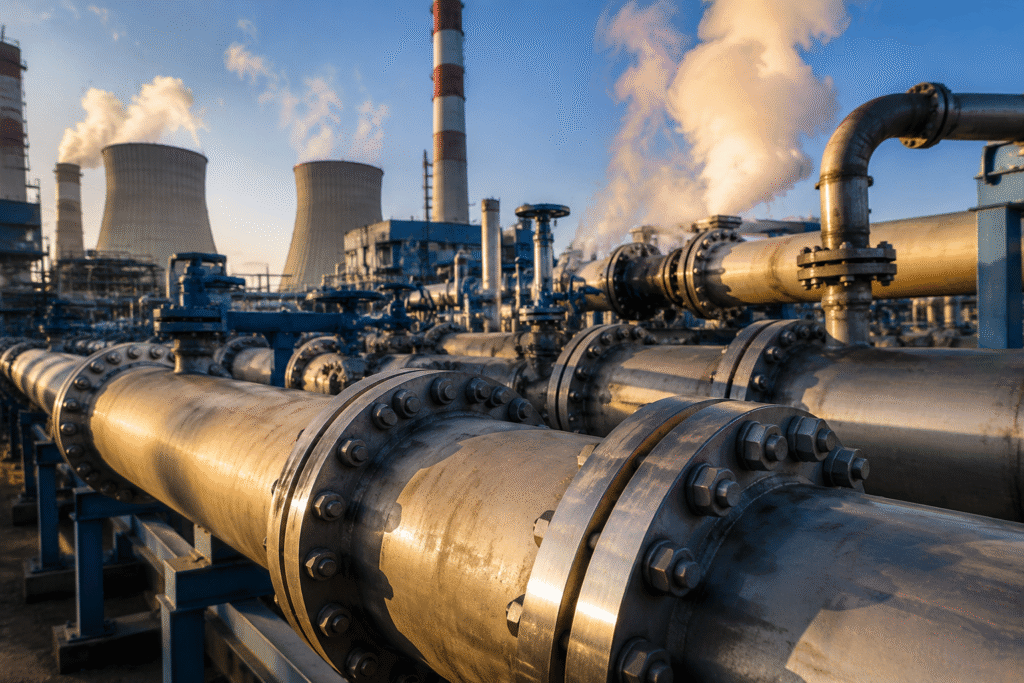
ステンレス鋼管フランジ市場: 7 型に関するデータに裏付けられた洞察, 用途, と隠れた利点
ステンレス鋼のパイプフランジは、現代のプロセス配管において依然として重要なコンポーネントです, especially as reliability, 耐食性, and compliance demands rise across global industry. グランドビューリサーチによると (2024), 世界の工業用フランジ市場は次のように評価されました。 $5.8 億で 2023 に達すると予測されています $7.2 10億まで 2030, which makes flange selection a strategic procurement decision rather than a routine commodity purchase.
エンジニアとバイヤー向け, the most intriguing stainless steel flange discussion is no longer just about material cost. It is about lifecycle value, 圧力の完全性, weld performance, and how to choose the right flange for a specific pipe system, 標準, and service condition.
Industrial Demand for Stainless Steel Pipe Flange Solutions Is Accelerating
Industrial operators continue to shift toward longer-life piping components because shutdowns are expensive and unplanned leakage creates direct operational risk. 統計局によると (2024), 石油・ガス産業が約 35% 世界のフランジ消費量の, which highlights how strongly critical-service sectors influence flange purchasing trends.
Regional manufacturing capacity also shapes sourcing strategy. IBISWorldによると (2024), アジア太平洋地域が占める割合は超過 45% 世界のフランジ生産量の, 中国が最大の製造国である, which gives global buyers access to broad size ranges, custom machining, and competitive lead times.
These numbers explain why procurement teams increasingly compare not only price but also testing capability, raw material traceability, and export documentation. In high-consequence industries such as petrochemical and power generation, a flange failure can stop production lines and trigger costly reinspection programs.
さらに, stainless steel continues to gain preference where chloride exposure, 衛生的なサービス, or elevated temperature performance matter. Mordor Intelligence (2024) reports that demand for corrosion-resistant alloys in industrial processing is growing steadily as operators extend plant life and reduce maintenance intervals.
That trend supports the Hidden advantages of Stainless Steel over lower-cost alternatives. Stainless grades such as 304, 316, 316l, 904l, 2205, そして 2507 deliver a strong balance of corrosion resistance, 靭性, and weldability when matched correctly to service media and temperature.
As materials scientist Dr. Helen Carter, a corrosion consultant, 州: “Selecting a flange only by initial cost ignores the full economics of corrosion, replacement labor, and process interruption.” Her point reflects what many EPC contractors already know. Material selection errors often cost far more than the original component price.
At the supplier level, capability matters as much as catalog breadth. SASA FLANGE serves buyers in Oil & ガス, 石油化学, 力, 海兵隊, 水処理, and Construction with stainless steel flanges and fittings produced to ANSI B16.5, ANSI B16.47, ASME B16.9, DIN, JIS, ゴスト, とEN 1092 要件.
と ISO 9001:2015 および PED 2014/68/EU 認証, SASA FLANGE supports export-oriented projects that require controlled quality systems and pressure-equipment compliance. さらに, the company offers materials from standard 304 and 316L to duplex, ニッケル合金, チタン, and specialty corrosion-resistant grades.
For buyers evaluating Flanges? supply partners, the market increasingly rewards manufacturers that combine CNC machining, PMI, dimensional control, そして EN 10204 3.1 ドキュメント. したがって, supplier assessment should include not only price and stock but also metallurgical consistency and responsiveness to custom drawings.
How to Choose Stainless Steel Pipe Flange Types, 材料, and Pressure Ratings
The best way to Choose a stainless steel pipe flange is to start with service conditions, not product category names. Pressure class, 腐食媒体, 温度, flange facing, connection method, and mating Pipe specification all influence which Flange design will actually perform.
According to ASME B16.5, standard flange dimensions, pressure-temperature ratings, 公差, and marking requirements create the baseline for safe interchangeability in NPS 1/2 を通して 24. For larger diameters, ASME B16.47 becomes the governing dimensional standard for many heavy industrial systems (ASME, 2023).
Material grade is the next selection gate. ASTM A182 covers forged or rolled alloy and stainless steel pipe flanges and forged fittings for high-temperature service, その間 ASTM A240 addresses plate, sheet, and strip for pressure vessels and general applications (ASTM, 2023).
マーケットリサーチの将来によると (2024), corrosion-related maintenance still accounts for billions of dollars in annual industrial spending worldwide. したがって, correct grade selection is one of the clearest Hidden advantages available to owners seeking lower lifecycle cost.
As piping engineer Mark Ellison, PE, 州: “A 316L flange is not automatically the right answer; 塩化物濃度, crevice conditions, and weld procedure determine whether duplex or higher-alloy materials are more appropriate.” That quote captures the reality behind Stainless Steel selection in modern process plants.
The most common stainless steel flange Types include:
- Weld neck flange for high pressure, 高温, and cyclic duty.
- Slip-on flange for moderate service where easier alignment and lower fabrication cost are preferred.
- Socket weld flange for smaller bore, high-pressure systems.
- Threaded flange for low-pressure or non-weld applications.
- Blind flange for isolation, テスト, and future expansion points.
- Lap joint flange for systems requiring frequent dismantling.
Material options also vary by corrosion environment and design code:
- 304 and 304L for general corrosion resistance and cost-effective utility service.
- 316 and 316L for better pitting resistance in chloride-bearing environments.
- 904L for aggressive acid service and enhanced corrosion resistance.
- 2205 duplex for higher strength and improved chloride stress corrosion cracking resistance.
- 2507 super duplex for severe offshore and seawater applications.
- インコネル, モネル, ハステロイ, and Titanium for specialized chemical and high-temperature service.
Pressure class selection requires equal discipline. Common ASME classes include 150, 300, 600, 900, 1500, そして 2500, but the allowable pressure depends on material group and temperature. A Class 300 stainless steel pipe flange does not perform identically across all alloys at elevated temperature, so buyers should verify pressure-temperature tables rather than rely on naming alone.
Facing style also affects leak integrity. Raised face, 平らな面, and ring type joint geometries serve different gasket systems and bolt-loading strategies, especially in refinery and high-pressure hydrocarbon service.
表面仕上げ, concentric serration, and dimensional tolerance directly influence gasket seating. According to NACE guidance and field experience, improper flange finish can accelerate leakage risk in corrosive environments even when the alloy itself is adequate (ネイス, 2023).
In practical sourcing terms, buyers should request the following before release:
- Material test certificates to EN 10204 3.1.
- Heat number traceability and positive material identification.
- Dimensional inspection reports.
- Pressure class and standard confirmation.
- Face finish verification and marking details.
- Any required NACE MR0175 or project-specific compliance.
SASA FLANGE supports these procurement requirements with manufacturing in 304, 316, 316l, 904l, 2205, 2507 その他のプレミアムグレード. 高度な CNC 加工と包括的な品質テストに裏付けられています, the company can supply standard and custom Flanges from 1/2 インチから 60 inch for international industrial projects.
Another intriguing point for buyers is that fittings and flanges should be sourced as a coordinated package when possible. Matching metallurgy, 寸法規格, and documentation across elbows, ティー, 減速機, キャップ, and flanges reduces mismatch risk during fabrication and site installation.
基準, コンプライアンス, and Inspection Requirements for Stainless Steel Pipe Flange Procurement
Compliance is not paperwork after production. It is a design and manufacturing framework that begins with the specification stage and continues through forging, 機械加工, 検査, マーキング, packing, and final shipment.
For most international projects, the core standards matrix includes ASME dimensional standards, ASTM material standards, and regional references such as DIN and EN 1092. In Europe, PED 2014/68/EU compliance often becomes essential for pressure equipment placed on the market within the EU.
The main standards relevant to stainless steel pipe flange procurement include:
- ASME B16.5 管フランジおよびフランジ付き継手用.
- ASME B16.47 大径鋼フランジ用.
- ASME B16.9 for factory-made wrought buttwelding fittings.
- ASTM A182 for forged stainless and alloy flanges.
- ASTM A240 for stainless steel plate products.
- EN 1092 for European flange dimensions and pressure designations.
- DIN and JIS standards for regional compatibility requirements.
- NACE MR0175 for sour service material considerations.
According to ISO (2023), certified quality systems improve process consistency by standardizing control points from purchasing through final inspection. That is why many EPC firms prefer suppliers with ISO 9001:2015 certification and documented nonconformance procedures.
重要なサービス用, buyers often compare standards and documentation in a structured way:
- ASME and ASTM dominate North American and many global energy projects.
- DIN and EN are common in European and export-driven process systems.
- JIS is frequently specified for Japanese industrial installations and related supply chains.
- NORSOK and DNV references may apply in offshore and marine environments.
Image alt text recommendation: stainless steel pipe flange dimensions and inspection under ASME standards.
Inspection scope should reflect service criticality. Standard checks usually include chemical composition review, 機械的特性, visual inspection, dimensional verification, and marking validation, while high-specification orders may also require PMI, ferrite testing, 硬さ試験, 超音波検査, or third-party witness inspection.
According to DNV guidance for offshore components, documentation quality and traceability are as important as nominal material strength because offshore maintenance and replacement costs are disproportionately high (DNV, 2023). したがって, marine and offshore buyers often specify enhanced traceability and corrosion-resistant grades such as 2205 または 2507.
For chemical processing and sour service, NACE compatibility should be checked early. While not every stainless steel pipe flange falls directly under sour-service criteria, the environment can quickly eliminate otherwise common grades if chlorides, H2S, or temperature combine unfavorably.
SASA FLANGE integrates ISO 9001:2015, PED 2014/68/EU, とAD 2000 quality frameworks into export production. This supports procurement teams that need not only compliant Flanges but also inspection reports, MTCs, and technical responsiveness during project execution.
Because many competitor pages stop at general material descriptions, compliance depth becomes a real differentiator. A supplier that can discuss ASTM grades, flange pressure classes, welding implications, and EN shipment documentation adds measurable value during bid qualification and vendor approval.
アプリケーション, 用途, and Selection Criteria Across Oil, ガス, 化学薬品, 力, and Marine Systems
Understanding actual Uses helps buyers avoid over-specification and under-specification at the same time. The strongest selection strategy links alloy grade, フランジタイプ, and standard to a specific process condition rather than treating all Stainless components as interchangeable.
In oil and gas, weld neck and blind flanges dominate critical service because they offer strong structural performance and reliable gasket loading. 統計局によると (2024), this sector represents about 35% 世界のフランジ消費量の, so lessons from upstream, midstream, and refining projects strongly shape best practices.
石油化学プラント内, 316L often becomes the starting point for moderate chloride service, while 904L, デュプレックス, or nickel alloys may be necessary for more aggressive media. In power generation, thermal cycling and pressure swings place a premium on forged quality, bolt loading consistency, and weld integrity.
Marine and shipbuilding projects create a different decision path. Seawater exposure, splash zones, and high humidity can push buyers toward duplex or super duplex options where standard austenitic grades may suffer pitting or crevice corrosion over time.
Common application examples include:
- Oil and gas gathering lines, separators, and process skids.
- Petrochemical transfer lines and reactor support systems.
- Power plant steam, condensate, and auxiliary systems.
- Shipbuilding ballast, cooling, and process piping.
- Water treatment and desalination systems.
- Construction and industrial utility piping.
When buyers ask what Hidden advantages stainless steel flanges offer, the answer usually includes reduced maintenance, cleaner internal surfaces, stable mechanical performance, and stronger resistance to oxidation or corrosion compared with carbon steel in the right service. しかし, the right service condition is the key qualifier.
Selection criteria should include:
- Fluid chemistry, including chlorides, acids, and sulfides.
- Operating and design temperature.
- Operating and design pressure.
- Pipe size, 壁の厚さ, and schedule compatibility.
- Flange class, 直面している, and gasket system.
- Weld procedure and fabrication environment.
- Required standards, 認証, and inspection level.
- Target service life and maintenance philosophy.
例えば, a 2-inch utility water line may only need a Class 150 slip-on stainless steel pipe flange in 304L. 対照的に, an offshore chemical injection line may require a weld neck flange in 2205 または 2507 with project-specific testing, PMI, and third-party witness inspection.
According to a 2024 industrial maintenance survey cited by Market Research Future, operators increasingly prioritize total cost of ownership over lowest bid price for corrosion-sensitive components. 結果として, procurement teams are more willing to specify premium alloys when downtime and replacement labor outweigh initial savings.
Custom manufacturing capability also affects project outcomes. SASA FLANGE offers custom sizes, special materials, and coordinated supply of flanges plus buttweld fittings such as elbows, ティー, 減速機, そしてキャップ, which simplifies sourcing for packaged systems and multi-line projects.
Serving 50+ 石油を巡る国々 & ガス, 石油化学, 力, 海洋産業, SASA FLANGE supports both standard and drawing-based orders. That matters when buyers need non-standard bores, drilled patterns, special facings, or alloy combinations outside commodity stock programs.
今後の展望, Pricing Logic, and Strategic Buying Recommendations
The near-term outlook for stainless steel pipe flange demand remains positive because infrastructure renewal, energy investment, 脱塩, and process modernization continue to support flange-intensive projects. グランドビューリサーチによると (2024), the market is expected to reach $7.2 10億まで 2030, which indicates sustained procurement activity across global industrial sectors.
同時に, pricing will remain sensitive to nickel, モリブデン, and alloy surcharge fluctuations. したがって, buyers should review not only the base quote but also material validity periods, substitute restrictions, machining tolerances, and required certification scope.
As industry analyst Robert Hayes notes: “The most resilient sourcing programs combine qualified suppliers, clear standards, and early engineering review rather than waiting until fabrication is already delayed.” That recommendation is especially relevant for engineered Flanges where project deviations create costly rework.
購入者に対する戦略的な推奨事項には次のものがあります。:
- Standardize preferred materials by service category.
- Prequalify suppliers by certification, テスト, and export capability.
- Bundle flange and fitting packages to reduce compatibility risk.
- Confirm standards and face types before PO release.
- リクエスト EN 10204 3.1 certificates and PMI for critical alloys.
- Consider lifecycle cost, not only ex-works price.
There is also a content lesson hidden in competitor analysis. Many suppliers discuss Stainless Steel broadly, but fewer explain how to Choose among flange Types, 圧力クラス, and alloy grades in practical project terms. Buyers increasingly reward suppliers who provide technically credible guidance with fast commercial response.
For procurement managers seeking a reliable source of stainless steel pipe flange products, technical documentation, and custom manufacturing support, early engagement shortens sourcing cycles and reduces risk. For projects that require ASME, ASTM, DIN, or EN-compliant Flanges and fittings, contacting SASA FLANGE during specification review can improve both technical clarity and purchasing efficiency.
よくある質問
What are stainless steel flanges used for?
●Stainless steel flanges are used to connect pipe, バルブ, パンプス, and pressure equipment in systems that require corrosion resistance, 圧力の完全性, and reliable maintenance access.
●統計局によると (2024), 石油・ガス産業が約 35% 世界のフランジ消費量の, which shows how important flanged joints are in critical process applications.
●They are commonly specified in petrochemical, 海洋, 水処理, food processing, and power generation systems where carbon steel may corrode too quickly.
●Common uses include line connection, equipment isolation, blind end closure, 検査アクセス, and transitions between piping components built to ASME B16.5 またはEN 1092 寸法.
●For projects requiring certified materials, dimensional consistency, and export documentation, working with established manufacturers like SASA FLANGE helps ensure the flange matches the service duty and applicable standard.
What flanges are made of stainless steel?
●ステンレス鋼フランジの主なタイプはウェルドネックです。, スリッポン, 盲目, ソケット溶接, ねじ切りされた, and lap joint flanges, and each serves a different mechanical or installation purpose.
●ASME B16.5 defines the dimensions and pressure-temperature framework for many stainless steel flanges from NPS 1/2 を通して 24, その間 ASTM A182 commonly governs forged stainless materials.
●These flanges can be produced in 304, 304l, 316, 316l, 904l, 2205, 2507, and specialty alloys depending on corrosion level, operating temperature, and design pressure.
●Weld neck flanges are usually preferred for high-pressure or cyclic service, whereas slip-on flanges are often chosen for lower-cost fabrication in less severe conditions.
●If a project includes custom drilling, non-standard bores, or higher-alloy materials, sourcing from a manufacturer such as SASA FLANGE can simplify specification matching and quality control.
Do they make stainless steel pipe fittings?
●はい, manufacturers produce stainless steel pipe fittings such as elbows, ティー, 減速機, and caps to match piping systems that use stainless steel flanges and welded pipe.
●ASME B16.9 is the key dimensional standard for many factory-made wrought buttwelding fittings, and ASTM material standards define the applicable stainless grades for service conditions.
●IBISWorldによると (2024), アジア太平洋地域が占める割合は超過 45% 世界のフランジ生産量の, and that same manufacturing ecosystem strongly supports large-scale stainless fitting supply as well.
●Coordinating fittings and flanges in the same alloy family reduces mismatch risk during welding, 製造, and final inspection, especially on multi-line industrial packages.
●For buyers who need a combined supply of stainless steel flanges and fittings with EN 10204 3.1 証明書, it is practical to work with integrated suppliers like SASA FLANGE.
What is the strongest type of piping flange?
●In most industrial piping systems, the weld neck flange is considered the strongest standard flange type because its tapered hub distributes stress more effectively than simpler designs.
●Its strength also depends on the material grade, 壁の厚さ, weld quality, and pressure class, so a duplex weld neck flange can outperform an austenitic slip-on flange by a wide margin in demanding service.
●ASME B16.5 pressure classes such as 600, 900, 1500, そして 2500 are commonly used where elevated pressure and temperature require stronger flange construction and tighter bolting control.
●As piping engineer Mark Ellison, PE, 州: “ジオメトリ, alloy strength, and welding practice together determine flange reliability, not type name alone.”
●For critical hydrocarbon, オフショア, or high-temperature duties, engineers should verify code compliance, material certification, and design calculations before selecting the strongest practical flange option.
How do I choose between 304, 316, 904l, and duplex stainless steel flanges?
●選ぶ 304 or 304L for general industrial service, 316 or 316L for better chloride resistance, 904L for aggressive chemical environments, and duplex grades for higher strength plus improved resistance to chloride stress corrosion cracking.
●マーケットリサーチの将来によると (2024), corrosion-related maintenance continues to drive significant industrial spending, so selecting the right alloy at the start often lowers total ownership cost.
●Factors such as chloride concentration, process temperature, acidity, crevice conditions, and fabrication method should guide final alloy choice rather than price alone.
●In seawater, オフショア, or sour environments, duplex grades such as 2205 そして 2507 are often more suitable than standard austenitic stainless steel, although project conditions must still be reviewed carefully.
●For specification support on alloy selection, 圧力クラス, および文書要件, buyers should consult a qualified manufacturer before issuing the purchase order.
What standards and certificates should I request when buying stainless steel pipe flanges?
●At minimum, buyers should request the applicable dimensional standard, 材質仕様, 圧力クラス, そして EN 10204 3.1 material test certificate for each stainless steel pipe flange order.
●Common references include ASME B16.5, ASME B16.47, ASTM A182, ASTM A240, EN 1092, and project-specific requirements such as NACE MR0175 or PED 2014/68/EU compliance.
●According to ISO (2023), certified quality systems improve process consistency by standardizing inspection and traceability controls across production stages.
●重要なサービス用, it is also wise to request PMI, dimensional inspection reports, 熱数トレーサビリティ, and any third-party witness records required by the project or end user.
●When the application involves export compliance, サワーサービス, or offshore duty, a certified supplier with ISO 9001:2015 and PED experience can reduce documentation risk and approval delays.
関連投稿
オリフィスフランジの定義, 詳細と ASME B16.36 フランジの概要: 市場データ, 選択ガイドとコンプライアンスに関する洞察
世界の工業用フランジ市場は次のように評価されました。 $5.8 十億…
ブラックディスポフランジ市場ガイド: 材料, 3.5″ 互換性, キッチン シンク フランジの B2B 調達データ
キッチン設備の購入者として黒色の使い捨てフランジの需要が高まっています…