
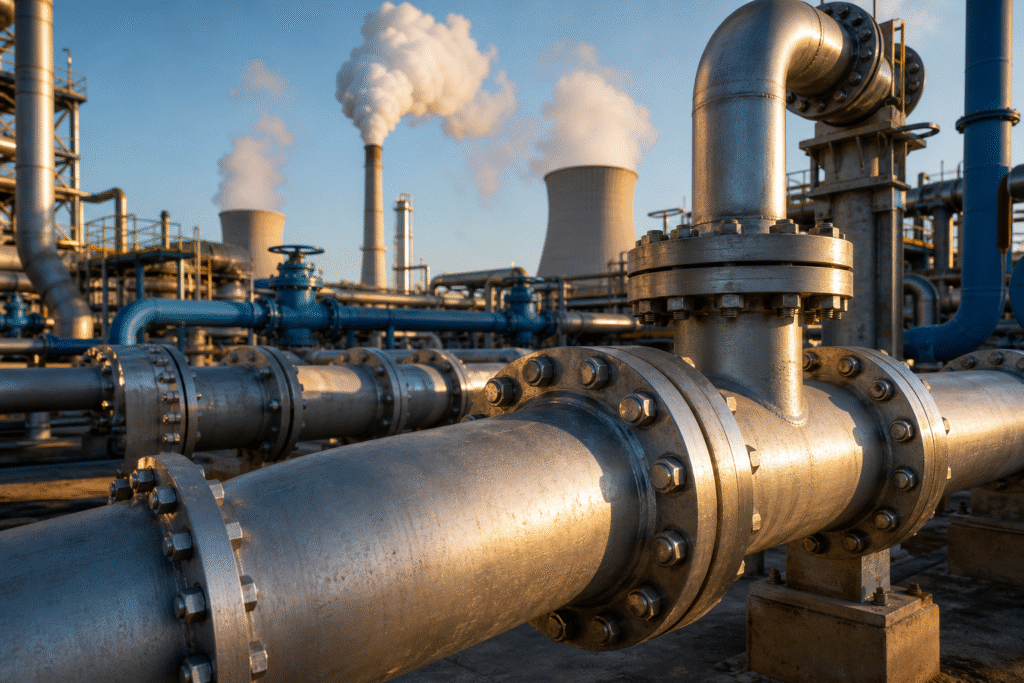
Thị trường mặt bích ống thép không gỉ sẽ đạt 7,2 tỷ USD vào năm nay 2030: Ưu điểm tiềm ẩn, Các loại, Hướng dẫn sử dụng và lựa chọn ASME B16.5
các mặt bích ống thép không gỉ market is expanding as process industries demand higher corrosion resistance, tuổi thọ dài hơn, và tuân thủ quy tắc chặt chẽ hơn. Theo nghiên cứu của Grand View (2024), thị trường mặt bích công nghiệp toàn cầu được định giá ở mức $5.8 tỷ trong 2023 và dự kiến sẽ đạt $7.2 tỷ bởi 2030.
That growth reflects the Hidden Advantages of Stainless Steel Flanges in critical Pipe systems. Dành cho kỹ sư và nhóm mua sắm, quyết định thực sự không chỉ là về giá cả, but also about durability, giá trị vòng đời, lớp vật liệu, Và ASME B16.5 Tuân thủ.
Market Drivers Behind Stainless Steel Pipe Flange Demand
Industrial buyers are increasingly shifting from commodity carbon steel options to higher-performance stainless solutions. Theo IBISWorld (2024), Châu Á - Thái Bình Dương chiếm hơn 45% sản xuất mặt bích toàn cầu, với Trung Quốc là nhà sản xuất lớn nhất.
That regional concentration matters for supply chain planning. Nó ảnh hưởng đến thời gian thực hiện, sự sẵn có của nhà máy, alloy sourcing, and factory-direct pricing for standard and custom forged products.
Đồng thời, end-use demand remains strongly tied to energy and process sectors. Theo Statista (2024), ngành dầu khí chiếm khoảng 35% tiêu thụ mặt bích toàn cầu.
Tuy nhiên, stainless steel pipe flange demand now extends well beyond upstream energy. Xử lý nước, hệ thống biển, cây dược phẩm, chế biến thực phẩm, and power generation all require Stainless, hợp vệ sinh, and corrosion-resistant connection points.
This shift has increased interest in 304, 316, 316L, 904L, 2205, Và 2507 điểm. In aggressive chloride service, buyers often move from 304 to molybdenum-bearing 316L or duplex grades to improve pitting resistance.
Theo Mordor Intelligence (2024), industrial infrastructure spending in emerging markets continues to support demand for pipe connection components with longer design life. Vì thế, buyers increasingly evaluate total installed cost rather than only initial unit price.
That is one reason the keyword Intriguing appears in many online searches, even if engineers would describe the topic differently. The more practical point is that the Versatility and durability of stainless steel pipe flange products make them suitable for both general utility systems and severe process conditions.
BẰNG SASA FLANGE supports buyers across Oil & Khí đốt, hóa dầu, Phát điện, Đóng tàu & Hàng hải, Xử lý nước, và Xây dựng, material selection is treated as a project risk decision. Với ISO 9001:2015 và chứng nhận PED 2014/68/EU, the company aligns manufacturing control with the documentation expectations of EPC contractors and global distributors.
Procurement managers also care about supply flexibility. Được hỗ trợ bởi gia công CNC tiên tiến và kiểm tra chất lượng toàn diện, SASA FLANGE cung cấp mặt bích inox, mặt bích thép carbon, mặt bích hợp kim, và các phụ kiện đường ống như khuỷu tay, áo thun, bộ giảm tốc, và mũ.
Theo Nghiên cứu thị trường Tương lai (2024), demand for corrosion-resistant piping components is growing faster in desalination, ngoài khơi, and chemical processing segments than in general industrial applications. Kết quả là, stainless steel flange types with tighter metallurgy control and traceable certification are gaining share.
Đối với người mua dự án, that means a stainless steel pipe flange is no longer a generic commodity. It is a specification-driven component linked to pressure class, kiểu đối mặt, trợ cấp ăn mòn, quy trình hàn, và yêu cầu kiểm tra.
Technical Advantages, Các loại, Uses and Material Selection Criteria
The Hidden Advantages of a stainless steel pipe flange start with corrosion resistance, but they do not end there. Stainless materials also support cleaner service conditions, better oxidation resistance, and more stable long-term sealing performance in many systems.
Theo thực hành vật liệu của ASTM và ASME, mặt bích không gỉ rèn thường được cung cấp theo ASTM A182 với kích thước được điều chỉnh bởi ASME B16.5 và ASME B16.47 nếu có thể áp dụng. Vì thế, a buyer must match chemistry, rèn chất lượng, lớp mặt bích, and dimensional standard together.
Như John Butterfield, Kỹ sư đường ống cao cấp, tiểu bang: “A flange failure rarely starts at the drawing stage alone; nó thường bắt đầu bằng sự không phù hợp giữa cấp vật liệu, quá trình hóa học, and bolt load assumptions.” That is why experienced sourcing teams review service media, nhiệt độ, đạp xe áp lực, and maintenance access before they Choose a flange type.
According to NACE guidance for sour and corrosive environments, alloy selection must consider chlorides, H2S, CO2, nhiệt độ, và lộ kẽ hở. Ngược lại, many low-risk water or air systems can use 304 or 304L economically when contamination and corrosion loads remain moderate.
The most common Stainless grades for a stainless steel pipe flange include the following:
- 304 and 304L for general industrial service, clean water, HVAC, và nhiệm vụ hóa học nhẹ.
- 316 and 316L for chloride-bearing service, khí quyển biển, and more aggressive chemical lines.
- 904L for strong corrosion resistance in severe acidic environments.
- 2205 duplex for higher strength and improved chloride stress corrosion resistance.
- 2507 siêu song công cho nước ngoài, khử muối, and highly corrosive process systems.
- Hợp kim niken như Inconel, Monel, and Hastelloy for specialized high-temperature or corrosive duties.
Material selection also depends on flange Types. Each design offers different fabrication, điều tra, and service advantages.
- Weld neck flanges support high pressure, tải theo chu kỳ, và các dòng quy trình quan trọng.
- Slip on flanges reduce fabrication cost for lower-pressure service and easier fit-up.
- Blind flanges terminate lines, thiết bị cô lập, and support hydrotest activities.
- Socket weld flanges suit smaller bore high-pressure piping.
- Threaded flanges work where welding is restricted or undesirable.
- Lapped joint flanges help systems that require frequent dismantling and alignment flexibility.
Theo ASME B16.5, standard flange pressure-temperature ratings vary by material group and class designation. Vì thế, Lớp học 150, 300, 600, 900, 1500, Và 2500 selection must always be verified against operating temperature.
Engineers also evaluate facing style because gasket interaction drives sealing performance. Mặt ngước lên, mặt phẳng, and ring type joint options each serve different service levels and bolting requirements.
Như Tiến sĩ. Emily Carver, Nhà khoa học vật liệu, tiểu bang: “The best stainless choice is rarely the highest alloy by default; it is the grade that delivers the required corrosion margin at the lowest total lifecycle cost.” Nguyên tắc đó đặc biệt quan trọng khi so sánh 304 so với 316L, or 316L versus duplex grades.
Ví dụ, 304 remains widely used because it offers a strong cost-to-performance balance. Tuy nhiên, 316L often becomes the better option in marine, hóa chất, and higher chloride environments because molybdenum improves pitting resistance.
In practical B2B sourcing, buyers should compare these technical factors:
- Tiêu chuẩn vật liệu như ASTM A182 F304, F304L, F316, F316L, F51, hoặc F53.
- Dimensional standard such as ANSI B16.5, ANSI B16.47, DIN, JIS, GOST, hoặc VN 1092.
- Lịch trình đường ống và trận đấu khoan, bao gồm cả Sch 10S, 40S, and heavier wall combinations.
- Loại đối mặt bao gồm RF, FF, RTJ, or custom machined facings.
- Testing documents such as EN 10204 3.1, PMI, thử thủy lực, độ cứng, and ultrasonic inspection.
- Truy xuất nguồn gốc, kiểm soát số nhiệt, và yêu cầu đánh dấu.
According to ISO manufacturing quality practice, process repeatability strongly influences sealing reliability and fit-up accuracy. Vì thế, CNC machining quality, kiểm soát rèn, and final inspection matter as much as raw material chemistry.
SASA FLANGE sản xuất mặt bích ở 304, 316, 904L, 2205, 2507 và các hạng cao cấp khác. Cung cấp kích thước tùy chỉnh từ 1/2" đến 60" với giá cả cạnh tranh trực tiếp tại nhà máy, the company supports project and distributor requirements across standard and non-standard dimensions.
Buyers looking for stainless steel pipe flange products often search by size, chẳng hạn như 2 inch hoặc 4 mặt bích ống thép không gỉ inch, or by application, such as marine, Mặt bích API, and water treatment service. Trong mỗi trường hợp, the engineering answer depends on media composition, lớp mặt bích, corrosion margin, thiết kế đệm, và phương pháp chế tạo.
For deeper project support or quotations, engineering and procurement teams can liên hệ SASA FLANGE for material recommendations and technical documentation. This is particularly useful when a project requires mixed standards, khoan tùy chỉnh, or urgent replacement parts.
ASME B16.5, ASTM A182, DIN and EN Compliance Requirements
Standards compliance is one of the most important buying criteria for any stainless steel pipe flange. A flange may appear dimensionally correct, yet fail project acceptance if documentation, đánh dấu, luyện kim, or testing does not align with contract requirements.
ASME B16.5 chi phối kích thước, dung sai, xếp hạng nhiệt độ áp suất, đánh dấu, and materials references for pipe flanges and flanged fittings up to NPS 24. Đối với đường kính lớn hơn, ASME B16.47 typically applies, especially in heavy industrial and pipeline projects.
ASTM A182 bao gồm các mặt bích ống thép không gỉ và hợp kim rèn hoặc cán, phụ kiện giả mạo, van, và các bộ phận cho dịch vụ nhiệt độ cao. Trong thực tế, buyers frequently specify ASTM A182 F304/F304L, F316/F316L, F904L, F51, or F53 depending on process duty.
European projects may instead call for EN 1092 flanges and PED documentation. Vì thế, suppliers must understand both dimensional differences and documentation differences across ASME, DIN, và hệ thống EN.
Key standards and compliance points include:
- ASME B16.5 for dimensions and pressure classes up to NPS 24.
- ASME B16.47 cho mặt bích có đường kính lớn hơn.
- ASME B16.9 for stainless steel butt weld fittings used with flange assemblies.
- ASTM A182 cho vật liệu mặt bích không gỉ và hợp kim giả mạo.
- EN 1092 về kích thước mặt bích và ký hiệu áp suất của mặt bích Châu Âu.
- PED 2014/68/EU for pressure equipment compliance in applicable EU projects.
- NACE MR0175 for sour service material selection in oil and gas environments.
The following comparison helps procurement teams align specifications:
- ASME systems commonly use NPS sizing and pressure classes such as 150 Và 300.
- EN and DIN systems often use DN sizing and PN designations such as PN16 or PN40.
- Facing dimensions, mẫu bu lông, and drilling can vary between ASME and EN standards.
- Material naming can differ even when corrosion performance is similar.
Theo khuôn khổ Ủy ban Châu Âu về PED, pressure equipment supplied into the EU often requires traceable technical files and conformity procedures. Vì thế, exporters must coordinate material certificates, báo cáo kiểm tra chiều, and marking records from the start of production.
Như Mark Jensen, Global Procurement Analyst, tiểu bang: “The most expensive flange in a project is the one that arrives without acceptable certification.” That observation reflects a common reality in EPC sourcing, where missing EN 10204 3.1 certificates or incomplete heat traceability can delay site release.
SASA FLANGE supports these compliance needs with ISO 9001:2015, PED 2014/68/EU, và AD 2000 chứng chỉ. Phục vụ 50+ các quốc gia trên khắp dầu mỏ & Khí đốt, hóa dầu, Quyền lực, và ngành hàng hải, the company integrates quality documentation into the manufacturing workflow instead of treating it as an afterthought.
Ngoài ra, buyers should verify inspection scope before ordering. Typical requirements may include PMI for alloy confirmation, kiểm tra độ cứng, thử nghiệm ferrite cho các lớp song công, kiểm tra siêu âm, and dimensional inspection against approved drawings.
For special service, gasket compatibility also deserves attention. Even a correctly manufactured stainless steel pipe flange can underperform if the gasket material, bề mặt hoàn thiện, or bolt load is unsuitable for process conditions.
According to DNV and offshore project practice, marine and offshore systems often impose stricter documentation and corrosion requirements than general industrial installations. Kết quả là, duplex and super duplex flange packages often include more extensive testing and traceability than standard 304 hoặc 316 utility flanges.
Cách chọn sản phẩm mặt bích ống thép không gỉ cho dầu, Khí đốt, Power and Marine Service
Application-based selection is the fastest way to reduce procurement risk. Instead of starting with a catalog alone, engineers should begin with service conditions, yêu cầu kiểm tra, and lifecycle expectations.
Trong hệ thống dầu khí, stainless steel pipe flange selection often depends on chlorides, tiếp xúc với dịch vụ chua, và lớp áp lực. Theo Statista (2024), this sector accounts for approximately 35% tiêu thụ mặt bích toàn cầu, so reliability expectations are high.
For upstream and petrochemical service, common selection rules include:
- Use weld neck flanges for high-pressure and cyclic service.
- Ôn tập NACE MR0175 where H2S or sour conditions exist.
- Consider duplex grades where chlorides and strength demands exceed 316L capability.
- Lời yêu cầu EN 10204 3.1 certification and PMI for critical alloys.
Trong xử lý hóa học, the main concern is media compatibility. A strong acid, chloride-rich stream, or oxidizing environment may require 316L, 904L, Hastelloy, or another corrosion-resistant alloy instead of standard 304.
Trong sản xuất điện, steam conditions and thermal cycling often drive the design choice. Vì thế, weld neck and socket weld configurations frequently offer better long-term integrity than lower-cost alternatives in critical lines.
Marine and shipbuilding applications demand resistance to salt spray, tiếp xúc với nước biển, and difficult maintenance conditions. For these Uses, 316L and duplex grades are commonly preferred because they provide a stronger corrosion margin.
Water treatment and desalination projects add another layer of complexity. Theo Nghiên cứu thị trường Tương lai (2024), corrosion-resistant piping components show stronger growth in desalination infrastructure than in many general industrial segments.
Khi người mua so sánh nhà cung cấp, they should use a structured checklist:
- Confirm material grade and forging standard.
- Confirm dimensional standard such as ASME B16.5 hoặc VN 1092.
- Match pressure class to design temperature.
- Check face type, lịch khoan, và độ dày của tường.
- Verify testing scope and certificate package.
- Xem xét thời gian thực hiện, bao bì, và tài liệu xuất khẩu.
- Ask about custom drilling, special machining, and non-standard sizes.
Stainless steel pipe flange price also varies for practical reasons. Hàm lượng niken, forging size, machining time, phạm vi thử nghiệm, and certificate requirements all influence landed cost.
Vì thế, the lowest quoted price may not represent the best commercial option. A competitively priced flange without proper PMI, độ chính xác chiều, or packing protection can create much higher downstream cost.
SASA FLANGE supports custom manufacturing for standard and special projects, including stainless steel flanges and fittings for multi-industry installations. Buyers can also review broader capabilities through the danh mục sản phẩm and discuss project details through the trang liên hệ.
Đối với gói hỗn hợp, coordination between flanges and fittings is essential. Pipe elbows, áo thun, bộ giảm tốc, and caps must align with the same metallurgy, lịch trình, and documentation level as the mating flange assembly.
That is why many B2B buyers prefer a supplier that can support both flange and fitting requirements. It simplifies inspection, export paperwork, and technical communication across the full package.
Triển vọng tương lai, Procurement Strategy and Long-Term Value
The flange market outlook remains positive because process industries continue investing in replacement, mở rộng, and reliability upgrades. Theo nghiên cứu của Grand View (2024), thị trường dự kiến sẽ đạt $7.2 tỷ bởi 2030, reflecting sustained demand across energy, Nước, và cơ sở hạ tầng công nghiệp.
Đồng thời, buyers face tighter control on total cost, not just purchase cost. Vì thế, procurement strategy must balance raw material volatility, fabrication lead times, and compliance documentation.
Several trends will shape stainless steel pipe flange buying decisions over the next five years:
- Greater demand for duplex and high-alloy materials in corrosive environments.
- More documentation requirements for export and EPC projects.
- Shorter project schedules and stronger preference for reliable factory-direct partners.
- Higher use of digital traceability, PMI, and quality reporting.
Theo IBISWorld (2024), China remains the largest manufacturing base within a region that accounts for over 45% sản xuất mặt bích toàn cầu. Kết quả là, strategic sourcing from qualified Chinese manufacturers can offer both scale and cost efficiency when quality systems are verified.
Đối với các nhóm mua sắm, the best practice is clear. Standardize approved flange specifications, qualify suppliers by certification and inspection capability, and compare total delivered value instead of nominal unit price alone.
Engineers should also avoid overspecification where it adds no measurable benefit. Ngược lại, they should not underspecify corrosion resistance, tài liệu, or machining quality in critical systems.
That balanced approach reveals the real Hidden Advantages of using a well-selected stainless steel pipe flange. Better durability, tắt máy ít hơn, easier compliance, and lower maintenance often outweigh a modest upfront premium.
For organizations seeking dependable supply, kích thước tùy chỉnh, and technical support across ASME, DIN, JIS, GOST, và tiêu chuẩn EN, a discussion with SASA FLANGE can help align specification, ngân sách, and lead-time targets. In competitive project environments, that kind of early technical coordination often creates the strongest commercial result.
Câu hỏi thường gặp
Mặt bích thép không gỉ dùng để làm gì?
●Mặt bích inox dùng để nối các đoạn ống, van, máy bơm, và thiết bị trong các hệ thống yêu cầu chống ăn mòn, clean service, và niêm phong đáng tin cậy dưới áp lực.
●Theo Statista (2024), ngành dầu khí chiếm khoảng 35% tiêu thụ mặt bích toàn cầu, which shows how critical flanges are in energy infrastructure.
●They are also widely used in chemical processing, hệ thống biển, xử lý nước, nhà máy điện, dược phẩm, and food-grade installations because stainless materials resist rust, chia tỷ lệ, and contamination better than many carbon steel options.
●Common Uses include line assembly, cách ly thiết bị, quyền truy cập bảo trì, and pressure boundary integrity in both low-pressure utility systems and high-pressure process lines.
●For best results, buyers should match material grade, lớp mặt bích, kiểu đối mặt, và tiêu chuẩn như ASME B16.5 to the actual service environment.
Họ có sản xuất phụ kiện đường ống bằng thép không gỉ không?
●Đúng, nhà sản xuất sản xuất phụ kiện ống thép không gỉ như khuỷu tay, áo thun, bộ giảm tốc, mũ lưỡi trai, and stub ends to work with flange and welded piping systems.
●Theo ASME B16.9, butt weld fittings are standardized for dimensions and tolerances, which helps engineers maintain fit-up consistency across piping assemblies.
●These fittings are commonly available in 304, 316, 316L, 904L, 2205, Và 2507 tùy thuộc vào nguy cơ ăn mòn, lớp áp lực, and process media.
●Trong nhiều dự án, flanges and fittings should be sourced with the same metallurgy and certification level to simplify inspection and avoid mixed-documentation issues.
●For projects requiring stainless steel flanges and Fittings with EN 10204 3.1 certificates or custom dimensions, làm việc với các nhà sản xuất có uy tín như SASA FLANGE helps reduce procurement risk.
Các loại mặt bích thép không gỉ khác nhau là gì?
●Các loại mặt bích inox chính là cổ hàn, trượt vào, mù, ổ cắm hàn, xâu chuỗi, và khớp nối, and each one suits different pressure, chế tạo, và điều kiện bảo trì.
●ASME B16.5 covers most common flange dimensions and pressure classes up to NPS 24, making it the core standard for many industrial buyers.
●Weld neck flanges are preferred for severe service and cyclic loading, while slip on flanges are often selected for easier alignment and lower fabrication cost in moderate duty.
●Blind flanges close line ends, threaded flanges help where welding is restricted, and lap joint flanges support systems that need frequent dismantling.
●The right choice depends on pressure rating, nhiệt độ, media corrosivity, lịch trình đường ống, phạm vi kiểm tra, và chiến lược bảo trì.
Ba loại mặt bích là gì?
●Ba loại mặt bích được nhắc đến phổ biến nhất trong thảo luận công nghiệp nói chung là mặt bích cổ hàn., trượt vào, và mặt bích mù.
●These three cover many typical applications because weld neck supports critical service, slip on offers economical installation, and blind provides positive line closure.
●Theo ASME B16.5, each type must still be selected by matching pressure-temperature rating, đối mặt với phong cách, and material group rather than by shape alone.
●Trong thực tế, engineers may also use socket weld, xâu chuỗi, and lap joint flanges where project conditions require them.
●Đối với các hệ thống quan trọng, the safest approach is to review piping stress, dịch vụ hóa học, and gasket design before final selection.
Mã ASME cho mặt bích thép không gỉ là gì?
●The primary ASME dimensional standard for a stainless steel pipe flange is ASME B16.5, trong khi ASME B16.47 is commonly used for larger diameters.
●Material requirements are often linked to ASTM A182 for forged stainless steel grades such as F304, F304L, F316, và F316L.
●Theo thông lệ ASME, xếp hạng nhiệt độ áp suất, kích thước, dung sai, đánh dấu, and flange classes must all be checked together during specification review.
●Buyers should also note that European projects may call for EN 1092 instead of ASME dimensions, so interchangeability is not automatic.
●For export or EPC projects, always request dimensional compliance records and material certificates before shipment release.
Làm thế nào để tôi lựa chọn giữa 304 Và 316 mặt bích thép không gỉ?
●Chọn 304 stainless steel flanges for general service and lower-corrosion environments, và chọn 316 hoặc 316L khi clorua, tiếp xúc với biển, or harsher chemicals are present.
●The key difference is molybdenum content in 316 điểm, which improves resistance to pitting and crevice corrosion in aggressive media.
●According to corrosion engineering practice and common ASTM A182 lựa chọn vật liệu, 316L is frequently preferred for marine, hóa chất, and higher-purity process systems.
●Tuy nhiên, 304 often remains the more economical solution when service conditions do not justify the added alloy cost.
●When the application is uncertain, a supplier with technical experience and documented quality systems such as SASA FLANGE can help evaluate the most cost-effective grade.
bài viết liên quan
Mặt bích hoàn thiện: Giải thích về răng cưa đồng tâm và xoắn ốc
Các răng cưa đồng tâm và xoắn ốc đều được gia công hoàn thiện mặt bích…
song công 2205 so với mặt bích 316L: Bạn nên chọn chất liệu nào?
Trả lời nhanh: song công 2205 mặt bích thường là ứng cử viên mạnh hơn…

Định nghĩa mặt bích lỗ, Chi tiết và tổng quan về mặt bích ASME B16.36: Dữ liệu thị trường, Hướng dẫn lựa chọn và thông tin chi tiết về tuân thủ
Thị trường mặt bích công nghiệp toàn cầu được định giá ở mức $5.8 tỷ…

Hướng dẫn thị trường mặt bích xử lý màu đen: Nguyên vật liệu, 3.5″ Khả năng tương thích, và dữ liệu tìm nguồn cung ứng B2B cho mặt bích bồn rửa nhà bếp
Nhu cầu mặt bích xử lý màu đen đang tăng lên khi người mua đồ đạc nhà bếp…