
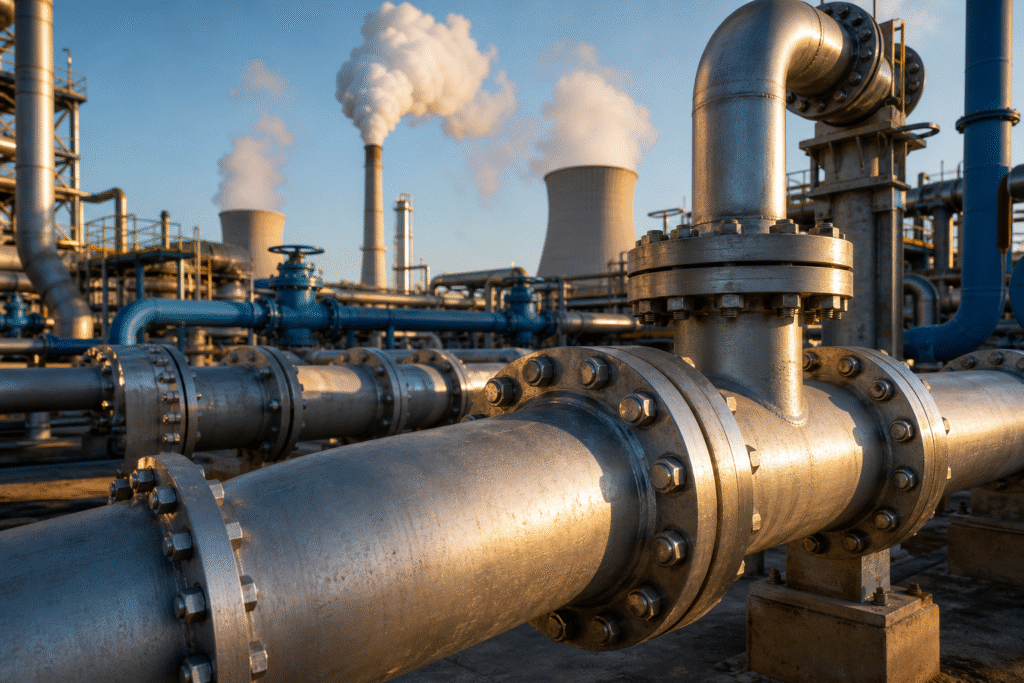
Pasar Flange Pipa Stainless Steel Mencapai $7,2 Miliar oleh 2030: Keuntungan Tersembunyi, Jenis, Penggunaan dan Panduan Seleksi ASME B16.5
Itu flensa pipa baja tahan karat market is expanding as process industries demand higher corrosion resistance, masa pakai lebih lama, dan kepatuhan kode yang lebih ketat. Menurut Penelitian Grand View (2024), pasar flensa industri global dihargai $5.8 miliar masuk 2023 dan diperkirakan akan tercapai $7.2 miliar oleh 2030.
That growth reflects the Hidden Advantages of Stainless Steel Flanges in critical Pipe systems. Untuk insinyur dan tim pengadaan, keputusan sebenarnya bukan hanya soal harga, but also about durability, nilai siklus hidup, kelas materi, Dan ASME B16.5 kepatuhan.
Penggerak Pasar Dibalik Permintaan Flange Pipa Stainless Steel
Industrial buyers are increasingly shifting from commodity carbon steel options to higher-performance stainless solutions. Menurut IBISWorld (2024), Asia-Pasifik menyumbang lebih dari itu 45% produksi flensa global, dengan Tiongkok sebagai produsen terbesar.
That regional concentration matters for supply chain planning. Ini mempengaruhi waktu tunggu, mill availability, alloy sourcing, and factory-direct pricing for standard and custom forged products.
Pada saat yang sama, end-use demand remains strongly tied to energy and process sectors. Menurut Statista (2024), industri minyak dan gas menyumbang sekitar 35% konsumsi flensa global.
Namun, stainless steel pipe flange demand now extends well beyond upstream energy. Pengolahan air, sistem kelautan, tanaman farmasi, pengolahan makanan, and power generation all require Stainless, higienis, and corrosion-resistant connection points.
This shift has increased interest in 304, 316, 316L, 904L, 2205, Dan 2507 nilai. In aggressive chloride service, buyers often move from 304 to molybdenum-bearing 316L or duplex grades to improve pitting resistance.
Menurut Intelijen Mordor (2024), industrial infrastructure spending in emerging markets continues to support demand for pipe connection components with longer design life. Karena itu, buyers increasingly evaluate total installed cost rather than only initial unit price.
That is one reason the keyword Intriguing appears in many online searches, even if engineers would describe the topic differently. The more practical point is that the Versatility and durability of stainless steel pipe flange products make them suitable for both general utility systems and severe process conditions.
Sebagai SASA FLANGE supports buyers across Oil & Gas, Petrokimia, Pembangkit Listrik, Pembuatan kapal & Laut, Pengolahan Air, dan Konstruksi, material selection is treated as a project risk decision. Dengan ISO 9001:2015 dan sertifikasi PED 2014/68/EU, the company aligns manufacturing control with the documentation expectations of EPC contractors and global distributors.
Procurement managers also care about supply flexibility. Didukung oleh permesinan CNC canggih dan pengujian kualitas yang komprehensif, SASA FLANGE memasok flensa baja tahan karat, flensa baja karbon, flensa paduan, dan alat kelengkapan pipa seperti siku, kaos, reduksi, dan topi.
Menurut Riset Pasar Masa Depan (2024), demand for corrosion-resistant piping components is growing faster in desalination, di lepas pantai, and chemical processing segments than in general industrial applications. Sebagai akibat, stainless steel flange types with tighter metallurgy control and traceable certification are gaining share.
For project buyers, that means a stainless steel pipe flange is no longer a generic commodity. It is a specification-driven component linked to pressure class, tipe menghadap, tunjangan korosi, prosedur pengelasan, dan persyaratan pemeriksaan.
Keuntungan Teknis, Jenis, Uses and Material Selection Criteria
The Hidden Advantages of a stainless steel pipe flange start with corrosion resistance, but they do not end there. Stainless materials also support cleaner service conditions, better oxidation resistance, and more stable long-term sealing performance in many systems.
Menurut praktik materi ASTM dan ASME, forged stainless flanges are commonly supplied under ASTM A182 with dimensions governed by ASME B16.5 and ASME B16.47 jika memungkinkan. Karena itu, a buyer must match chemistry, kualitas penempaan, kelas flensa, and dimensional standard together.
Seperti John Butterfield, Insinyur Perpipaan Senior, negara bagian: “A flange failure rarely starts at the drawing stage alone; it usually begins with a mismatch between material grade, proses kimia, and bolt load assumptions.” That is why experienced sourcing teams review service media, suhu, siklus tekanan, and maintenance access before they Choose a flange type.
According to NACE guidance for sour and corrosive environments, alloy selection must consider chlorides, H2S, CO2, suhu, dan paparan celah. Sebaliknya, many low-risk water or air systems can use 304 or 304L economically when contamination and corrosion loads remain moderate.
The most common Stainless grades for a stainless steel pipe flange include the following:
- 304 dan 304L untuk layanan industri umum, air bersih, AC, dan tugas kimia ringan.
- 316 and 316L for chloride-bearing service, atmosfer laut, and more aggressive chemical lines.
- 904L for strong corrosion resistance in severe acidic environments.
- 2205 duplex for higher strength and improved chloride stress corrosion resistance.
- 2507 super dupleks untuk lepas pantai, desalinasi, and highly corrosive process systems.
- Paduan nikel seperti Inconel, Monel, and Hastelloy for specialized high-temperature or corrosive duties.
Material selection also depends on flange Types. Each design offers different fabrication, inspeksi, and service advantages.
- Weld neck flanges support high pressure, pemuatan siklik, dan jalur proses kritis.
- Slip on flanges reduce fabrication cost for lower-pressure service and easier fit-up.
- Blind flanges terminate lines, peralatan isolasi, and support hydrotest activities.
- Socket weld flanges suit smaller bore high-pressure piping.
- Threaded flanges work where welding is restricted or undesirable.
- Lapped joint flanges help systems that require frequent dismantling and alignment flexibility.
Menurut ASME B16.5, standard flange pressure-temperature ratings vary by material group and class designation. Karena itu, Kelas 150, 300, 600, 900, 1500, Dan 2500 selection must always be verified against operating temperature.
Engineers also evaluate facing style because gasket interaction drives sealing performance. Wajah terangkat, wajah datar, and ring type joint options each serve different service levels and bolting requirements.
Sebagai Dr. Emily Carver, Ilmuwan Material, negara bagian: “The best stainless choice is rarely the highest alloy by default; it is the grade that delivers the required corrosion margin at the lowest total lifecycle cost.” Prinsip itu sangat penting ketika membandingkan 304 versus 316L, or 316L versus duplex grades.
Misalnya, 304 remains widely used because it offers a strong cost-to-performance balance. Namun, 316L often becomes the better option in marine, kimia, and higher chloride environments because molybdenum improves pitting resistance.
In practical B2B sourcing, buyers should compare these technical factors:
- Standar material seperti ASTM A182 F304, F304L, F316, F316L, F51, atau F53.
- Dimensional standard such as ANSI B16.5, ANSI B16.47, DIN, JIS, gost, atau EN 1092.
- Jadwal pipa dan kecocokan bore, termasuk Sch 10S, 40S, and heavier wall combinations.
- Tipe menghadap termasuk RF, FF, RTJ, or custom machined facings.
- Testing documents such as EN 10204 3.1, PMI, uji hidro, kekerasan, and ultrasonic inspection.
- Ketertelusuran, kontrol nomor panas, dan persyaratan penandaan.
According to ISO manufacturing quality practice, process repeatability strongly influences sealing reliability and fit-up accuracy. Karena itu, CNC machining quality, pengendalian penempaan, and final inspection matter as much as raw material chemistry.
SASA FLANGE memproduksi flensa di 304, 316, 904L, 2205, 2507 dan nilai premium lainnya. Menawarkan ukuran khusus mulai 1/2" ke 60" dengan harga kompetitif langsung dari pabrik, the company supports project and distributor requirements across standard and non-standard dimensions.
Buyers looking for stainless steel pipe flange products often search by size, seperti 2 inci atau 4 flensa pipa baja tahan karat inci, or by application, such as marine, Flensa API, dan layanan pengolahan air. Dalam setiap kasus, the engineering answer depends on media composition, kelas flensa, corrosion margin, desain paking, dan metode fabrikasi.
For deeper project support or quotations, engineering and procurement teams can kontak SASA FLANGE for material recommendations and technical documentation. This is particularly useful when a project requires mixed standards, pengeboran khusus, or urgent replacement parts.
ASME B16.5, ASTM A182, DIN and EN Compliance Requirements
Standards compliance is one of the most important buying criteria for any stainless steel pipe flange. A flange may appear dimensionally correct, yet fail project acceptance if documentation, menandai, metalurgi, or testing does not align with contract requirements.
ASME B16.5 mengatur dimensi, toleransi, peringkat tekanan-suhu, menandai, and materials references for pipe flanges and flanged fittings up to NPS 24. Untuk diameter lebih besar, ASME B16.47 biasanya berlaku, especially in heavy industrial and pipeline projects.
ASTM A182 mencakup paduan tempa atau canai dan flensa pipa baja tahan karat, perlengkapan palsu, katup, dan suku cadang untuk layanan suhu tinggi. Dalam praktiknya, buyers frequently specify ASTM A182 F304/F304L, F316/F316L, F904L, F51, or F53 depending on process duty.
European projects may instead call for EN 1092 flensa dan dokumentasi PED. Karena itu, suppliers must understand both dimensional differences and documentation differences across ASME, DIN, dan sistem EN.
Key standards and compliance points include:
- ASME B16.5 for dimensions and pressure classes up to NPS 24.
- ASME B16.47 untuk flensa berdiameter lebih besar.
- ASME B16.9 for stainless steel butt weld fittings used with flange assemblies.
- ASTM A182 untuk bahan flensa stainless dan paduan tempa.
- EN 1092 untuk dimensi flensa Eropa dan sebutan tekanan.
- PED 2014/68/EU for pressure equipment compliance in applicable EU projects.
- NACE MR0175 for sour service material selection in oil and gas environments.
The following comparison helps procurement teams align specifications:
- ASME systems commonly use NPS sizing and pressure classes such as 150 Dan 300.
- EN and DIN systems often use DN sizing and PN designations such as PN16 or PN40.
- Facing dimensions, pola baut, and drilling can vary between ASME and EN standards.
- Material naming can differ even when corrosion performance is similar.
Menurut kerangka Komisi Eropa untuk PED, pressure equipment supplied into the EU often requires traceable technical files and conformity procedures. Karena itu, exporters must coordinate material certificates, laporan inspeksi dimensi, and marking records from the start of production.
Seperti Mark Jensen, Global Procurement Analyst, negara bagian: “The most expensive flange in a project is the one that arrives without acceptable certification.” That observation reflects a common reality in EPC sourcing, where missing EN 10204 3.1 certificates or incomplete heat traceability can delay site release.
SASA FLANGE supports these compliance needs with ISO 9001:2015, PED 2014/68/UE, dan IKLAN 2000 sertifikasi. Porsi 50+ negara-negara di seluruh Minyak & Gas, Petrokimia, Kekuatan, dan industri Kelautan, the company integrates quality documentation into the manufacturing workflow instead of treating it as an afterthought.
Selain itu, buyers should verify inspection scope before ordering. Typical requirements may include PMI for alloy confirmation, pengujian kekerasan, pengujian ferit untuk nilai dupleks, pemeriksaan ultrasonik, and dimensional inspection against approved drawings.
For special service, gasket compatibility also deserves attention. Even a correctly manufactured stainless steel pipe flange can underperform if the gasket material, permukaan akhir, or bolt load is unsuitable for process conditions.
Menurut DNV dan praktik proyek lepas pantai, marine and offshore systems often impose stricter documentation and corrosion requirements than general industrial installations. Sebagai akibat, duplex and super duplex flange packages often include more extensive testing and traceability than standard 304 atau 316 utility flanges.
Cara Memilih Produk Flange Pipa Stainless Steel untuk Oli, Gas, Tenaga dan Pelayanan Kelautan
Application-based selection is the fastest way to reduce procurement risk. Instead of starting with a catalog alone, engineers should begin with service conditions, persyaratan pemeriksaan, and lifecycle expectations.
Dalam sistem minyak dan gas, pemilihan flensa pipa baja tahan karat seringkali bergantung pada klorida, paparan layanan asam, dan kelas tekanan. Menurut Statista (2024), this sector accounts for approximately 35% konsumsi flensa global, so reliability expectations are high.
For upstream and petrochemical service, common selection rules include:
- Use weld neck flanges for high-pressure and cyclic service.
- Tinjauan NACE MR0175 where H2S or sour conditions exist.
- Consider duplex grades where chlorides and strength demands exceed 316L capability.
- Meminta EN 10204 3.1 certification and PMI for critical alloys.
Dalam pemrosesan kimia, the main concern is media compatibility. A strong acid, chloride-rich stream, or oxidizing environment may require 316L, 904L, Hastelloy, or another corrosion-resistant alloy instead of standard 304.
Dalam pembangkit listrik, steam conditions and thermal cycling often drive the design choice. Karena itu, weld neck and socket weld configurations frequently offer better long-term integrity than lower-cost alternatives in critical lines.
Aplikasi kelautan dan pembuatan kapal menuntut ketahanan terhadap semprotan garam, paparan air laut, and difficult maintenance conditions. For these Uses, 316L and duplex grades are commonly preferred because they provide a stronger corrosion margin.
Water treatment and desalination projects add another layer of complexity. Menurut Riset Pasar Masa Depan (2024), corrosion-resistant piping components show stronger growth in desalination infrastructure than in many general industrial segments.
When buyers compare suppliers, they should use a structured checklist:
- Confirm material grade and forging standard.
- Confirm dimensional standard such as ASME B16.5 atau EN 1092.
- Match pressure class to design temperature.
- Check face type, jadwal membosankan, dan ketebalan dinding.
- Verify testing scope and certificate package.
- Tinjau waktu tunggu, kemasan, dan mengekspor dokumentasi.
- Ask about custom drilling, special machining, and non-standard sizes.
Stainless steel pipe flange price also varies for practical reasons. Konten nikel, ukuran penempaan, waktu pemesinan, ruang lingkup pengujian, and certificate requirements all influence landed cost.
Karena itu, the lowest quoted price may not represent the best commercial option. A competitively priced flange without proper PMI, akurasi dimensi, or packing protection can create much higher downstream cost.
SASA FLANGE supports custom manufacturing for standard and special projects, including stainless steel flanges and fittings for multi-industry installations. Buyers can also review broader capabilities through the product portfolio and discuss project details through the halaman kontak.
Untuk paket campuran, coordination between flanges and fittings is essential. Pipe elbows, kaos, reduksi, and caps must align with the same metallurgy, jadwal, and documentation level as the mating flange assembly.
That is why many B2B buyers prefer a supplier that can support both flange and fitting requirements. It simplifies inspection, export paperwork, and technical communication across the full package.
Pandangan Masa Depan, Strategi Pengadaan dan Nilai Jangka Panjang
The flange market outlook remains positive because process industries continue investing in replacement, expansion, and reliability upgrades. Menurut Penelitian Grand View (2024), pasar diperkirakan akan tercapai $7.2 miliar oleh 2030, reflecting sustained demand across energy, air, and industrial infrastructure.
Pada saat yang sama, buyers face tighter control on total cost, not just purchase cost. Karena itu, procurement strategy must balance raw material volatility, fabrication lead times, dan dokumentasi kepatuhan.
Several trends will shape stainless steel pipe flange buying decisions over the next five years:
- Greater demand for duplex and high-alloy materials in corrosive environments.
- More documentation requirements for export and EPC projects.
- Shorter project schedules and stronger preference for reliable factory-direct partners.
- Higher use of digital traceability, PMI, and quality reporting.
Menurut IBISWorld (2024), China remains the largest manufacturing base within a region that accounts for over 45% produksi flensa global. Sebagai akibat, strategic sourcing from qualified Chinese manufacturers can offer both scale and cost efficiency when quality systems are verified.
Untuk tim pengadaan, the best practice is clear. Standardize approved flange specifications, qualify suppliers by certification and inspection capability, and compare total delivered value instead of nominal unit price alone.
Engineers should also avoid overspecification where it adds no measurable benefit. Sebaliknya, they should not underspecify corrosion resistance, dokumentasi, or machining quality in critical systems.
That balanced approach reveals the real Hidden Advantages of using a well-selected stainless steel pipe flange. Better durability, lebih sedikit penutupan, easier compliance, and lower maintenance often outweigh a modest upfront premium.
For organizations seeking dependable supply, ukuran khusus, and technical support across ASME, DIN, JIS, gost, dan standar EN, diskusi dengan SASA FLANGE dapat membantu menyelaraskan spesifikasi, anggaran, and lead-time targets. In competitive project environments, that kind of early technical coordination often creates the strongest commercial result.
Pertanyaan yang Sering Diajukan
Untuk apa flensa baja tahan karat??
●Flensa baja tahan karat digunakan untuk menyambung bagian Pipa, katup, pompa, dan peralatan dalam sistem yang membutuhkan ketahanan terhadap korosi, clean service, dan penyegelan yang andal di bawah tekanan.
●Menurut Statista (2024), industri minyak dan gas menyumbang sekitar 35% konsumsi flensa global, which shows how critical flanges are in energy infrastructure.
●They are also widely used in chemical processing, sistem kelautan, pengolahan air, pembangkit listrik, obat-obatan, and food-grade installations because stainless materials resist rust, penskalaan, and contamination better than many carbon steel options.
●Common Uses include line assembly, isolasi peralatan, akses pemeliharaan, and pressure boundary integrity in both low-pressure utility systems and high-pressure process lines.
●Untuk hasil terbaik, buyers should match material grade, kelas flensa, tipe menghadap, dan standar seperti ASME B16.5 to the actual service environment.
Apakah mereka membuat alat kelengkapan pipa stainless steel?
●Ya, produsen memproduksi alat kelengkapan pipa stainless steel seperti siku, kaos, reduksi, topi, and stub ends to work with flange and welded piping systems.
●Menurut ASME B16.9, butt weld fittings are standardized for dimensions and tolerances, which helps engineers maintain fit-up consistency across piping assemblies.
●These fittings are commonly available in 304, 316, 316L, 904L, 2205, Dan 2507 tergantung pada risiko korosi, kelas tekanan, and process media.
●Dalam banyak proyek, flanges and fittings should be sourced with the same metallurgy and certification level to simplify inspection and avoid mixed-documentation issues.
●For projects requiring stainless steel flanges and Fittings with EN 10204 3.1 certificates or custom dimensions, bekerja dengan produsen mapan seperti SASA FLANGE helps reduce procurement risk.
Apa sajakah jenis flensa baja tahan karat?
●The main stainless steel flange Types are weld neck, mengenakan, buta, las soket, berulir, dan sambungan pangkuan, and each one suits different pressure, pembuatan, dan kondisi pemeliharaan.
●ASME B16.5 covers most common flange dimensions and pressure classes up to NPS 24, making it the core standard for many industrial buyers.
●Weld neck flanges are preferred for severe service and cyclic loading, while slip on flanges are often selected for easier alignment and lower fabrication cost in moderate duty.
●Blind flanges close line ends, flensa berulir membantu jika pengelasan dibatasi, and lap joint flanges support systems that need frequent dismantling.
●The right choice depends on pressure rating, suhu, media corrosivity, jadwal pipa, ruang lingkup pemeriksaan, dan strategi pemeliharaan.
Sebutkan tiga jenis flensa?
●The three most commonly referenced flange types in general industrial discussion are weld neck, mengenakan, dan flensa buta.
●These three cover many typical applications because weld neck supports critical service, slip on offers economical installation, and blind provides positive line closure.
●Menurut ASME B16.5, each type must still be selected by matching pressure-temperature rating, gaya menghadapi, and material group rather than by shape alone.
●Dalam praktiknya, engineers may also use socket weld, berulir, and lap joint flanges where project conditions require them.
●Untuk sistem kritis, the safest approach is to review piping stress, kimia layanan, and gasket design before final selection.
Apa Kode ASME untuk flensa baja tahan karat?
●The primary ASME dimensional standard for a stainless steel pipe flange is ASME B16.5, ketika ASME B16.47 biasanya digunakan untuk diameter yang lebih besar.
●Material requirements are often linked to ASTM A182 for forged stainless steel grades such as F304, F304L, F316, dan F316L.
●Menurut praktik ASME, peringkat tekanan-suhu, ukuran, toleransi, menandai, and flange classes must all be checked together during specification review.
●Buyers should also note that European projects may call for EN 1092 instead of ASME dimensions, so interchangeability is not automatic.
●For export or EPC projects, always request dimensional compliance records and material certificates before shipment release.
Bagaimana cara memilih di antara keduanya 304 Dan 316 flensa baja tahan karat?
●Memilih 304 stainless steel flanges for general service and lower-corrosion environments, dan pilih 316 atau 316L ketika klorida, paparan laut, or harsher chemicals are present.
●The key difference is molybdenum content in 316 nilai, which improves resistance to pitting and crevice corrosion in aggressive media.
●According to corrosion engineering practice and common ASTM A182 pemilihan bahan, 316L is frequently preferred for marine, kimia, and higher-purity process systems.
●Namun, 304 often remains the more economical solution when service conditions do not justify the added alloy cost.
●When the application is uncertain, a supplier with technical experience and documented quality systems such as SASA FLANGE can help evaluate the most cost-effective grade.
Posting Terkait
Selesai Wajah Flange: Penjelasan Gerigi Konsentris vs Spiral
Gerigi konsentris dan spiral keduanya merupakan penyelesaian permukaan flensa yang dikerjakan dengan mesin…
Rangkap 2205 vs Flensa 316L: Bahan Mana Yang Harus Anda Pilih?
Jawaban cepat: Rangkap 2205 flensa biasanya merupakan kandidat yang lebih kuat…

Definisi Flensa Lubang, Detail dan Ikhtisar Flensa ASME B16.36: Data Pasar, Panduan Seleksi dan Wawasan Kepatuhan
Pasar flensa industri global dihargai $5.8 miliar…

Panduan Pasar Flensa Pembuangan Hitam: Bahan, 3.5″ Kesesuaian, dan Data Sumber B2B untuk Flensa Wastafel Dapur
Permintaan flensa pembuangan hitam meningkat sebagai pembeli perlengkapan dapur…