
Por qué las juntas de brida nunca deben reutilizarse: Principios de ingeniería y mejores prácticas
respuesta directa
For most pressure-boundary flange joints, a gasket removed after service should not be reinstalled. Initial bolt load permanently changes its thickness and contact pattern; temperatura, pressure and the process fluid may further reduce recovery. Reuse should occur only when the gasket manufacturer and the governing engineering procedure explicitly allow it—not because the removed gasket still looks intact.
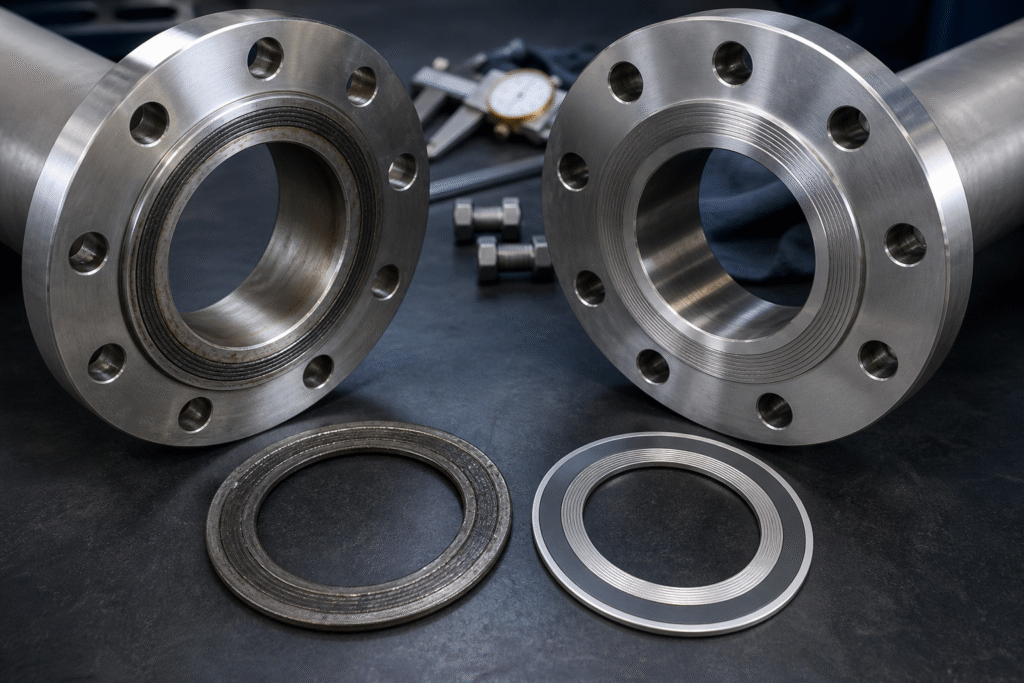
A flange gasket is part of a loaded sealing system made up of two mating flange faces, the gasket, sujetadores, lubricant and the assembly method. During tightening, bolt load compresses the gasket so it conforms to the flange finish and blocks potential leakage paths. The installed gasket is therefore no longer identical to the unused component that was originally selected.
When the joint is opened, stored elastic recovery is released but permanent deformation remains. Reinstalling the same gasket rarely recreates the original contact stress at every point around the circumference. The risk is especially important where leakage could expose personnel, release a hazardous fluid, interrupt production or damage nearby equipment.
Conclusiones clave
- A used gasket may have hidden compression loss, chemical attack or thermal damage even when its surface appears acceptable.
- The flange faces, empaquetadora, pernos, lubricant and tightening procedure must be treated as one engineered joint.
- RTJ rings, spiral-wound gaskets and many soft-cut gaskets rely on deformation that is not reliably repeatable after removal.
- A new gasket is not a substitute for cleaning, alineación, face inspection and controlled bolt loading.
Why a flange gasket changes during its first installation
Permanent compression and a joint-specific contact pattern
The gasket must be compressed enough to seat against the flange surface and maintain sealing stress during operation. Part of that deformation is elastic, but part is permanent. Serrations, waviness, local flange rotation and small alignment differences create a contact pattern unique to the assembled joint. Once removed, the gasket cannot be expected to return to its original thickness or reproduce the same pattern in a second assembly.
A second installation may also rotate or shift the gasket relative to the original imprint. High and low contact areas then occur at different locations. Applying more torque does not guarantee correction: it may overload the gasket, fasteners or flange while other areas remain below the stress needed for sealing.
Relaxation, creep and loss of recovery
Gasket stress normally decreases after tightening as the gasket relaxes and embeds into the flange finish. Soft materials can creep under sustained temperature and load. Spiral-wound constructions can lose recovery if the winding is compressed beyond its intended operating range. Metallic rings are plastically seated into matched grooves. These mechanisms are useful during first assembly, but they make an unknown used gasket a poor reference point for a controlled second assembly.
Service exposure changes material condition
Heat can harden, embrittle or oxidize some filler and facing materials. Process fluids can cause swelling, dissolution, corrosion or deposit formation. Thermal cycling and pressure cycling change load distribution, while vibration can produce fretting at the interfaces. The most important damage may be internal or microscopic and cannot be cleared by a quick visual inspection.
Reuse risk by common gasket type
| Gasket type | What happens during seating | Why reuse is unreliable | Normal maintenance approach |
|---|---|---|---|
| Spiral-wound gasket | Metal windings and filler compress while guide and inner rings control geometry | Recovery and winding condition may be reduced; local over-compression may be hidden | Install a new, correctly specified gasket after joint opening |
| RTJ metal ring | The ring plastically deforms against the matched flange grooves | The seated contact band is joint-specific and may not reseat uniformly | Use a new ring of the specified number, profile and material unless an approved procedure explicitly states otherwise |
| Compressed fiber or graphite sheet | The sheet fills flange finish and local surface variation | Thickness loss, creep, cracking or surface adhesion can remain after removal | Cut or obtain a new gasket to the required dimensions and material specification |
| PTFE-based gasket | The material flows under compression to conform to the faces | Creep and cold flow can reduce thickness and dimensional stability | Replace and verify temperature, chemical compatibility and seating stress |
| Elastomeric gasket | Elastic compression creates the seal | Compression set, swelling, hardening or cracking may reduce resilience | Replace according to the equipment and gasket manufacturer procedure |
Flange-joint reassembly checklist
1. Confirm the specification
Identify flange standard, NPS o DN, clase o PN, frente a, tipo de junta, dimensiones, filler or material, ring number where applicable, and the required standard edition.
2. Inspect both flange faces
Clean by an approved method and evaluate finish, scratches, corrosión, llanura, groove condition and remaining gasket material before assembly.
3. Check alignment and pipe strain
Do not use the bolts to force a severely misaligned joint into position. Verify the site procedure and engineering limits.
4. Inspect fasteners and lubrication
Confirm bolt and nut specification, thread condition, washer requirement, lubrication and any replacement criteria in the joint procedure.
5. Install one new gasket
Keep it clean, dry and centered. Do not stack gaskets or apply unapproved compounds to compensate for poor fit.
6. Apply controlled bolt load
Use the approved tightening method, pattern, passes, tools and target load. Record critical-joint assembly data where required.
Replacing the gasket addresses only one component. Reassembly can still leak if the wrong gasket is selected, the faces are damaged, the joint is misaligned or the target bolt load is not achieved. For a broader failure review, see our guide to the common causes of flange leakage and the explanation of gasket stress in bolted flange joints.
Primary standards and references
- ASME PCC-1 — Pressure Boundary Bolted Flange Joint Assembly: industry guidance for developing flange-joint assembly procedures, inspección, alineación, tightening and troubleshooting.
- ASME B16.20 — Metallic Gaskets for Pipe Flanges: dimensional and marking requirements for ring-joint, spiral-wound and other metallic gasket constructions within its scope.
- ASME B16.21 — Nonmetallic Flat Gaskets for Pipe Flanges: tipos, tamaños, materiales, dimensiones, tolerances and markings for nonmetallic flat gaskets.
Use the edition adopted by the purchase order, piping code and owner specification. These references do not replace the gasket manufacturer’s service limits or a site-specific joint assembly procedure.
Preguntas frecuentes
Can a flange gasket be reused if it looks undamaged?
normalmente no. Appearance does not confirm remaining thickness, recovery, chemical condition or the ability to recreate uniform seating stress. Use a new gasket unless an approved manufacturer and engineering procedure explicitly permits reuse.
¿Se puede reutilizar una junta de anillo RTJ??
RTJ rings are normally treated as single-use sealing elements because seating plastically deforms the ring against matched grooves. Check the governing project procedure and ring manufacturer requirements.
Will higher bolt torque make a reused gasket seal?
Not reliably. More torque can overload the gasket, bolts or flange and still leave low-stress areas. The correct goal is controlled bolt load with a new specified gasket and acceptable flange condition.
Should bolts also be replaced whenever a gasket is replaced?
No automáticamente. Fastener reuse depends on the bolting material, servicio, thread and corrosion condition, any yielding or damage, and the site procedure. Inspect and replace fasteners according to the governing requirements.
Guías técnicas relacionadas
Specify a complete flange joint
Send the flange standard, tamaño, clase de presión, frente a, material, tipo de junta, bolting specification, condiciones de servicio, requisitos de cantidad e inspección. SASA FLANGE can review the component description before quotation.
Posts Relacionados
Bridas ASTM B564 UNS N06625: Calificación 1 frente a grado 2
Aprenda cómo calificar ASTM B564 1 y grado 2 aplicar…
Bridas C-2000 frente a C22: Selección de materiales y comprobaciones de RFQ
Compare las identidades de los materiales de las bridas C-2000 y C22, condiciones de servicio, forja…
Bridas ASTM A182 F51 frente a F60: S31803 frente a S32205 explicados
Compare bridas dúplex ASTM A182 F51 y F60, incluido S31803/S32205…
Bridas UNS S32750 frente a S32760: ASTM A182 F53 o F55?
Compare las bridas súper dúplex S32750 y S32760, incluyendo ASTM A182…