
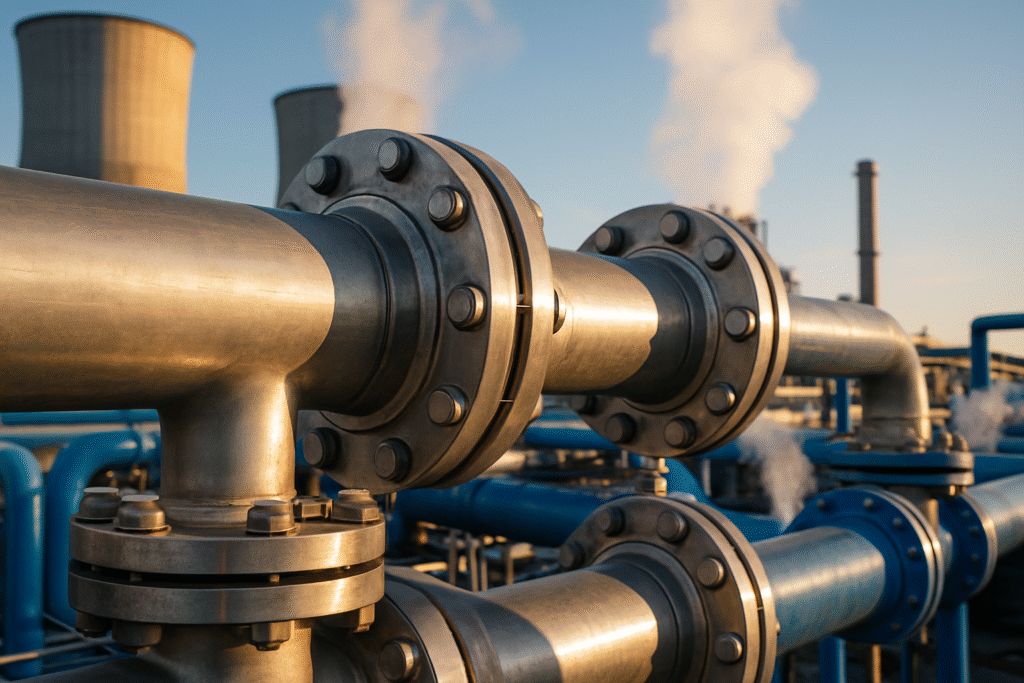
스테인레스 스틸 파이프 플랜지: 흥미로운 데이터, 숨겨진 장점, 유형, 용도 및 다양한 플랜지를 선택하는 방법
그만큼 스테인레스 스틸 파이프 플랜지 market sits at the center of industrial piping reliability, 숫자는 전략적 가치를 확인시켜줍니다.. 그랜드뷰 리서치에 따르면 (2024), 전 세계 산업용 플랜지 시장의 가치는 다음과 같습니다. $5.8 10억 2023 도달할 것으로 예상됩니다. $7.2 10억 단위로 2030.
엔지니어 및 조달 관리자용, that growth reflects one reality: stainless steel flanges remain essential where corrosion resistance, 압력 무결성, and traceable compliance matter most. 게다가, buyers now expect more than material labels, so technical selection, 선적 서류 비치, and manufacturing quality have become decisive.
스테인레스 스틸 파이프 플랜지 수요를 뒷받침하는 산업 시장 동인
Demand for stainless steel flanges continues to rise because industrial plants need durable, low-maintenance connections across aggressive service environments. IBISWorld에 따르면 (2024), 아시아 태평양 계정은 이상입니다. 45% 글로벌 플랜지 생산량의, 중국이 가장 큰 제조사이기 때문에.
That regional concentration affects lead time, 가격, and sourcing strategy for global EPC contractors and distributors. 그러므로, buyers increasingly evaluate factory capability, 수출 경험, and quality documentation alongside unit cost.
스태티스타에 따르면 (2024), 석유 및 가스 산업은 대략적으로 35% 글로벌 플랜지 소비량. This is significant because upstream, 내의 한복판, and downstream systems depend on flanged joints for inspection access, maintenance flexibility, and secure bolted sealing.
발전, 조선, 수처리, and petrochemical processing also support strong demand. 게다가, 다음과 같은 스테인레스 등급 304, 316, 316엘, 904엘, 2205, 그리고 2507 address very different chloride, 온도, and pressure profiles.
The intriguing shift in procurement is not only about volume. It is also about selecting the right flange face, 압력 등급, 단조 루트, and inspection package to reduce lifecycle cost.
As Mark Jensen, 수석 배관 엔지니어, 주: “A flange failure rarely begins at installation; it usually starts with a mismatch between alloy, 압력 등급, 깃 달기, and service chemistry.” That insight explains why engineers now compare hidden advantages across materials instead of treating all stainless options as interchangeable.
모르도르 정보국에 따르면 (2024), industrial infrastructure upgrades in energy and water sectors are sustaining steady growth in piping components globally. 뿐만 아니라, stricter maintenance planning is increasing demand for predictable, standards-compliant flange assemblies.
조달팀용, stainless steel pipe flange sourcing should therefore include more than a price check. It should cover forging quality, 가공 공차, PMI, hydrotest needs, EN 10204 3.1 인증, and packaging for export logistics.
SASA FLANGE operates in this quality-focused environment with ISO 9001:2015 및 PED 2014/68/EU 인증. 피복재 50+ 석유를 건너는 나라들 & 가스, 석유화학, 힘, 해양산업, 회사는 스테인레스 스틸 플랜지를 공급합니다, 탄소강 플랜지, 합금 플랜지, and pipe fittings with factory-direct support.
실제로, industrial buyers compare suppliers based on consistency, not only catalog breadth. 고급 CNC 가공 및 포괄적인 품질 테스트를 통해 뒷받침됨, SASA FLANGE supports project requirements from standard ASME B16.5 dimensions to custom export orders in premium alloys.
스테인레스 스틸 파이프 플랜지 유형, 재료, and Hidden Advantages in Technical Selection
The strongest buying decisions start with understanding the different flange types and the hidden advantages of each design. While the keyword focus is stainless steel pipe flange, engineers actually choose among multiple mechanical interfaces depending on pressure cycling, 유지 보수 액세스, and weld procedure qualification.
에 따르면 ASME B16.5, 플랜지 치수, 교련, 깃 달기, and pressure-temperature ratings must be standardized to ensure interchangeability (ASME, 2023). 결과적으로, design engineers can align piping classes around repeatable geometry instead of project-specific improvisation.
박사로서. 일레인 모리스, 재료 과학자, 주: “316L is often selected for corrosion resistance, but duplex grades can deliver a more compelling balance of strength and chloride resistance when stress and environment justify the upgrade.” That is a practical reminder that stainless steel flange selection should always match the actual process condition.
Common stainless materials in industrial flange manufacturing include ASTM A182 F304, F304L, F316, F316L, F904L, F51, 그리고 F53. 추가적으로, special applications may require Inconel, 모넬, 하스텔로이, or Titanium for sour service, 바닷물, 또는 부식성이 강한 매체.
- 304/304엘: Cost-effective general corrosion resistance for water, 음식, 및 가벼운 화학물질 의무.
- 316/316엘: Improved pitting resistance due to molybdenum, widely used in marine and chemical service.
- 904엘: Enhanced resistance in sulfuric and chloride-rich environments.
- 2205 듀플렉스: Higher strength than austenitic grades, often selected for offshore and desalination systems.
- 2507 슈퍼 듀플렉스: Excellent chloride stress corrosion cracking resistance for severe seawater service.
From a mechanical standpoint, the main flange types solve different installation and operating challenges. 그러므로, buyers should match the flange design to alignment tolerance, 작동 압력, and future maintenance expectations.
- 용접 목 플랜지: 고압에 가장 적합, 고온, and cyclic duty because its tapered hub reduces stress concentration.
- 슬립온 플랜지: Easier to align and generally more economical for lower-pressure service.
- 블라인드 플랜지: Used to isolate lines, terminate connections, or allow future expansion.
- 소켓 용접 플랜지: Suitable for smaller bore piping where a smooth bore and strong connection are required.
- 스레드 플랜지: 용접이 불가능한 곳에 유용, although pressure and vibration limitations must be considered.
- 랩 조인트 플랜지: Preferred when frequent dismantling or stub-end rotation is advantageous.
에 따르면 ASTM A182/A182M, forged or rolled alloy and stainless steel pipe flanges must meet defined chemical and mechanical property requirements (ASTM, 2023). This matters because chemistry control and forging integrity directly affect corrosion performance and load-bearing reliability.
압력 등급도 마찬가지로 중요합니다.. ASME 시스템에서, common ratings include Class 150, 300, 600, 900, 1500, 그리고 2500, and the final selection depends on material group and service temperature.
시장 조사 미래에 따르면 (2024), corrosion-related maintenance can account for a substantial share of plant operating costs in process industries, often ranging between 3% 그리고 5% of asset value annually. 그러므로, choosing a better-suited flange alloy can save far more than the initial material premium.
The hidden advantages of a correctly specified stainless steel pipe flange include more than corrosion resistance. Buyers also gain better weldability, lower contamination risk, longer inspection intervals, and stronger resale confidence in regulated industries.
Surface finish and facing also affect sealing performance. 제기된 얼굴, 편평한 얼굴, 링형 조인트, 혀와 그루브, and male-female facings each support different gasket systems and pressure ranges.
예를 들어, 에이 4 클래스의 인치 스테인레스 스틸 파이프 플랜지 150 for water treatment differs dramatically from a 4 인치급 600 weld neck flange for offshore hydrocarbons. Although the nominal size is identical, the metallurgy, 허브 디자인, 개스킷 선택, and bolt load requirements are not.
SASA FLANGE 플랜지를 제조합니다. 304, 316, 316엘, 904엘, 2205, 2507 그리고 다른 프리미엄 등급, plus matching elbows, 티셔츠, 감속기, 그리고 모자. 맞춤형 크기 제공 1/2 인치에서 60 경쟁력 있는 공장 직접 가격의 인치, the company supports both standard and made-to-drawing orders.
게다가, advanced CNC machining improves concentricity, 볼트 구멍 정확도, and facing finish consistency. For EPC and distributor clients, that helps reduce fit-up delays during site installation and lowers rework risk.
Procurement managers should also compare documentation scope before ordering. EN 10204 3.1 선교사 훈련원, PMI, 차원 보고서, hardness tests, 페라이트 검사, 그리고 NACE MR0175 review can be critical in oil, 가스, and sour service projects.
ASME, ASTM, DIN and EN Standards That Govern Stainless Steel Pipe Flange Compliance
Industrial buyers should never evaluate a stainless steel pipe flange without checking the governing standards first. Compliance determines interchangeability, 추적성, and legal acceptance in pressure equipment applications.
For dimensional and rating requirements, ASME B16.5 covers flanges and flanged fittings from NPS 1/2 ~을 통해 24. ASME B16.47 extends coverage for large diameter steel flanges from NPS 26 ~을 통해 60 (ASME, 2023).
재료 표준도 똑같이 중요합니다. ASTM A182 단조 또는 압연 합금 및 스테인리스강 파이프 플랜지를 정의합니다., ~하는 동안 ASTM A240 governs stainless plate, 시트, 압력 용기 및 일반 응용 분야용 스트립 (ASTM, 2023).
European and international projects often call for DIN, EN 1092, or PED-related compliance. 게다가, marine and offshore applications may require DNV, 노르웨이, or project-specific third-party inspection.
According to the European Commission PED 2014/68/EU framework, pressure equipment supplied into the EU must meet essential safety requirements and applicable conformity assessment procedures. 그러므로, documentation discipline is not optional when supplying regulated projects.
Key standards and references commonly used in procurement include:
- ASME B16.5: 치수, 공차, 압력 온도 등급, 마킹.
- ASME B16.47: Large diameter flange dimensions and drilling.
- ASME B16.9: 공장에서 제작한 단조 맞대기 용접 피팅.
- ASTM A182: Forged stainless and alloy steel flanges and fittings.
- ASTM A240: Stainless plate and sheet material specification.
- EN 1092: 유럽 플랜지 치수 및 압력 등급.
- NACE MR0175/ISO 15156: Material requirements for H2S-containing environments.
These standards do more than define dimensions. They establish the basis for pressure boundary integrity, welding compatibility, and quality assurance throughout fabrication and installation.
As David Kerr, 산업 시장 분석가, 주: “글로벌 프로젝트에서, the supplier that controls certification, 추적성, and cross-standard equivalency often wins over the supplier with the lowest nominal price.” That observation is especially true when shutdown cost or regulatory delay exceeds hardware cost.
A practical comparison helps procurement teams choose correctly:
- ASME/ANSI systems: Common in North America, 중동, and many global oil and gas projects.
- DIN/EN systems: Common in Europe and equipment exported to EU-regulated markets.
- JIS systems: Often specified in Japanese industrial projects and related supply chains.
- GOST systems: Used in certain CIS and regional industrial applications.
Buyers should also verify pressure-temperature ratings by material group rather than assuming class numbers are universal. 예를 들어, austenitic stainless grades and carbon steels do not always share identical allowable values across temperature ranges.
와 함께 ISO 9001:2015 및 PED 2014/68/EU 인증, SASA FLANGE supports projects that require documented quality systems and export-ready records. The company also offers AD 2000 지원하다, 재료 추적성, and inspection coordination for demanding international orders.
게다가, matching fittings matter when building complete systems. 팔꿈치, 티셔츠, 감속기, and caps produced to ASME B16.9 help maintain dimensional consistency across the piping assembly.
Purchasers looking for stainless steel flanges and fittings should therefore assess the full package. A compliant flange with undocumented fittings can still create project risk.
How to Choose Different Flanges for Oil, 가스, 화학적인, Power and Marine Uses
Choosing the right stainless steel pipe flange requires a service-based approach. Engineers should begin with media composition, 작동 압력, 설계 온도, 부식 허용량, and the applicable piping code.
석유 및 가스 분야, 316L의 용접 넥 플랜지, 듀플렉스 2205, 또는 슈퍼 듀플렉스 2507 are common where chlorides, 압력 사이클링, or offshore exposure exist. 스태티스타에 따르면 (2024), 석유와 가스는 약 35% 글로벌 플랜지 소비량, so reliability expectations in this sector strongly influence overall market standards.
Chemical processing often requires more careful alloy selection than mechanical design alone. 그러므로, buyers may move from 304L to 316L, 904엘, 하스텔로이, or other corrosion-resistant materials depending on acid concentration and temperature.
Power generation applications prioritize pressure integrity and long-term thermal stability. 따라서, high-pressure lines often specify weld neck or socket weld designs with rigorous NDE and documentation controls.
Marine and shipbuilding projects need resistance to salt spray, 바닷물, and galvanic concerns. 이러한 경우, 316엘, 2205, 그리고 2507 frequently offer better lifecycle value than basic austenitic grades.
Water treatment and desalination systems also drive demand for stainless and duplex materials. According to ISO-related industry studies cited by market analysts, lifecycle corrosion performance is increasingly prioritized over lowest first cost in municipal and industrial water projects.
플랜지를 선택할 때, engineers should review these factors:
- Material grade and corrosion resistance in actual process media.
- Nominal size and schedule compatibility with connected pipe.
- Pressure class and pressure-temperature rating.
- 직면 유형 및 개스킷 호환성.
- Welding procedure and installation constraints.
- 점검, 테스트, 및 인증 요구 사항.
- Standard system, such as ASME, DIN, JIS, 또는 EN.
- 리드타임, 포장, and destination-country compliance.
에이 2 inch stainless steel flange for sale in a distributor catalog may look equivalent to another part number, yet practical suitability can differ significantly. The better choice depends on metallurgy, 압력 등급, 깃 달기, and certificate package rather than size alone.
Pricing also varies by alloy and processing route. Stainless steel pipe flange price is influenced by nickel and molybdenum content, forging cost, 가공 복잡성, 수량, 압력 등급, 테스트 범위, and export packaging.
예를 들어, a stainless steel threaded pipe flange may reduce field welding cost in low-pressure utility service. 하지만, an API-oriented hydrocarbon line will often favor a weld neck flange because it offers better fatigue resistance and structural continuity.
Custom manufacturing can be essential when standard stock does not fit project conditions. SASA FLANGE supports custom drilling, 비표준 두께, 특별한 외장, and machining for project-specific assemblies used in oil and gas, 석유화학, 발전, 해양 부문.
That flexibility is important for EPC contractors handling mixed-standard projects. 게다가, integrated supply of flanges and fittings can simplify vendor qualification and reduce coordination risk during shutdowns or new plant construction.
Procurement professionals should request drawings, MTC samples, previous export references, and inspection plans before placing large orders. This approach improves comparison accuracy and reduces the chance of hidden total-cost issues after award.
미래 전망, Buying Recommendations and Strategic Sourcing for Stainless Steel Pipe Flange Projects
The outlook for stainless steel pipe flange demand remains positive because industrial capital expenditure continues in energy, 약, 물, 인프라. 그랜드뷰 리서치에 따르면 (2024), 시장은 다음과 같이 성장할 것으로 예상됩니다. $5.8 10억 2023 에게 $7.2 10억 단위로 2030.
This expansion will likely favor manufacturers that combine alloy range, documentation control, and export responsiveness. 대조적으로, suppliers competing only on basic price may struggle in projects requiring PED, 광고 2000, or higher-level traceability.
IBISWorld에 따르면 (2024), 중국은 아시아 태평양 지역에서 가장 큰 제조 기지로 남아 있습니다., which produces over 45% 글로벌 플랜지의. 결과적으로, strategic buyers are increasingly developing direct factory relationships to improve cost transparency and lead-time control.
Digital procurement is also changing how buyers evaluate suppliers. Technical datasheets, MTC previews, inspection photos, and fast quotation response now influence vendor selection almost as much as catalog breadth.
The intriguing advantage for modern sourcing teams is that better information enables better standardization. 그러므로, buyers can reduce SKU complexity by aligning flange types, 재료, and fitting combinations across multiple projects.
Recommended sourcing actions include:
- Standardize core materials such as 304L, 316엘, 2205, 그리고 2507 서비스 카테고리별.
- ASME 공급업체 사전 자격 획득, ASTM, EN, and PED documentation needs.
- Request clear pricing separation for material, 가공, 테스트, 그리고 포장.
- Confirm dimensional tolerances and facing finish before order release.
- Bundle flanges and fittings where possible to simplify quality control.
For procurement managers comparing flange manufacturers, the best partner is usually the one that can explain why a given flange should be chosen, not only what it costs. That is especially true for different applications where corrosion, 피로, and compliance interact.
For projects requiring standard or custom stainless steel pipe flange supply, SASA FLANGE offers technical support, broad material coverage, and export-oriented manufacturing coordination. That combination helps buyers move from quote collection to specification confidence with fewer delays.
자주 묻는 질문
스테인레스 스틸 플랜지는 무엇에 사용됩니까??
●A stainless steel flange is used to connect pipes, 밸브, 슬리퍼, and pressure equipment in systems that require a detachable, sealed joint.
●스태티스타에 따르면 (2024), 석유 및 가스 산업은 대략적으로 35% 글로벌 플랜지 소비량, which shows how important flanged connections are in high-value industrial service.
●실제로, stainless steel flanges are chosen for corrosion resistance, 위생, 기계적 강도, and easier maintenance compared with permanent welded-only systems.
●Common uses include petrochemical lines, 수처리 스키드, marine pipework, food processing systems, and power plant utility piping.
●For projects requiring reliable material traceability and standards compliance, 다음과 같은 기존 제조업체와 협력 SASA FLANGE helps ensure the right alloy, 압력 등급, 및 인증 패키지.
그들은 스테인레스 스틸 파이프 피팅을 만드나요??
●예, 제조업체는 엘보우와 같은 스테인레스 스틸 파이프 피팅을 생산합니다., 티셔츠, 감속기, and caps to match stainless piping and flange systems.
●ASME B16.9 공장에서 제작한 단조 맞대기 용접 피팅의 핵심 표준입니다., while ASTM material standards define chemistry and mechanical properties for stainless grades.
●These fittings are widely supplied in 304, 316, 316엘, 904엘, 2205, 그리고 2507 depending on corrosion severity, 압력, and end-use industry.
●Using matched stainless steel flanges and fittings improves welding compatibility, 차원 일관성, and long-term corrosion performance.
●For integrated sourcing, buyers often prefer one supplier for both flanges and fittings so inspection records and material traceability remain aligned.
스테인레스 스틸 플랜지의 표준은 무엇입니까?
●The most common standards for stainless steel flanges are ASME B16.5, ASME B16.47, ASTM A182, DIN, 그리고 EN 1092, depending on the project region and code basis.
●ASME B16.5 covers dimensions, 교련, 외장, and pressure-temperature ratings for NPS 1/2 에게 24, ~하는 동안 ASTM A182 covers forged stainless material requirements.
●European projects may require EN 1092 and PED 2014/68/EU compliance, especially when equipment enters regulated EU pressure equipment markets.
●Buyers should confirm not only the flange standard but also inspection documents such as EN 10204 3.1 MTCs and any NACE MR0175 requirement for sour service.
●중요한 애플리케이션용, asking suppliers to clarify standard equivalency before purchase can prevent costly installation and approval issues.
What is the strongest type of piping flange?
●The weld neck flange is generally considered the strongest common piping flange for high-pressure, 고온, and cyclic service.
●Its tapered hub and butt-weld connection distribute stress more effectively than slip-on or threaded designs, which improves fatigue resistance in demanding systems.
●According to ASME design practice, weld neck flanges are widely preferred in refinery, 난바다 쪽으로 부는, and power applications where pressure integrity is critical.
●하지만, the strongest practical choice still depends on the full design basis, including alloy grade, 압력 등급, 직면 유형, 개스킷 시스템, and bolt load.
●Engineers should evaluate service conditions carefully before selecting a flange, because an oversized or poorly matched design can still underperform in operation.
How do buyers choose between 304, 316엘, 2205, 그리고 2507 스테인레스 스틸 플랜지?
●Buyers usually choose 304 for general corrosion service, 316L for better chloride resistance, 2205 for higher strength and good chloride performance, 그리고 2507 for severe seawater or offshore duty.
●박사로서. 일레인 모리스, 재료 과학자, 설명하다, duplex grades can provide a better strength-to-corrosion balance than standard austenitic grades when service conditions justify the upgrade.
●Material cost rises as alloy complexity increases, but lifecycle savings can offset the premium when corrosion failure or shutdown risk is high.
●시장 조사 미래에 따르면 (2024), corrosion-related maintenance can consume 3% 에게 5% of asset value annually in process industries, so alloy optimization matters financially.
●Procurement teams should review chloride content, 온도, 압력, 용접 방법, and required documentation before finalizing grade selection.
What factors affect stainless steel pipe flange price and lead time?
●Stainless steel pipe flange price and lead time depend on alloy grade, 크기, 압력 등급, 단조 가용성, 가공 복잡성, 테스트 범위, 및 주문 수량.
●예를 들어, a standard 2 인치급 150 304 flange is typically faster and less expensive than a custom 2507 weld neck flange with PMI, 제3자 검사, and PED documentation.
●IBISWorld에 따르면 (2024), 아시아 태평양 지역은 45% 글로벌 플랜지의, which means sourcing strategy and factory access can strongly influence delivery schedules and landed cost.
●Additional factors include raw material volatility, export packaging requirements, 특별한 외장, and whether matching fittings are ordered together.
●For time-sensitive projects, requesting a detailed quotation with separate line items for material, 가공, 테스트, and shipment provides the clearest basis for comparison.
관련 게시물

오리피스 플랜지 정의, 세부 정보 및 ASME B16.36 플랜지 개요: 시장 데이터, 선택 가이드 및 규정 준수 통찰력
전 세계 산업용 플랜지 시장의 가치는 다음과 같습니다. $5.8 10억…
