
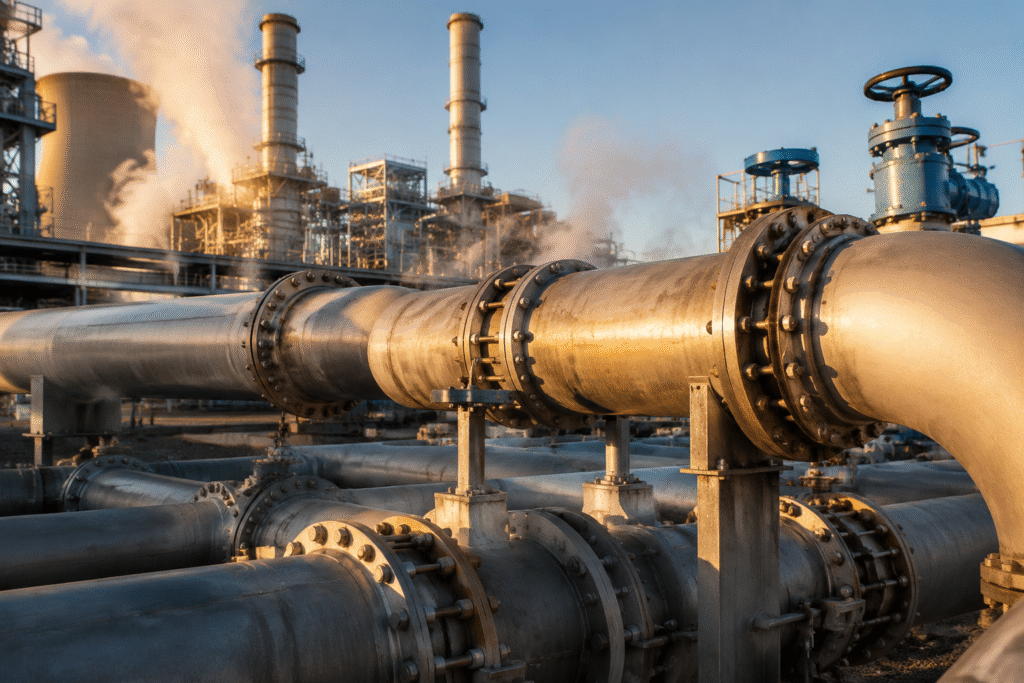
압력과 부식 위험을 고려한 스테인레스 스틸 플랜지 선택
산업 프로젝트가 내식성을 우선시함에 따라 스테인레스 스틸 파이프 플랜지 수요가 계속 증가하고 있습니다., 압력 무결성, 및 수명주기 가치. 그랜드뷰 리서치에 따르면 (2024), 전 세계 산업용 플랜지 시장의 가치는 다음과 같습니다. $5.8 10억 2023 도달할 것으로 예상됩니다. $7.2 10억 단위로 2030.
엔지니어 및 조달 팀용, 성장은 실제 현실을 반영한다. 스테인레스, 강철, and alloy Flanges remain critical in Oil & 가스, 석유화학, 힘, 선박, and water treatment systems where leakage risk, 중단 시간, and compliance costs are high.
Industrial Market Context for Stainless Steel Pipe Flange Procurement
The market for industrial flanges is expanding because process plants are upgrading aging piping infrastructure and specifying higher-performance materials. IBISWorld에 따르면 (2024), 아시아 태평양 계정은 이상입니다. 45% 글로벌 플랜지 생산량의, 중국이 가장 큰 제조사이기 때문에.
That regional manufacturing strength matters for buyers who need volume, 추적성, 그리고 짧은 리드타임. It also explains why global sourcing teams increasingly evaluate Chinese suppliers with strong machining, 점검, and export documentation capabilities.
End-use demand remains concentrated in heavy industry. 스태티스타에 따르면 (2024), 석유 및 가스 산업은 대략적으로 35% 글로벌 플랜지 소비량, making pressure-rated connections a core procurement category.
게다가, flange purchasing decisions are becoming more technical. Buyers now compare not only price, but also ASTM grade, ASME pressure class, EN compliance, MTC availability, 부식 허용량, 및 총 설치 비용.
For stainless steel pipe flange applications, 304, 316, 316엘, 904엘, 2205, 그리고 2507 are frequently specified because they balance corrosion resistance and mechanical performance. In chloride service, 하지만, engineers often move from standard austenitic grades toward duplex or super duplex to reduce pitting risk.
모르도르 정보국에 따르면 (2024), industrial process modernization and energy infrastructure investment are accelerating demand for higher-integrity piping components worldwide. 결과적으로, standard catalog items are no longer enough for many EPC and MRO buyers.
They increasingly require custom bores, 비표준 드릴링, 특수 외장 마감, and project-specific packaging. 그러므로, manufacturer capability has become nearly as important as material grade.
SASA FLANGE 이 환경에서 작동 ISO 9001:2015 및 PED 2014/68/EU 인증, serving customers across Oil & 가스, 석유화학, 힘, 해양산업. 고급 CNC 가공 및 포괄적인 품질 테스트를 통해 뒷받침됨, 회사는 스테인레스 스틸 플랜지를 공급합니다, 탄소강 플랜지, 합금 플랜지, and pipe fittings in materials from 304 and 316L to 904L, 2205, 2507, 인코넬, 모넬, 하스텔로이, 그리고 티타늄.
In practical sourcing terms, this matters because flange reliability depends on manufacturing precision. 얼굴 높이를 높였습니다., bore tolerance, bolt hole alignment, serration finish, and heat traceability all affect fit-up and sealing performance.
ISO에 부합하는 품질 관리 원칙에 따름, process consistency reduces rework, inspection disputes, and field installation delays (ISO, 2024). 뿐만 아니라, third-party documentation such as EN 10204 3.1 certification is often mandatory for regulated and export-driven projects.
Procurement teams should also look beyond the basic question of Flanges? Types and Uses are only part of the evaluation. The Hidden Advantages often come from quality systems, metallurgy control, and the ability to support ASME B16.5, ASME B16.47, DIN, JIS, 고스트, 그리고 EN 1092 dimensional requirements from one factory source.
스테인레스 스틸 파이프 플랜지 유형, 숨겨진 장점, 및 전문가 선택 통찰력
There are many stainless steel pipe flange Types, yet the correct selection always depends on pressure class, 중간, 온도, 순환 부하, 유지관리 전략. 결과적으로, choosing between weld neck, 미끄러지다, 눈이 먼, 스레드, 랩 조인트, and socket weld Flange designs should be driven by engineering data rather than habit.
As John Breslin, 수석 배관 엔지니어, 주: “A flange is not a commodity when service conditions become aggressive; 마무리를 향함, 야금, and dimensional accuracy directly affect leak-free performance.” That view aligns with field experience in refineries, LNG 터미널, 및 해양 플랫폼.
에 따르면 ASME B16.5, dimensional standardization for NPS 1/2 ~을 통해 24 supports interchangeability and consistent sealing performance across manufacturers (ASME, 2024). 더 큰 직경의 경우, ASME B16.47 NPS를 커버 26 ~을 통해 60 and becomes essential in transmission, 저장, and water infrastructure projects (ASME, 2024).
그러므로, specifying the right standard is the first step. The second is matching the flange design to fabrication and service conditions.
- 용접 목 플랜지: 고압에 가장 적합, 고온, 테이퍼형 허브가 응력 분산을 개선하므로 순환 서비스.
- 슬립온 플랜지: Cost-effective and easy to align, especially for low to moderate pressure systems and fabrication-friendly projects.
- 블라인드 플랜지: Used to isolate lines, terminate piping systems, and support future expansion points.
- 스레드 플랜지: 용접이 제한된 곳에 유용, although it is generally limited to lower pressure and non-severe service.
- 소켓 용접 플랜지: Common in small-bore, high-pressure lines where a smooth bore and strong joint are needed.
- 랩 조인트 플랜지: Preferred for systems requiring frequent dismantling and where corrosion-resistant stub ends optimize cost.
재료 선택도 마찬가지로 중요합니다. ASTM A182 is the primary forged fitting and flange specification for many stainless and alloy grades, ~하는 동안 ASTM A240 is relevant when plate products are used in associated fabrication and clad systems (ASTM, 2024).
Among austenitic grades, 304 and 304L remain versatile and economical. 하지만, 316 and 316L offer better resistance in chloride-bearing environments because molybdenum improves pitting and crevice corrosion resistance.
시장 조사 미래에 따르면 (2024), corrosion-resistant alloys are seeing above-average demand growth in process industries due to stricter reliability and maintenance targets. 게다가, operators are increasingly calculating total lifecycle cost rather than just purchase price.
That shift explains the growing use of duplex grades such as 2205 그리고 2507. These materials offer higher strength than standard 300-series stainless grades, which can support thinner wall design or improved safety margins in demanding service.
박사로서. Elena Markovic, 재료 과학자, 주: “The best flange selection balances corrosion mode, 작동 온도, and inspection philosophy, not just alloy prestige.” Her point is especially relevant in offshore, 신맛이 나는 서비스, 및 담수화 애플리케이션.
For engineers comparing common stainless grades, the following matrix provides a practical overview.
- 304/304엘: General industrial use, 좋은 용접성, suitable for water treatment, food-grade utilities, 그리고 온화한 화학 서비스.
- 316/316엘: 더 나은 염화물 저항성, preferred in marine, 화학적인, and coastal environments.
- 904엘: Strong resistance in acidic and chloride-rich service, often specified for aggressive chemical processing.
- 2205 듀플렉스: Higher strength and strong chloride stress corrosion cracking resistance for offshore and process duty.
- 2507 슈퍼 듀플렉스: Premium performance in high-chloride and seawater systems with severe corrosion exposure.
According to NACE guidance for corrosion control, material mismatch in bolted flange joints can accelerate localized failure under aggressive conditions (NACE, 2024). 따라서, 플랜지, 틈 메우는 물건, 탈당, and pipe material should be reviewed as one system.
Dimensional details also affect how buyers Choose correctly. Face type, RF와 같은, RTJ, and FF, must match the gasket design and service class.
예를 들어, ring type joint Flanges are common in high-pressure hydrocarbon duty because the metal-to-metal groove geometry supports reliable sealing. 대조적으로, flat face connections are often used with cast iron or low-bolt-load equipment nozzles.
SASA FLANGE 1/2부터 사용자 정의 크기 제공" 60까지" with competitive factory-direct pricing and supports ANSI B16.5, ANSI B16.47, ASME B16.9, DIN, JIS, 고스트, 그리고 EN 1092 요구 사항. 추가적으로, the company can manufacture elbows, 티셔츠, 감속기, and caps in matching grades, which simplifies package procurement for complete Pipe systems.
For large projects, supplier integration reduces administration and inspection complexity. Instead of managing multiple vendors for Flange and fitting packages, EPC teams can centralize material certificates, PMI 기록, 및 치수 보고서.
This approach also lowers the risk of cross-supplier tolerance mismatch. 그러므로, it can improve site productivity during spool assembly and turnaround work.
ASME B16.5, B16.47, ASTM, DIN, and EN Compliance for Stainless Steel Flange Supply
Standards compliance is not a paperwork issue alone. It is the framework that ensures a stainless steel pipe flange will fit, 밀봉하다, 그리고 안전하게 서비스를 수행하세요.
ASME B16.5 NPS의 파이프 플랜지 및 플랜지 피팅을 포함합니다. 1/2 에게 24. ASME B16.47 applies to larger diameters from NPS 26 에게 60, and it is divided into Series A and Series B with different bolt patterns and masses (ASME, 2024).
ASTM material standards define chemistry and mechanical properties. For forged stainless flanges, ASTM A182 is a key specification, while corresponding pipe and plate standards must be checked for system compatibility (ASTM, 2024).
유럽 프로젝트에는 EN이 필요한 경우가 많습니다. 1092 dimensions and PED compliance. 게다가, petrochemical and offshore buyers may ask for NACE MR0175 검토, DNV-related documentation, or customer-specific QA plans depending on media and jurisdiction.
- ASME B16.5: Standard for flanges up to NPS 24, widely used in refinery, 석유화학, 및 전력 프로젝트.
- ASME B16.47: Standard for large-diameter flanges from NPS 26 에게 60 for transmission and infrastructure systems.
- ASTM A182: Material specification for forged or rolled alloy and stainless steel pipe flanges and forged fittings.
- EN 1092: European flange dimensional standard widely used in EU and export projects.
- NACE MR0175: Corrosion-related material guidance for sour service environments.
- PED 2014/68/EU: 유럽 시장의 압력 장비에 대한 규제 프레임워크.
Buyers should also request the right inspection and documentation package. Typical requirements include MTC EN 10204 3.1, PMI, hardness testing where applicable, 치수검사, hydrostatic or pneumatic test evidence at system level, and marking traceability.
According to DNV-oriented supply chain practice, traceability and certification quality strongly influence approval speed for critical industrial components (DNV, 2024). 결과적으로, well-documented flange manufacturers often reduce project bottlenecks more effectively than low-price suppliers with weak paperwork control.
There is also an important distinction between dimensional compliance and actual quality execution. A flange may technically match ASME B16.5 치수, yet poor forging quality, 표면 마무리, or heat traceability can still create installation and audit problems.
그런 이유로, procurement specifications should define more than standard numbers. They should state material grade, 수업 평가, 직면 유형, 테스트 범위, coating or passivation needs, packaging requirements, and certificate expectations.
와 함께 ISO 9001:2015, PED 2014/68/EU, 그리고 광고 2000 인증, SASA FLANGE supports quality-driven procurement for export and regulated markets. The company also manufactures flanges in 304, 316, 904엘, 2205, 2507 그리고 다른 프리미엄 등급, 고급 CNC 가공 및 포괄적인 품질 테스트를 통해 뒷받침됨.
From a compliance perspective, that matters in audits and bid evaluations. Engineers can compare suppliers more clearly when the manufacturer provides dimensional reports, 열 숫자, raw material traceability, and standard-specific conformity records.
게다가, mixed-standard projects require careful coordination. A system may combine ASME piping classes with EN equipment interfaces, so bolt circles, face forms, and pressure nomenclature must be reviewed line by line.
그러므로, experienced flange manufacturers provide technical clarification before production begins. That early review prevents expensive remake costs and avoids site-fit disputes later in the project.
신청안내: 산업별 스테인레스 스틸 파이프 플랜지를 선택하는 방법, 압력, and Corrosion Risk
The best way to Choose a stainless steel pipe flange is to start with actual service conditions. 중간, 온도, 압력 등급, 염화물 함량, inspection interval, and shutdown cost should all shape the final decision.
기름에 & 가스, flange failure can create severe production losses. 그러므로, weld neck and RTJ Flanges in ASTM A182 F316/F316L, 듀플렉스 2205, 또는 슈퍼 듀플렉스 2507 are common in corrosive and high-pressure applications.
스태티스타에 따르면 (2024), 석유 및 가스 부문은 35% 글로벌 플랜지 소비량. That scale explains why this sector often drives higher standards for documentation, 신맛 서비스 리뷰, 및 치수 일관성.
석유화학 및 화학공장에서, corrosion mechanism usually governs material choice. 산, 염화물, and elevated temperatures may justify 316L, 904엘, 하스텔로이, or Monel depending on concentration and process upset risk.
Power generation projects often emphasize pressure class, 열 순환, and outage reliability. 결과적으로, weld neck and socket weld connections are frequently selected for steam, 응축수, and auxiliary high-pressure lines.
Marine and shipbuilding environments add external chloride exposure to the challenge. 따라서, 316L is often the baseline, while duplex grades become attractive for seawater, 안정기, 및 해양 유틸리티 시스템.
Water treatment and desalination projects require careful balancing of budget and corrosion performance. For less aggressive service, 304L may be acceptable, but 316L, 2205, 또는 2507 are often preferred where chloride levels are high.
- Media compatibility: Check chlorides, 황 화합물, acidity, 고체, 그리고 청소용 화학물질.
- 작동 온도: Confirm whether the grade is suitable for sustained elevated temperature service.
- 압력 등급: Match Class 150, 300, 600, 900, 1500, 또는 2500 to design conditions and code basis.
- 플랜지형: Choose weld neck, 미끄러지다, 눈이 먼, 스레드, 소켓 용접, or lap joint based on fabrication and stress profile.
- Facing style: RF 확인, RTJ, or FF compatibility with the gasket and mating equipment.
- 검사범위: Define MTC 3.1, PMI, 임사체험, 페라이트, 경도, or third-party witness needs.
- Project logistics: Review MOQ, 리드타임, 포장, 마킹, 및 수출 문서.
According to API-oriented project procurement practices, standardization of component classes reduces inventory complexity and maintenance downtime (API, 2024). 하지만, over-standardization can be costly if the material grade is excessive for the real service environment.
That is why experienced engineering review is essential. A lower initial price can become more expensive if corrosion, 누출, or replacement frequency increases over time.
SASA FLANGE supports custom manufacturing for industrial buyers needing non-standard sizes, 특수 드릴링, large-diameter dimensions, or matching fittings in one package. 피복재 50+ 석유를 건너는 나라들 & 가스, 석유화학, 힘, 해양산업, the company can help procurement teams align technical requirements with practical delivery schedules.
예를 들어, a marine contractor may need 4 inch stainless steel pipe flange items in 316L with EN 1092 교련, while an EPC contractor may require ASME B16.5 수업 300 용접 목 플랜지 2205 ~와 함께 EN 10204 3.1 인증서. These are very different applications, even when the word Stainless appears in both RFQs.
비슷하게, buyers searching for stainless steel flange 2 인치, stainless steel pipe flange sizes, or Stainless Steel Threaded Pipe Flange options should verify more than nominal size. Bore schedule, 얼굴형, 압력 등급, and welding procedure compatibility all affect suitability.
Future Outlook for Stainless Steel Pipe Flange Supply and Strategic Sourcing Recommendations
The outlook for stainless steel pipe flange sourcing remains positive because industrial decarbonization, LNG expansion, water treatment investment, and asset replacement all support long-term demand. 그랜드뷰 리서치에 따르면 (2024), 산업용 플랜지 시장은 다음과 같이 성장할 것으로 예상됩니다. $7.2 10억 단위로 2030.
동시에, sourcing expectations are becoming stricter. Buyers increasingly want digital documentation, heat-level traceability, faster inspection turnaround, and integrated supply of flanges plus fittings.
IBISWorld에 따르면 (2024), Asia-Pacific continues to dominate flange production, which gives global buyers access to scale and competitive pricing. 하지만, procurement success will depend on selecting qualified manufacturers rather than chasing the lowest quote.
그러므로, strategic buyers should build supplier scorecards around five factors. These are standards compliance, 물질적 폭, 문서 품질, 가공 정밀도, and on-time delivery performance.
It is also wise to segment purchases by criticality. Standard utility Flanges can often be sourced on price efficiency, while offshore, 신맛이 나는 서비스, and high-temperature items should be sourced on technical reliability and certification strength.
As industrial specifications become more demanding, manufacturers that combine ASME, ASTM, DIN, EN, and PED familiarity will gain an advantage. That is especially true for projects spanning multiple geographies and end-user approval systems.
For procurement managers evaluating long-term partners, the Hidden Advantages usually appear in execution. These include responsive engineering support, project-level customization, consistent markings, and complete quality dossiers.
Companies seeking a dependable supplier for stainless steel pipe flange, 합금 플랜지, and matching fittings can review capabilities through SASA FLANGE. For projects that require certified materials, 맞춤 측정기준, 및 수출 준비 문서, early technical engagement typically shortens procurement cycles and reduces total project risk.
자주 묻는 질문
다양한 유형의 스테인레스 스틸 플랜지는 무엇입니까?
●주요 스테인레스 스틸 플랜지 유형은 용접 넥입니다., 미끄러지다, 눈이 먼, 스레드, 소켓 용접, 그리고 랩 조인트, ~와 함께 ASME B16.5 covering most sizes from NPS 1/2 에게 24 (ASME, 2024).
●Each type serves a different function because stress distribution, 용접 방법, 유지 보수 액세스, and sealing performance vary by design.
●For projects requiring accurate type selection and full certification, 다음과 같은 기존 제조업체와 협력 SASA FLANGE helps ensure the flange matches pressure class, 얼굴형, 및 재료 등급.
어느 것이 더 낫습니까? 304 또는 420 스테인레스 스틸?
●대부분의 스테인레스 스틸 파이프 플랜지 적용 분야에 적합, 304 일반적으로 다음보다 낫습니다. 420 because it offers stronger corrosion resistance and easier weldability in industrial piping service.
●등급 420 is a martensitic stainless steel used more often where hardness and wear resistance matter, but it is less suitable for corrosive process piping and standard flange fabrication.
●When engineers need flange materials for water, 화학적인, 선박, or general industrial duty, 304 또는 316 grades are usually the safer and more common choice under ASTM A182 supply practice.
세 가지 유형의 플랜지는 무엇입니까?
●기본 산업 논의에서 가장 일반적으로 언급되는 세 가지 플랜지 유형은 용접 넥입니다., 미끄러지다, and blind flanges because they cover many connection, 집회, 그리고 격리 요구.
●Weld neck flanges are preferred for higher pressure and cyclic duty, slip on flanges simplify fabrication for moderate service, and blind flanges close the end of a line or nozzle.
●If the service includes elevated pressure, 염화물, or strict code review, buyers should request a technical recommendation based on ASME B16.5 수업, 직면 유형, and ASTM grade.
스테인레스 스틸 플랜지에 대한 ASME 코드는 무엇입니까?
●The primary ASME standards for stainless steel flanges are ASME B16.5 NPS용 1/2 에게 24 그리고 ASME B16.47 NPS용 26 에게 60, ~하는 동안 ASTM A182 일반적으로 단조 스테인리스 소재를 관리합니다. (ASME, 2024; ASTM, 2024).
●이러한 표준은 치수를 정의합니다., 교련, 압력 온도 등급, 공차, and material reference frameworks that support interchangeability and safe installation.
●수출 또는 규제 대상 프로젝트의 경우, buyers should also confirm related EN 1092, PED 2014/68/EU, 그리고 EN 10204 3.1 documentation requirements before placing the order.
스테인레스 스틸 파이프 플랜지 가격에 영향을 미치는 것은 무엇입니까??
●스테인레스 스틸 파이프 플랜지 가격은 주로 합금 등급에 영향을 받습니다., 크기, 압력 등급, 플랜지형, 가공 복잡성, 검사 범위, 및 주문량, while volatile nickel and molybdenum costs can significantly change 316L and higher-alloy pricing.
●그랜드뷰 리서치에 따르면 (2024), continued market growth and industrial demand are keeping corrosion-resistant flange categories strategically important across global supply chains.
●견적을 정확하게 비교하려면, procurement teams should review whether the price includes MTC 3.1, PMI, 마무리를 향함, 수출 포장, and any third-party inspection requirements.
How do I choose a flange manufacturer or flange vendor for industrial projects?
●A strong flange manufacturer should demonstrate ASME and ASTM familiarity, ISO 9001:2015 품질 관리, 재료 추적성, 가공 정밀도, and documented export experience for Oil & 가스, 힘, 선박, or Water Treatment projects.
●IBISWorld에 따르면 (2024), 아시아 태평양 지역은 45% 글로벌 플랜지의, so supplier evaluation should focus on capability and compliance rather than geography alone.
●For buyers needing custom sizes, premium grades like 2205 또는 2507, and complete documentation packages, 연락하다 SASA FLANGE 실용적인 다음 단계입니다.
관련 게시물

오리피스 플랜지 정의, 세부 정보 및 ASME B16.36 플랜지 개요: 시장 데이터, 선택 가이드 및 규정 준수 통찰력
전 세계 산업용 플랜지 시장의 가치는 다음과 같습니다. $5.8 10억…
