
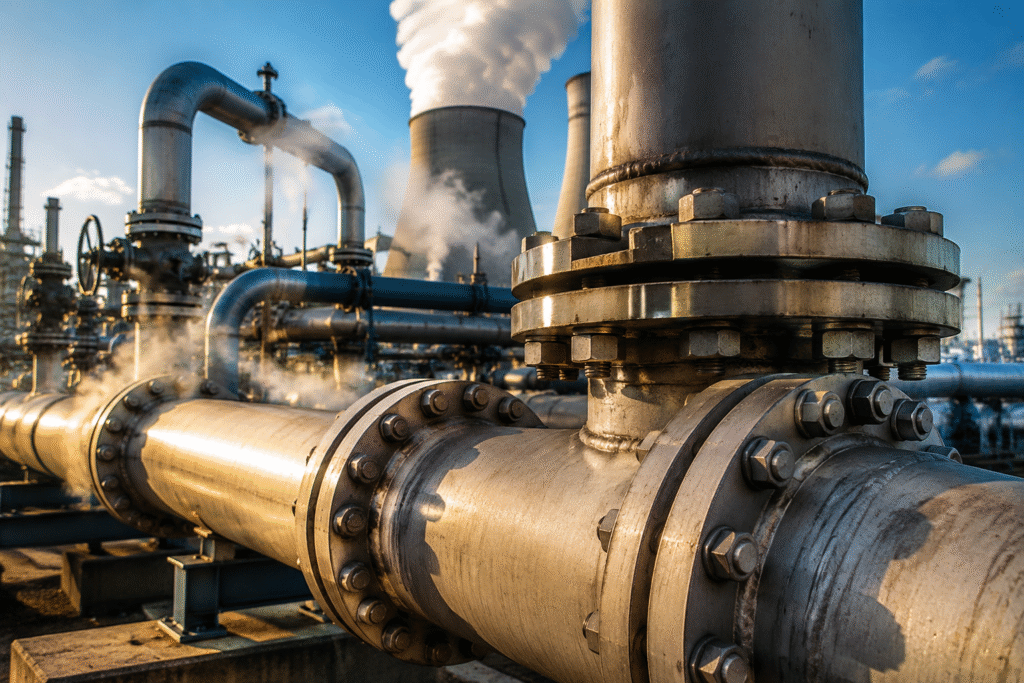
스테인레스 스틸 파이프 플랜지 시장 가이드: 7.2 10억 전망, 유형, 용도, 및 선택 방법
그랜드뷰 리서치에 따르면 (2024), 전 세계 산업용 플랜지 시장의 가치는 다음과 같습니다. $5.8 10억 2023 도달할 것으로 예상됩니다. $7.2 10억 단위로 2030. 이러한 성장으로 인해 EPC 계약업체는 스테인레스 스틸 파이프 플랜지 소싱을 더욱 전략적으로 활용할 수 있게 되었습니다., OEM, and industrial procurement teams.
Buyers today need more than a catalog. They need verified standards, clear material guidance, and a supplier that understands pressure classes, 부식 메커니즘, 및 문서 요구 사항.
Why the stainless steel pipe flange market is expanding across industrial sectors
The flange market is growing because process industries continue to invest in resilient piping systems. 스태티스타에 따르면 (2024), 석유 및 가스 산업은 대략적으로 35% 글로벌 플랜지 소비량.
That demand is not limited to upstream projects. 석유화학 플랜트, 발전소, 담수화 시스템, marine vessels, and water treatment facilities all rely on stainless steel pipe flange assemblies for leak-tight, serviceable connections.
Regional supply dynamics also matter. IBISWorld에 따르면 (2024), 아시아 태평양 계정은 이상입니다. 45% 글로벌 플랜지 생산량의, 중국이 가장 큰 제조사이기 때문에.
그러므로, global buyers increasingly evaluate Chinese manufacturers on quality systems, 추적성, and export execution rather than price alone. This shift benefits suppliers with certified production and stable material control.
조달 관리자용, stainless steel remains attractive because it balances corrosion resistance, 기계적 강도, fabrication efficiency, 그리고 긴 서비스 기간. In many media, the total installed cost is lower than repeated replacement of coated carbon steel components.
재료공학 박사로서. Helen Zhou, Corrosion Specialist, 주: “In chloride-bearing and cyclic-temperature service, flange selection errors often begin with underestimating localized corrosion, not pressure rating.” Her point is critical for engineers choosing between 304, 316엘, or duplex grades.
Standards also shape market demand. ASME B16.5 그리고 ASME B16.47 define key dimensional requirements for pipe flanges, ~하는 동안 ASTM A182 governs forged stainless and alloy steel flanges for high-temperature service (ASME, 2023; ASTM, 2024).
European and international projects frequently specify EN 1092-1, DIN, 소아과, 그리고 EN 10204 3.1 검사 문서. 따라서, cross-standard fluency is now a competitive requirement, especially for export-driven projects.
SASA FLANGE supports this need with ISO 9001:2015 and PED 2014/68/EU aligned manufacturing practices. 고급 CNC 가공 및 포괄적인 품질 테스트를 통해 뒷받침됨, 회사는 스테인레스 스틸 플랜지를 공급합니다, 탄소강 플랜지, 합금 플랜지, 오일용 및 파이프 피팅 & 가스, 석유화학, 힘, 선박, 수처리, 및 건설 부문.
Buyers comparing global sources should also look beyond basic grade listings. They should assess heat number traceability, PMI 가용성, 치수검사, hydrostatic or NDT coordination, and the ability to issue EN 10204 3.1 재료 인증서.
실제로, a flange is not just a component. It is a pressure boundary, a maintenance access point, and often a compliance checkpoint during project inspection.
For teams evaluating qualified supply partners, SASA FLANGE presents a useful benchmark with export experience, broad material coverage, and custom manufacturing capability. That combination matters when project schedules tighten and specifications become more complex.
스테인레스 스틸 파이프 플랜지 유형, 재료, and how engineers choose the right option
Not all stainless steel pipe flange designs perform the same way in service. Selection depends on pressure class, 온도, 부식 환경, 진동, 검사 접근, and the welding procedure used in fabrication.
시장 조사 미래에 따르면 (2024), demand for corrosion-resistant piping components is rising in desalination, offshore energy, and chemical processing due to lifecycle cost pressures. That trend is pushing more projects toward 316L, 듀플렉스 2205, 그리고 슈퍼 듀플렉스 2507.
The first technical distinction is flange type. Geometry determines how the load transfers from bolts to gasket to hub and then into the connected pipe.
- 웰드 넥 플랜지: 고압에 선호, 열 순환, and severe service because the tapered hub reduces stress concentration.
- 플랜지에 미끄러짐: economical and easy to align, but usually less fatigue-resistant than weld neck designs.
- 블라인드 플랜지: used to close pipe ends, valve outlets, 또는 향후 확장 지점.
- 소켓 용접 플랜지: suitable for small-bore, high-pressure systems where socket welding is preferred.
- 스레드 플랜지: useful where welding is restricted, especially in utility or hazardous maintenance environments.
- 랩 조인트 플랜지: selected where frequent dismantling or expensive alloy stub ends make cost control important.
The second distinction is material grade. Grade selection should follow actual process conditions rather than habit or initial unit price.
304 and 304L are common choices for general industrial service. They offer good formability and corrosion resistance, but chloride exposure can trigger pitting and crevice attack.
316 316L에는 몰리브덴이 포함되어 있습니다., which improves resistance in chloride-containing environments. 그러므로, they are widely specified for marine, 화학적인, and pharmaceutical installations.
904L provides stronger performance in aggressive acidic service, especially where sulfuric or mixed media are present. 듀플렉스 2205 increases strength and chloride stress corrosion cracking resistance, ~하는 동안 2507 extends that performance further for offshore and seawater systems.
As piping consultant Mark Ellison, 체육, 주: “For many process lines, the wrong flange material costs far more than the flange itself because shutdowns, 재작업, and lost production dominate lifecycle economics.” That is why serious buyers compare corrosion allowance, PREN values, and weldability before purchase.
모르도르 정보국에 따르면 (2024), corrosion-related maintenance can account for a significant share of operating expense in process facilities, especially in marine and chemical assets. Although the exact cost burden varies by sector, materials optimization consistently reduces unplanned downtime.
Engineers often compare materials using practical criteria rather than marketing claims. The matrix below reflects typical purchasing logic.
- 304/304엘: economical for mild corrosive service, 식품 가공, and indoor industrial utilities.
- 316/316엘: stronger choice for chlorides, coastal conditions, 수처리, and general chemical service.
- 904엘: suitable for aggressive acid service where standard austenitic grades may fail.
- 2205 듀플렉스: higher strength, better SCC resistance, and lower wall thickness potential in many systems.
- 2507 슈퍼 듀플렉스: excellent for seawater, offshore topside piping, and high-chloride process lines.
- 인코넬, 모넬, 하스텔로이, 티탄: selected for highly specialized media, 온도 상승, or severe corrosion environments.
Dimensions and ratings must also align with the system code. ASME B16.5 일반적으로 NPS를 다룹니다. 1/2 ~을 통해 24, ~하는 동안 ASME B16.47 더 큰 직경을 다룹니다, 일반적으로 NPS 26 ~을 통해 60 (ASME, 2023).
Pressure classes such as Class 150, 300, 600, 900, 1500, 그리고 2500 indicate pressure-temperature capability within the standard. 하지만, the allowable pressure depends on material group and service temperature, not class number alone.
Surface finish and facing style affect sealing reliability. 올려진 얼굴, 평평한 얼굴, and ring type joint options must match gasket design, 볼트 하중, and flange alignment requirements.
SASA FLANGE 플랜지를 제조합니다. 304, 316, 316엘, 904엘, 2205, 2507, A105, A182, 인코넬, 모넬, 하스텔로이, 및 티타늄 등급. 맞춤형 크기 제공 1/2 인치에서 60 경쟁력 있는 공장 직접 가격의 인치, the company supports both standard and project-specific requirements.
게다가, buyers often require related fittings in matching metallurgy. SASA FLANGE supplies elbows, 티셔츠, 감속기, 그리고 밑에 모자 ASME B16.9 to help maintain consistency across complete piping packages.
For buyers comparing stock and custom options, the product range is most valuable when paired with engineering review. That process helps confirm facing, 교련, 지루한 일정, and inspection scope before production starts.
표준, 테스트, and compliance requirements for stainless steel pipe flange procurement
Compliance determines whether a flange can be installed, inspected, and accepted on a regulated project. 그러므로, engineers should verify both dimensional standards and material standards at the inquiry stage.
The most commonly referenced dimensional standards include ASME B16.5, ASME B16.47, DIN, JIS, 고스트, 그리고 EN 1092-1. Material and forging standards often include ASTM A182, while plate-based flanges may involve ASTM A240 and related product specifications (ASTM, 2024).
For sour service and corrosive hydrocarbon environments, buyers may also review NACE MR0175 또는 ISO 15156 requirements depending on project scope. In offshore and European projects, PED 2014/68/EU, DNV rules, and NORSOK references may also apply.
The practical difference between standards is not cosmetic. Small dimensional mismatches in bolt circle, 직면 높이, or thickness can create installation delays and gasket failures.
- ASME B16.5: standard for pipe flanges and flanged fittings in common industrial pressure classes.
- ASME B16.47: large diameter steel flanges for major transmission and plant piping systems.
- ASTM A182: 단조 또는 압연 합금 및 스테인레스 스틸 파이프 플랜지, 피팅, 밸브, 및 고온 서비스용 부품.
- EN 1092-1: European flange dimensions and PN pressure designations.
- ASME B16.9: factory-made wrought buttwelding fittings such as elbows, 티셔츠, 감속기, 그리고 모자.
- NACE MR0175 / ISO 15156: material guidance for H2S-containing environments in oil and gas production.
Inspection and documentation are equally important. Serious buyers usually request mill test certificates, 차원 보고서, PMI for alloy verification, hardness or mechanical property data, and visual or NDT reports where specified.
According to ISO guidance and industry purchasing practice, traceability from raw material heat to final marking is a core quality requirement for pressure boundary components. 결과적으로, manufacturers without robust identification systems create unnecessary supply risk.
For projects requiring formal conformity assessment, SASA FLANGE operates with ISO 9001:2015 quality management and supports PED 2014/68/EU expectations. The company also aligns with export documentation needs such as EN 10204 3.1 certification and project-specific inspection workflows.
Procurement managers should compare suppliers on more than declared standards. They should confirm tolerances, 가공능력, 수압 조정, packaging for export, and responsiveness to third-party inspection agencies.
A simple supplier checklist improves outcomes.
- Verify exact standard edition and pressure class.
- Confirm flange type, 깃 달기, 구경, 일정, and finish.
- Request ASTM and heat treatment compliance where relevant.
- Specify MTC, EN 10204 3.1, PMI, 및 마킹 요구 사항.
- Confirm packing, 리드타임, and third-party inspection availability.
- Check if fittings and flanges can be supplied in matching heats or grades.
Authoritative resources should always support technical review. Buyers can reference official guidance directly from ASME when validating code and standard language for project documentation.
In regulated projects, this discipline saves time. It also reduces NCRs, 사이트 재작업, and late-stage substitution requests.
신청안내: 용도, 크기, and selection criteria for industrial projects
Application-specific selection is where many purchase decisions succeed or fail. A stainless steel pipe flange that performs well in treated water may not survive offshore splash zones or acidic process media.
Oil and gas remains the largest demand center. 스태티스타에 따르면 (2024), the sector accounts for approximately 35% 글로벌 플랜지 소비량, which explains the strong emphasis on pressure classes, sour service compatibility, 완전한 추적성.
In upstream and midstream oil and gas systems, weld neck and blind flanges are common because they tolerate pressure fluctuation and maintenance shutdowns well. 듀플렉스 2205 그리고 2507 are often chosen for seawater injection, 해양 배관, and chloride-heavy service.
석유화학공장에서, 316L and higher alloys may be specified for corrosive process streams, 용제 취급, or mixed acid environments. 여기, gasket compatibility and bolt load control are just as important as base material selection.
Power generation projects often prioritize temperature resistance, 피로 성능, 및 치수 신뢰성. High-temperature service may require forged materials, controlled heat treatment, and more stringent inspection records.
Marine and shipbuilding environments create continuous chloride exposure. 그러므로, 316엘, 듀플렉스, and super duplex grades often provide better value than lower-alloy stainless options over the equipment lifecycle.
Water treatment and desalination systems require close attention to pitting and crevice corrosion. For these projects, engineers often review water chemistry, flow regime, and shutdown conditions before finalizing the grade.
Common buyer searches such as stainless steel pipe flange sizes, 4 인치 스테인레스 스틸 파이프 플랜지, and stainless steel threaded pipe flange reflect practical procurement needs. 하지만, size alone never determines suitability.
Selection should follow a structured evaluation.
- 미디어 구성: 염화물, 산, H2S, caustics, 고체, or cleaning chemicals.
- 온도 범위: continuous operation, 열 순환, 그리고 당황스러운 상황.
- 압력 등급: ASME 클래스 150 ~을 통해 2500 or EN PN designation.
- 연결 유형: 용접 목, 미끄러지다, 눈이 먼, 스레드, 소켓 용접, 아니면 랩 조인트.
- Pipe schedule and bore: ensure proper fit-up and flow continuity.
- 직면 유형: RF, FF, or RTJ according to gasket design.
- 검사 수준: MTC, PMI, 페라이트, 경도, NDT, and third-party witness if required.
- Compliance needs: ASME, ASTM, DIN, EN 1092, 소아과, 또는 NACE MR0175.
Lead time and packaging should also be evaluated early. Large-diameter or non-standard drilling patterns can affect machining schedules, while export seaworthy packing helps prevent damage in transit.
SASA FLANGE supports custom manufacturing for project-specific requirements, including special sizes, 비표준 드릴링, and material upgrades. 피복재 50 plus countries across Oil & 가스, 석유화학, 힘, 해양산업, the company combines factory-direct pricing with technical support.
When buyers need a coordinated package, combining flanges and fittings from one supplier simplifies documentation and material matching. That approach often reduces project administration time and minimizes compatibility issues at site.
For design review or RFQ support, 연락하다 SASA FLANGE with size, 수업, 재료 등급, 깃 달기, and quantity details. Early technical clarification usually prevents costly revision cycles later.
Future outlook, pricing considerations, and strategic recommendations for buyers
The next several years will reward buyers who combine cost discipline with technical precision. 그랜드뷰 리서치에 따르면 (2024), 세계 산업용 플랜지 시장은 다음과 같이 성장할 것으로 예상됩니다. $7.2 10억 단위로 2030, reflecting steady infrastructure and process industry investment.
동시에, procurement teams face tighter compliance demands, volatile alloy surcharges, and rising expectations for documentation. 그러므로, selecting a qualified stainless steel pipe flange supplier becomes a strategic supply chain decision, not just a transactional purchase.
가격은 여전히 중요하다, especially for repeat maintenance and MRO orders. 하지만, stainless steel pipe flange price should be reviewed against machining quality, material authenticity, 테스트 범위, and total lifecycle performance.
According to industry analyst commentary in IBISWorld (2024), regional manufacturing concentration in Asia-Pacific gives buyers strong sourcing options, but supplier qualification remains the decisive factor. 다시 말해서, competitive pricing only creates value when quality systems are reliable.
As metallurgist Dr. Aaron Lim states: “The most cost-effective flange is the one that meets code, seals correctly on first installation, and avoids premature replacement in the actual service environment.” That is a simple test for every RFQ.
Procurement and engineering teams can improve buying outcomes with a few practical steps.
- Standardize approved flange types and grades for repeat applications.
- Define documentation requirements in the RFQ, not after PO release.
- Compare suppliers on lead time, 추적성, and inspection responsiveness.
- 수명주기 비용 사용, not piece price alone, for corrosive environments.
- Bundle fittings and flanges when metallurgical consistency matters.
- Qualify one reliable export-ready supplier for urgent and project orders.
For companies planning long-term sourcing, the strongest partners are those that can support both standard inventory and engineered custom work. That balance becomes especially useful when project scopes shift during fabrication.
SASA FLANGE fits this model by offering stainless steel, 탄소강, 합금 플랜지, and matching fittings under recognized global standards. For buyers needing technical review, competitive quotation, or custom sizes, SASA FLANGE can support specification alignment from inquiry through shipment.
자주 묻는 질문
다양한 유형의 스테인레스 스틸 플랜지는 무엇입니까?
●The most common stainless steel pipe flange types are weld neck, 미끄러지다, 눈이 먼, 소켓 용접, 스레드, 그리고 랩 조인트, ~와 함께 ASME B16.5 covering many standard dimensions.
●그랜드뷰 리서치에 따르면 (2024), 산업용 플랜지 시장 진출 $5.8 10억 2023, which reflects broad demand across oil, 가스, 물, 선박, and chemical systems that use these flange types differently.
●Weld neck flanges usually suit high-pressure and cyclic-temperature service because the tapered hub improves stress distribution at the pipe-to-flange transition.
●Slip on flanges are often selected for lower-pressure applications and easier alignment, while blind flanges close off lines for isolation, 테스트, 아니면 향후 확장.
●Threaded and socket weld flanges are useful in smaller bore systems, while lap joint flanges help where frequent dismantling or expensive alloy stub ends make maintenance easier.
●Material grade also matters because 304, 316엘, 2205, 그리고 2507 each deliver different corrosion resistance and strength profiles in service.
●배관 엔지니어 Mark Ellison으로서, 체육, 주: “Flange type determines load path, but alloy selection determines service life in corrosive systems.”
●Engineers should match type, 깃 달기, and pressure class with the media, 온도, 파이프 일정, and maintenance strategy before issuing a purchase order.
●For projects requiring certified custom sizes, flange facing options, 그리고 EN 10204 3.1 선적 서류 비치, 다음과 같은 기존 제조업체와 협력 SASA FLANGE improves procurement confidence.
어느 것이 더 낫습니까? 304 또는 420 스테인레스 스틸?
●대부분의 스테인레스 스틸 파이프 플랜지 적용 분야에 적합, 304 일반적으로 다음보다 낫습니다. 420 because it offers stronger corrosion resistance and better weldability in industrial piping systems.
●420 stainless is a martensitic grade that can achieve higher hardness, but it is less commonly used for pressure-retaining industrial flanges than austenitic grades such as 304 또는 316.
●According to ASTM material practice and common process piping standards, forged stainless flanges are more often supplied under ASTM A182 in grades like F304, F304L, F316, and F316L than in 420-based configurations.
●304 performs well in general industrial service, 식품 가공, and mild atmospheric exposure, ~하는 동안 420 is more often chosen for wear-resistant parts, blades, or components needing hardness after heat treatment.
●하지만, 304 is not ideal in chloride-rich marine or chemical environments because pitting resistance is limited compared with 316 or duplex grades.
●대조적으로, 420 may lose corrosion performance more quickly in wet or aggressive media, which can make it a poor choice for flange connections that must remain leak-tight over long operating cycles.
●스태티스타에 따르면 (2024), 석유와 가스는 약 35% 글로벌 플랜지 소비량, and this sector rarely prioritizes hardness over corrosion resistance for mainstream stainless flange selection.
●재료 과학자 Dr. Helen Zhou states: “Hardness is not a substitute for corrosion resistance when the component is part of a sealed pressure boundary.”
●If your application involves standard process piping, 304 is usually the safer baseline, while 316L or duplex may be the better upgrade for corrosive service; for specification review, 구매자는 상담할 수 있습니다 SASA FLANGE.
세 가지 유형의 플랜지는 무엇입니까?
●The three flange types most often referenced in basic industrial discussions are weld neck, 미끄러지다, 및 블라인드 플랜지.
●These three appear frequently because they cover the most common needs in process piping, namely high-integrity connection, 쉬운 설치, and end-of-line closure.
●Weld neck flanges are preferred for demanding pressure and temperature conditions because the long tapered hub reduces stress concentration and improves fatigue performance.
●Slip on flanges are more economical and easier to fit during fabrication, although they usually offer lower fatigue strength than weld neck flanges.
●Blind flanges do not connect to a pipe bore, so they are used to seal the end of a line, 장비를 분리하다, or provide future access points.
●에 따르면 ASME B16.5 (2023), each of these flange types is available in standardized dimensions and pressure classes, which supports interchangeability and design consistency.
●실제 프로젝트에서는, engineers may also use threaded, 소켓 용접, and lap joint flanges depending on line size, welding restrictions, 유지관리 전략.
●IBISWorld에 따르면 (2024), 아시아 태평양 지역은 45% 글로벌 플랜지의, so buyers can access all major flange types from qualified export manufacturers, but only if standards and inspection requirements are clearly defined.
●When selecting among the three main types, the best choice depends on pressure class, 서비스 유체, 종료 빈도, and required compliance documents, and experienced suppliers such as SASA FLANGE can help validate the final specification.
스테인레스 스틸 플랜지에 대한 ASME 코드는 무엇입니까?
●The main ASME standard for many stainless steel pipe flange dimensions is ASME B16.5, while large-diameter flanges are commonly covered by ASME B16.47.
●이러한 표준은 치수를 정의합니다., 교련, 깃 달기, 압력 등급, 및 공차, but they do not replace the separate material specification used to define metallurgy and mechanical properties.
●For forged stainless flanges, ASTM A182 is one of the most important material standards, and it commonly applies to grades such as F304, F304L, F316, F316L, F321, and F347.
●그러므로, engineers usually reference both ASME and ASTM together when preparing a compliant flange purchase specification.
●예를 들어, a typical inquiry may call for ASME B16.5 용접 목 플랜지, ASTM A182 F316L, 수업 300, 제기된 얼굴, ~와 함께 EN 10204 3.1 인증.
●ASME에 따르면 (2023), 압력-온도 등급은 재료 그룹 및 등급에 따라 다릅니다., so buyers should never assume that Class 300 means the same allowable pressure for all alloys and temperatures.
●European projects may also require EN 1092-1 or PED 2014/68/EU compliance, especially where CE-related documentation or notified-body review is involved.
●결과적으로, 문구 “ASME code for stainless steel flanges” usually means a package of dimensional, 재료, 점검, and documentation standards rather than one single code number.
●For projects involving mixed global standards, buyers should confirm the exact ASME, ASTM, EN, or DIN references before production, 그리고 제조업체는 다음과 같습니다 SASA FLANGE can support that alignment.
What affects intriguing stainless steel flanges for industrial use price?
●스테인레스 스틸 파이프 플랜지 가격은 주로 재료 등급에 영향을 받습니다., 플랜지형, 크기, 압력 등급, 가공 복잡성, 테스트 범위, 및 주문량.
●에이 4 인치 스테인레스 스틸 파이프 플랜지 304 may be priced very differently from a 4 inch weld neck flange in 316L, 2205, 또는 2507 because alloy cost and machining time vary significantly.
●그랜드뷰 리서치에 따르면 (2024), the flange market is growing toward $7.2 10억 단위로 2030, and stronger global demand can influence lead times, alloy surcharges, and export pricing.
●Blind and weld neck flanges typically use more material than slip on flanges, so geometry alone can change the quote even before inspection and certification are added.
●Documentation requirements also matter because PMI, 제3자 검사, EN 10204 3.1 인증서, 특수 마킹, and export seaworthy packaging add real production and handling cost.
●In corrosive service, the lowest piece price is rarely the lowest lifecycle cost because premature corrosion, 누출, and shutdown risk can outweigh initial savings.
●According to industry analysts cited by IBISWorld (2024), Asia-Pacific remains the leading production hub, which gives global buyers competitive sourcing options, but pricing still depends on supplier capability and quality controls.
●The best way to control cost is to define exact size, 수업, 재료, 깃 달기, 수량, and documentation needs at the RFQ stage so the quote reflects the actual project scope.
●For accurate factory-direct quotations on standard or custom stainless steel pipe flange orders, procurement teams can send drawings or specifications to SASA FLANGE.
How do I choose a flange manufacturer or flange vendor for API and industrial projects?
●You should choose a flange manufacturer or flange vendor based on standards compliance, 추적성, material range, 검사능력, 수출 경험, and responsiveness to technical RFQs.
●A supplier that only lists products online is not enough for critical service because pressure-boundary components require dimensional accuracy, verifiable metallurgy, and complete quality records.
●IBISWorld에 따르면 (2024), 아시아 태평양 지역은 45% 글로벌 플랜지 생산량의, so buyers have many sourcing options, but qualification discipline is what separates low-risk suppliers from high-risk ones.
●Start by checking whether the manufacturer can supply to ASME B16.5, ASME B16.47, ASTM A182, ASME B16.9, DIN, JIS, 그리고 EN 1092 requirements where relevant to your project.
●Then confirm available grades such as 304, 316엘, 904엘, 2205, 2507, 니켈 합금, and titanium if your media or corrosion profile demands upgraded materials.
●Reliable suppliers should also support ISO 9001:2015 시스템, PED-related requirements for applicable exports, EN 10204 3.1 서류, PMI, 및 제3자 검사 조정.
●As piping consultant Mark Ellison, 체육, 주: “A qualified flange vendor reduces total project risk by preventing substitutions, 문서화 공백, and dimensional surprises at site.”
●If API flanges or API flange catalogue requirements are involved, buyers should verify the exact product scope because API-related project language often overlaps with ASME, ASTM, and end-user specifications rather than relying on a catalog title alone.
●For buyers needing a manufacturer with custom capability, broad metallurgy, and coordinated supply of flanges and fittings, SASA FLANGE is a practical option to evaluate.
관련 게시물

오리피스 플랜지 정의, 세부 정보 및 ASME B16.36 플랜지 개요: 시장 데이터, 선택 가이드 및 규정 준수 통찰력
전 세계 산업용 플랜지 시장의 가치는 다음과 같습니다. $5.8 10억…
