
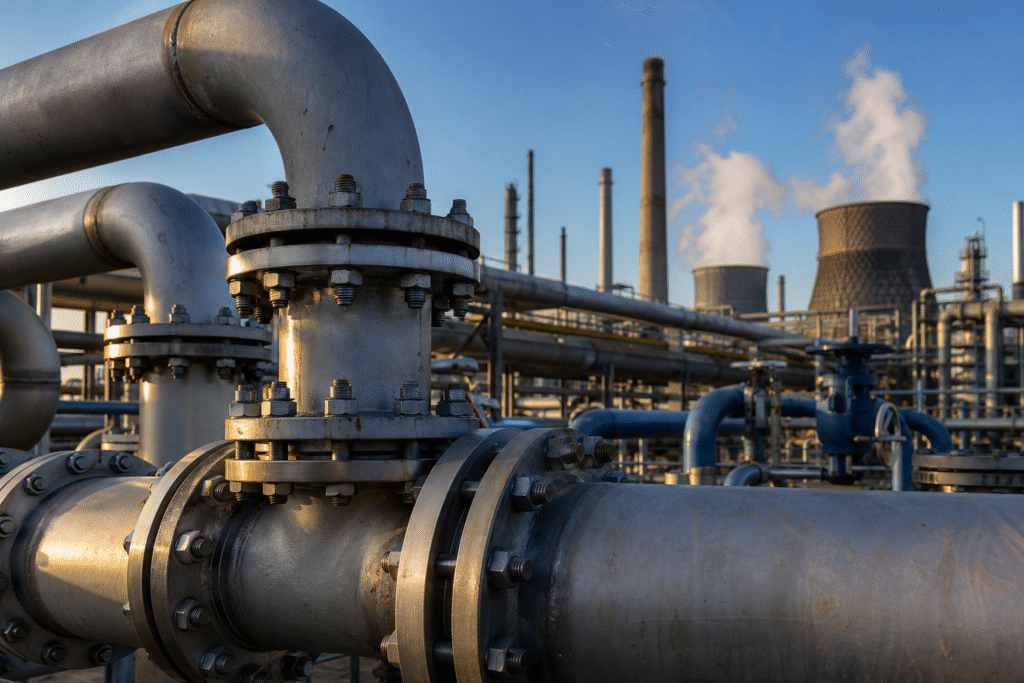
스테인레스 스틸 파이프 플랜지 시장 가이드: 유형, 용도, 표준 및 선택 방법 $5.8 10억 산업
그만큼 스테인레스 스틸 파이프 플랜지 remains one of the most specified components in industrial piping because sealing reliability, 내식성, 규정 준수는 공장 가동 시간에 직접적인 영향을 미칩니다.. 그랜드뷰 리서치에 따르면 (2024), 전 세계 산업용 플랜지 시장의 가치는 다음과 같습니다. $5.8 10억 2023 도달할 것으로 예상됩니다. $7.2 10억 단위로 2030, which shows how critical flanges are to energy, 화학적인, 선박, and water infrastructure.
조달 관리자 및 배관 엔지니어용, the most common challenge is not finding flanges in general. It is choosing the right stainless steel pipe flange material, 직면 유형, 압력 등급, and standard for a specific service condition.
Industrial Demand for Stainless Steel Pipe Flange Solutions Is Expanding Worldwide
Global demand is rising because projects now require longer service life, 유지 보수 감소, and stronger compliance documentation. IBISWorld에 따르면 (2024), 아시아 태평양 계정은 이상입니다. 45% 글로벌 플랜지 생산량의, 중국이 가장 큰 제조사이기 때문에.
That manufacturing concentration matters for buyers seeking scale, 더 짧은 리드타임, and competitive export pricing. 하지만, supply alone is not enough, because industrial purchasers also need traceability, 치수 정확도, and mill-certified material chemistry.
스태티스타에 따르면 (2024), 석유 및 가스 산업은 대략적으로 35% 글로벌 플랜지 소비량. 그러므로, stainless and alloy flange suppliers that serve upstream, 내의 한복판, 정제, and petrochemical projects must understand pressure-temperature ratings, 신맛이 나는 서비스, and corrosive media compatibility.
In many plants, flange failure does not begin with dramatic rupture. 대신에, it starts with small gasket seating problems, poor bolt load distribution, or incorrect material substitution during maintenance.
존 레이놀즈처럼, 부식 및 재료 엔지니어, 주: “Flange selection is never just about pressure class. It is about the full system, including media chemistry, cyclic temperature, 개스킷 호환성, and fabrication quality.”
This is why buyers increasingly prefer suppliers that can support both standard and project-specific requirements. 와 함께 ISO 9001:2015 및 PED 2014/68/EU 인증, SASA FLANGE supports industrial customers needing stainless steel flanges, 탄소강 플랜지, 합금 플랜지, and pipe fittings for regulated environments.
게다가, material versatility has become a decisive sourcing factor. 게다가 304, 316, 그리고 316L, many projects now specify 904L, 듀플렉스 2205, 슈퍼 듀플렉스 2507, A182 등급, 니켈 합금, and titanium for more severe duty cycles.
모르도르 정보국에 따르면 (2024), process industries are increasing investment in corrosion-resistant piping systems as operators target lower lifecycle costs and fewer shutdown-related losses. 결과적으로, stainless steel pipe flange procurement increasingly focuses on total value rather than unit price alone.
For engineering contractors, the most common purchasing filters include pressure rating, dimension standard, 문서 패키지, and machining consistency. 예를 들어, a refinery may require ASME B16.5 수업 300 용접 목 플랜지 ASTM A182 F316L with EN 10204 3.1 인증, while a desalination plant may prioritize duplex grades for chloride resistance.
고급 CNC 가공 및 포괄적인 품질 테스트를 통해 뒷받침됨, SASA FLANGE manufactures flanges and fittings for Oil & 가스, 석유화학, 발전, 조선 & 선박, 수처리, 및 건설. Buyers that need standard and custom sizes can also review broader production capabilities through the company’s 제품군 and manufacturing profile on its 페이지 소개.
스테인레스 스틸 파이프 플랜지 유형, 재료, and the Most Common Selection Criteria
The most common flange decision starts with connection type. 하지만, the better question is which flange type best matches operating pressure, vibration level, inspection accessibility, welding constraints, 유지보수 빈도.
박사로서. Robert Stevens, piping systems analyst, 주: “The wrong flange type can increase installation cost, but the wrong material grade can multiply lifecycle cost. Good engineering balances both from the start.”
시장 조사 미래에 따르면 (2024), corrosion-resistant alloy demand in industrial piping continues to outpace conventional material growth in several processing sectors. 추가적으로, stainless steel remains a preferred option where cleanliness, 내산화성, and media purity are important.
For stainless steel pipe flange applications, the most common material grades include 304, 304엘, 316, 그리고 316L. 등급 304 suits general industrial service, ~하는 동안 316 and 316L offer improved resistance in chloride-bearing and chemical environments.
Higher-performance projects may specify 321 for elevated temperatures, 347 for stabilized service, or duplex 2205 where strength and chloride stress corrosion resistance matter. In aggressive offshore and desalination service, 2507 super duplex or 904L may deliver better long-term performance.
- 304 / 304엘: 일반 내식성, 식품 가공, 수처리, mild chemical service.
- 316 / 316엘: Better pitting resistance, marine exposure, 석유화학, 프로세스 배관.
- 321 / 347: Elevated-temperature service with improved stability.
- 2205 듀플렉스: Higher strength and chloride resistance than austenitic grades.
- 2507 슈퍼 듀플렉스: Severe marine, 난바다 쪽으로 부는, and high-chloride process environments.
- 904엘: Strong resistance in reducing acids and difficult chemical media.
Buyers also compare flange face types because sealing performance varies by service condition. Raised face is the most common for industrial plants, ring type joint is preferred for high-pressure critical service, and flat face is used where mating equipment cannot tolerate concentrated gasket loads.
- 용접 목 플랜지: 고압에 가장 적합, 열 순환, and critical lines.
- 슬립온 플랜지: Economical and easy to align for moderate service.
- 스레드 플랜지: 용접이 제한된 곳에 유용.
- 소켓 용접 플랜지: 소구경에 적합, 고압 시스템.
- 블라인드 플랜지: Used to isolate, terminate, or inspect piping systems.
- 랩 조인트 플랜지: Practical where frequent dismantling is required.
에 따르면 ASME B16.5, flange dimensions and pressure-temperature ratings must align with pressure class, 소재 그룹, 및 서비스 조건 (ASME, 2023). 그러므로, engineers should never treat a 4 inch stainless steel pipe flange as interchangeable across all standards, because facing details, 구경, 교련, and rating can differ.
Material certification is equally important. ASTM A182 일반적으로 단조 또는 압연 합금 및 스테인레스 스틸 파이프 플랜지를 포함합니다., 단조 피팅, 밸브, 및 고온 서비스용 부품 (ASTM, 2023).
For buyers reviewing the most common purchase requests, these are the usual specification checkpoints:
- Nominal pipe size from 1/2 인치에서 60 인치.
- 다음과 같은 압력 등급 150, 300, 600, 900, 1500, 또는 2500.
- Standard including ANSI B16.5, ANSI B16.47, DIN, JIS, 고스트, 또는 EN 1092.
- Material grade such as 304, 316엘, 2205, 2507, A105, or A182.
- RF와 같은 외장형, FF, 또는 RTJ.
- Inspection and documentation including PMI, 수력 테스트 지원, 그리고 EN 10204 3.1.
실제로, the question “How do I choose flanges?” should be answered by process data, 카탈로그 편의성이 아님. 온도 범위, 유체화학, 부식 허용량, and joint criticality must drive the decision.
Manufacturing execution also affects field performance. 맞춤형 크기 제공 1/2 인치에서 60 경쟁력 있는 공장 직접 가격의 인치, SASA FLANGE supplies stainless steel pipe flange products and matching elbows, 티셔츠, 감속기, 통합 배관 패키지용 캡 및 캡.
ASME, ASTM, DIN, 스테인레스 스틸 파이프 플랜지 규정 준수에 대한 EN 요구 사항
표준은 호환성을 정의합니다., safety margins, 그리고 검사 기대. 따라서, any serious stainless steel pipe flange supplier must map products clearly to the correct dimensional, 재료, and regulatory framework.
The most widely referenced dimensional standards for industrial flanges include ANSI B16.5 and ANSI B16.47 for larger diameters. ASME B16.9 governs many butt weld fittings used together with flange systems, IN 동안 1092 covers many European flange applications.
Key standards buyers should verify include:
- ASME B16.5: NPS용 파이프 플랜지 및 플랜지 피팅 1/2 ~을 통해 24.
- ASME B16.47: NPS용 대구경 강철 플랜지 26 ~을 통해 60.
- ASTM A182: 단조 또는 압연 합금 및 스테인리스강 플랜지 재질.
- ASME B16.9: 공장에서 제작한 단조 맞대기 용접 피팅.
- EN 1092-1: European flanges and dimensions.
- DIN and JIS: Regional dimensional systems for project-specific compatibility.
According to the European Commission’s Pressure Equipment Directive, pressure-retaining components sold into applicable EU markets may require conformity assessment and technical documentation under PED 2014/68/EU. 그러므로, exporters serving Europe must align material traceability and inspection records with customer and regulatory expectations.
NACE MR0175 그리고 ISO 15156 become essential where sour service is present. In oil and gas environments containing hydrogen sulfide, material hardness, 열처리, and metallurgy control can determine whether a flange is acceptable.
As Emily Carter, 수석 배관 엔지니어, 주: “Standards are not paperwork afterthoughts. They are the framework that keeps global projects buildable, auditable, and safe.”
The table below summarizes the most common compliance focus areas:
- 치수 준수: ASME B16.5, B16.47, EN 1092, DIN, JIS.
- Material compliance: ASTM A182, ASTM A240 where plate-backed components are relevant.
- 선적 서류 비치: 히트 번호 추적성, MTC, EN 10204 3.1, PMI 보고서.
- Quality systems: ISO 9001:2015 manufacturing control.
- Regulatory export requirements: PED 2014/68/EU, 광고 2000 지정된 곳에.
For authoritative dimensional and code references, buyers should also review the official ASME resource at ASME.org. That step is particularly useful when cross-checking project specifications against supplier quotations.
와 함께 ISO 9001:2015, PED 2014/68/EU, 그리고 광고 2000 신임장, SASA FLANGE supports customers that require documented compliance rather than generic trading supply. This is especially relevant for EPC contractors and OEMs that need consistent quality records over multi-batch procurement cycles.
How to Choose Stainless Steel Pipe Flange Products for Oil, 가스, 화학적인, 힘, 해양 프로젝트
Application drives selection. Even the most common stainless steel flange types perform differently once chloride exposure, 진동, 열 피로, or shutdown maintenance frequency are considered.
석유 및 가스 분야, weld neck and RTJ configurations are often preferred for high-pressure hydrocarbon lines. 스태티스타에 따르면 (2024), 이 부문은 약 35% 글로벌 플랜지 소비량, so its technical preferences strongly influence worldwide sourcing patterns.
For petrochemical and chemical plants, 316엘, 904엘, and nickel alloys are often reviewed for corrosive streams. Where crevice corrosion or pitting is a concern, buyers should compare PREN-related material performance and actual process chemistry rather than relying only on generic grade descriptions.
발전에 있어서, thermal cycling becomes a major factor. 그러므로, flange design should consider pressure class, gasket behavior, and welding quality to reduce leak risk during startup and shutdown sequences.
Marine and shipbuilding environments create another challenge because salt exposure accelerates corrosion on lower-grade materials. 듀플렉스 2205 and 316L are therefore common review candidates, 온도에 따라, 압력, and cost targets.
Water treatment and desalination projects often prioritize corrosion resistance and lifecycle value over lowest purchase price. 결과적으로, duplex and super duplex grades can deliver stronger economics where chloride content is high.
When buyers compare stainless steel flange types and uses, these selection criteria are the most practical:
- 공정 매체, including chloride content, acidity, 그리고 고체.
- Design pressure and temperature versus flange class limits.
- Weldability and fabrication method.
- 검사 수준, including PMI and third-party verification.
- 필수 표준, such as ASME, DIN, JIS, 또는 EN 1092.
- Total installed cost versus lifecycle maintenance cost.
- Lead time and packaging for export projects.
예를 들어, 에이 2 inch threaded stainless steel pipe flange may suit utility service where welding is undesirable. 하지만, 클래스 600 weld neck flange in ASTM A182 F316L is more appropriate for critical process lines with higher stress concentration and thermal cycling.
Procurement teams should also compare complete package capability, not only standalone flange quotes. When the same supplier can provide elbows, 티셔츠, 감속기, 모자, and matching metallurgy, project coordination usually improves and documentation becomes easier to manage.
플랜지 제조 304, 316, 904엘, 2205, 2507 그리고 다른 프리미엄 등급, SASA FLANGE supports custom production for industrial projects that require standard and non-standard dimensions. 피복재 50+ 석유를 건너는 나라들 & 가스, 석유화학, 힘, 해양산업, the company aligns supply capability with export documentation and quality control expectations.
Future Outlook for Stainless Steel Pipe Flange Sourcing and Strategic Buying Recommendations
The flange market is becoming more specification-driven and less commodity-driven. 그랜드뷰 리서치에 따르면 (2024), market value is expected to increase from $5.8 10억 2023 에게 $7.2 10억 단위로 2030, which reflects ongoing industrial investment and replacement demand.
추가적으로, buyers now face stronger pressure to reduce total cost of ownership. That means corrosion failures, maintenance shutdowns, and delayed documentation can outweigh a lower unit price very quickly.
IBISWorld에 따르면 (2024), Asia-Pacific contributes over 45% 글로벌 플랜지 생산량의, so global buyers will continue sourcing from the region for capacity and cost efficiency. 하지만, the best purchasing strategy will combine regional manufacturing advantage with verified quality systems, metallurgy control, and communication responsiveness.
Procurement leaders should take five practical steps before placing the next flange order:
- Lock the exact standard, 재료 등급, 깃 달기, and pressure class in the RFQ.
- Request MTC and EN 10204 3.1 documentation requirements in writing.
- Clarify whether the application involves chlorides, 신맛이 나는 서비스, or thermal cycling.
- Compare lifecycle suitability, not just stainless steel pipe flange price.
- Choose a supplier that can support both standard flanges and related fittings.
앞으로 몇 년 안에, digital procurement, third-party inspection integration, and traceability expectations will likely intensify. 그러므로, established manufacturers that combine technical depth with export experience will be better positioned than generic resellers.
For buyers evaluating the most common flange types, 용도, 및 규정 준수 요구 사항, the key is disciplined specification. When projects require certified stainless, 합금, and custom-machined flange solutions, engineers and sourcing teams can streamline discussion by contacting SASA FLANGE with service conditions, 그림, and target standards early in the process.
자주 묻는 질문
스테인레스 스틸 플랜지는 무엇에 사용됩니까??
●A stainless steel flange is used to connect pipes, 밸브, 슬리퍼, and pressure equipment while allowing assembly, 분해, 점검, and maintenance in industrial piping systems.
●스태티스타에 따르면 (2024), 석유와 가스는 대략적으로 35% 글로벌 플랜지 소비량, which shows how central flanged joints are in process-critical service.
●실제로, engineers specify a stainless steel pipe flange when corrosion resistance, 위생, or temperature stability matters more than lowest initial cost.
●Common uses include petrochemical lines, 해양 배관, 수처리 스키드, food-grade systems, and marine installations where carbon steel may corrode too quickly.
●For projects requiring certified materials, 압력 등급 검증, 및 수출 준비 문서, 다음과 같은 기존 제조업체와 협력 SASA FLANGE 소싱 위험을 줄이는 데 도움이 됩니다..
다양한 유형의 스테인레스 스틸 플랜지는 무엇입니까?
●가장 일반적인 스테인레스 스틸 플랜지 유형은 용접 넥입니다., 미끄러지다, 눈이 먼, 스레드, 소켓 용접, 및 랩 조인트 플랜지, and each serves a different mechanical and maintenance purpose.
●ASME B16.5 defines dimensional requirements for many standard flange types, so buyers should confirm the standard before comparing sizes or prices across suppliers.
●Weld neck flanges are preferred for severe pressure and thermal cycling, while slip on flanges are often selected for moderate service because installation is simpler and more economical.
●Blind flanges isolate systems, threaded flanges avoid welding in certain services, and lap joint flanges support frequent dismantling where the stub end design is advantageous.
●For projects requiring help to choose flanges by pressure class, 재료 등급, 및 직면 구성, 연락하다 SASA FLANGE can speed up technical evaluation.
세 가지 유형의 플랜지는 무엇입니까?
●The three types of flanges most commonly referenced in basic industrial discussions are weld neck, 미끄러지다, and blind flanges because they cover many core piping connection needs.
●These three are widely used because they balance structural strength, installation practicality, and system isolation capability across many plant environments.
●Weld neck flanges provide the strongest stress transition, slip on flanges are cost-effective for moderate conditions, and blind flanges terminate or block off a line for testing or future expansion.
●하지만, this simplified grouping should not replace full engineering review, because threaded, 랩 조인트, and socket weld designs may be more suitable for specific services.
●중요한 프로젝트의 경우, engineers should match flange type to code, 메디아, and maintenance strategy rather than relying on the most common catalog option.
What is the ASTM standard for stainless steel flanges?
●The principal ASTM material standard for forged stainless steel flanges is ASTM A182, which covers forged or rolled alloy and stainless steel pipe flanges, 피팅, 밸브, and related parts.
●ASTM A182 addresses material chemistry and mechanical property requirements, ~하는 동안 ASME B16.5 or B16.47 usually governs dimensional details and pressure-temperature ratings.
●Buyers sometimes confuse ASTM and ASME roles, but ASTM generally defines the material specification and ASME generally defines design dimensions and pressure classifications.
●예를 들어, a procurement description may call for ASME B16.5 수업 300 용접 목 플랜지 ASTM A182 F316L, which combines a dimensional standard with a material grade requirement.
●For regulated applications, it is also advisable to request EN 10204 3.1 certificates and verify traceability from raw material to finished flange.
다음 중에서 어떻게 선택하나요? 304, 316, 2205, 그리고 2507 스테인레스 스틸 파이프 플랜지 재료?
●The correct material depends on chloride exposure, 공정화학, 압력, 온도, and lifecycle expectations rather than simple price comparison.
●등급 304 is common for general service, 316 and 316L improve corrosion resistance in chemical and marine environments, 2205 offers higher strength and chloride resistance, 그리고 2507 is selected for severe high-chloride duty.
●시장 조사 미래에 따르면 (2024), demand for corrosion-resistant alloys in industrial piping continues to grow as operators prioritize lower maintenance and longer service intervals.
●실용적인 측면에서, 316L is often the starting point for more corrosive services, 이중으로 하는 동안 2205 may reduce wall thickness needs because of its higher mechanical strength.
●If the process involves seawater, 신맛이 나는 서비스, or aggressive chemical streams, buyers should ask for a material review tied to actual operating data before finalizing the order.
스테인레스 스틸 파이프 플랜지 가격과 리드 타임에 영향을 미치는 요소?
●스테인레스 스틸 파이프 플랜지 가격은 주로 재료 등급에 따라 다릅니다., 크기, 압력 등급, 가공 복잡성, 수량, 테스트 범위, 및 문서 요구 사항.
●그랜드뷰 리서치에 따르면 (2024), 세계 산업용 플랜지 시장 진출 $5.8 10억 2023, and stronger demand in energy and processing sectors can influence lead times for forged stainless grades.
●에이 4 인치 스테인레스 스틸 파이프 플랜지 304 may be priced very differently from a Class 600 weld neck flange in 316L, 2205, 또는 2507 because raw material cost and machining time increase significantly.
●Lead time also changes when buyers request PED compliance, 제3자 검사, PMI, custom drilling, or non-standard dimensions under DIN, JIS, or EN specifications.
●To improve quoting accuracy, procurement teams should send full technical details, including standard, 크기, 압력 등급, 재료, 깃 달기, 수량, 및 인증 요구 사항, at the RFQ stage.
관련 게시물

오리피스 플랜지 정의, 세부 정보 및 ASME B16.36 플랜지 개요: 시장 데이터, 선택 가이드 및 규정 준수 통찰력
전 세계 산업용 플랜지 시장의 가치는 다음과 같습니다. $5.8 10억…
