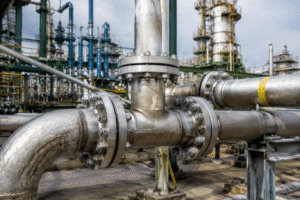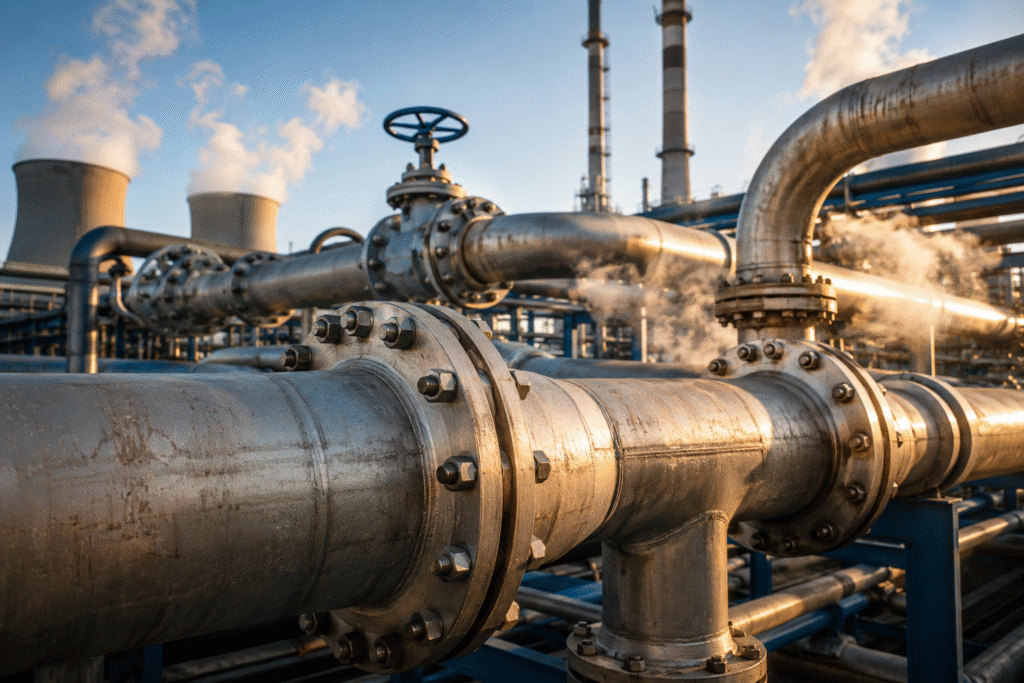
스테인레스 스틸 파이프 플랜지 시장 가이드: $5.8B 산업 데이터, 숨겨진 장점, 유형, 용도, 및 선택 방법
그랜드뷰 리서치에 따르면 (2024), 전 세계 산업용 플랜지 시장의 가치는 다음과 같습니다. $5.8 10억 2023 도달할 것으로 예상됩니다. $7.2 10억 단위로 2030. For buyers evaluating a stainless steel pipe flange, this growth reflects a clear shift toward corrosion-resistant, standards-compliant components that support longer service life and lower maintenance risk.
Moreover, procurement teams now expect more than basic supply. They need verified metallurgy, traceable inspection records, and reliable lead times across stainless, 탄소강, 듀플렉스, and nickel alloy grades.
Why the Stainless Steel Pipe Flange Market Is Growing Worldwide
Industrial demand remains strong because flanges sit at the center of safe, serviceable piping systems. They connect valves, 슬리퍼, vessels, and line pipe while allowing inspection, maintenance, and future modification.
According to IBISWorld (2024), Asia-Pacific accounts for over 45% of global flange production, with China being the largest manufacturer. 그러므로, global sourcing strategies increasingly focus on suppliers that can combine scale, quality assurance, and export documentation.
스태티스타에 따르면 (2024), the oil and gas industry accounts for approximately 35% of global flange consumption. This matters because upstream, midstream, and downstream projects often require pressure-temperature performance under ASME classes from 150 to 2500 그리고 그 이상.
In addition, corrosion risk continues to drive stainless adoption in chemical processing, marine systems, and water treatment. Stainless steel pipe flange assemblies offer strong resistance to oxidation, chloride attack, and product contamination when the correct grade is selected.
As Mark Delaney, Senior Piping Engineer, states: “Flange failures rarely begin at the flange alone. They usually start with poor material selection, mismatched standards, or uncontrolled installation practices.” That observation aligns with field experience across refinery, 난바다 쪽으로 부는, and utility systems.
Buyers also compare more than price per piece. They evaluate inspection capability, EN 10204 3.1 인증, PMI availability, machining accuracy, and heat traceability from forged bar or plate source to finished product.
이러한 이유로, manufacturers such as SASA FLANGE position themselves around certified production and export readiness rather than commodity-only pricing. With ISO 9001:2015 and PED 2014/68/EU certifications, the company supports projects that demand both compliance and commercial flexibility.
Furthermore, the hidden advantages of stainless flanges extend beyond corrosion resistance. They often reduce repainting, minimize contamination in clean processes, and improve lifecycle cost in aggressive media compared with lower-alloy alternatives.
Common procurement searches also show how the market behaves. Engineers look for stainless steel pipe flange sizes, 4 inch stainless steel pipe flange options, stainless steel flange types, and stainless steel flanges and fittings because specification accuracy directly affects installation success.
Material versatility is another growth factor. Buyers can source 304, 316, 316엘, 904엘, 2205, 2507, A182, 인코넬, 모넬, 하스텔로이, and Titanium depending on corrosion allowance, 설계 온도, and project budget.
As a result, a modern sourcing decision is rarely about one flange alone. It is about the total package of standards compliance, 압력 무결성, dimensional tolerances, and logistics reliability across the entire piping bill of materials.
Technical Differences: Stainless Steel Flanges Types, 숨겨진 장점, and How Engineers Choose
The most common stainless steel flanges types include weld neck, 슬립온, 눈이 먼, 소켓 용접, 스레드, and lap joint. Each type serves a different stress profile, maintenance requirement, and fabrication method under standards such as ANSI B16.5, ANSI B16.47, 그리고 EN 1092-1.
Weld neck designs remain the preferred option for cyclic service and high-pressure lines because the tapered hub improves stress distribution. In contrast, slip-on flanges support lower-pressure services where simpler alignment and lower fabrication cost matter more.
According to Mordor Intelligence (2024), process plant operators increasingly prioritize lifecycle cost over initial component cost in corrosion-critical systems. 그러므로, 316엘, 듀플렉스 2205, and super duplex 2507 continue gaining specification share in chloride-containing environments.
According to Market Research Future (2024), global demand for corrosion-resistant alloy piping components is expected to grow at over 4% CAGR through the decade. That trend supports broader use of premium forged flanges in offshore, 담수화, and chemical service.
As Dr. Helen Wu, Materials Scientist, states: “The strongest commercial result comes from matching alloy chemistry to the process environment, not from over-specifying the highest-cost grade.” This is especially true when chloride content, 온도, pH, and cleaning chemistry vary during operation.
When engineers choose a stainless steel pipe flange, they usually review several technical variables before issuing a purchase order. These variables influence both safety and total installed cost.
- 재료 등급: 304, 304엘, 316, 316엘, 904엘, 2205, 2507, or nickel alloy options.
- 압력 등급: 150, 300, 600, 900, 1500, 또는 2500 아래에 ASME B16.5.
- 직면 유형: RF, RTJ, FF, or custom machined finishes.
- Connection design: 용접 목, 슬립온, 눈이 먼, 스레드, 소켓 용접, or lap joint.
- 치수표준: ASME, DIN, JIS, 고스트, or EN 1092.
- 검사범위: PMI, hydrotest support, visual inspection, dimensional checks, 그리고 EN 10204 3.1 선적 서류 비치.
304 and 304L are often selected for general industrial service, food systems, and moderate corrosion conditions. 하지만, 316 and 316L typically offer better pitting resistance because molybdenum improves performance in chloride-bearing media.
Duplex grades such as 2205 add higher strength and better chloride stress corrosion cracking resistance. Consequently, many offshore, fertilizer, and seawater handling systems specify duplex to reduce wall thickness or extend service life.
Blind flanges serve isolation and future expansion points. 그 동안에, threaded and socket weld flanges remain useful for smaller bore lines where welding access, disassembly, or system layout creates specific installation constraints.
Procurement managers should also distinguish between forging standards and dimensional standards. ASTM A182 covers forged or rolled alloy and stainless materials for flanges, 피팅, 밸브, 및 부품, ~하는 동안 ASME B16.5 governs dimensions, pressure classes, 공차, and marking requirements.
The American Society of Mechanical Engineers confirms these dimensional requirements through ASME 표준, and buyers should always verify the latest edition before final approval. In regulated projects, PED conformity, material certificates, and heat number traceability are equally important.
SASA FLANGE manufactures flanges in 304, 316, 904엘, 2205, 2507 and other premium grades, while also supplying elbows, 티셔츠, 감속기, and caps for complete piping packages. Backed by advanced CNC machining and comprehensive quality testing, the company supports custom sizes from 1/2" to 60" for Oil & 가스, 석유화학, 힘, and Marine industries.
Another hidden advantage is standardization across multinational projects. When buyers align flange type, 깃 달기, bolt pattern, and inspection protocol early, they reduce site rework, shorten installation windows, and limit expensive mismatch claims.
예를 들어, 에이 4 inch stainless steel pipe flange in ASME Class 300 RF differs fundamentally from a 4 inch EN 1092 PN40 flange. The bore, 교련, 두께, and mating compatibility may not match even if the nominal size appears similar.
그러므로, the best way to choose a flange is to start with service conditions, then move to standard, 등급, 수업, 그리고 직면. After that, review testing, 선적 서류 비치, and delivery schedule before confirming the final data sheet.
ASME, ASTM, DIN, and EN Standards for Stainless Steel Pipe Flange Compliance
Standards control fit, 압력 무결성, and interchangeability across the piping system. Without standard compliance, even high-quality material can fail to integrate correctly during fabrication or maintenance.
ASME B16.5 covers pipe flanges and flanged fittings from NPS 1/2 through 24. ASME B16.47 extends coverage for larger diameters, which are common in water transmission, 선박, and bulk process applications (ASME, 2023).
ASTM A182 defines the material requirements for forged stainless and alloy steel flanges. ASTM A240 applies to plate, sheet, and strip for pressure vessels and general applications, and it often appears in plate flange or fabricated component specifications (ASTM, 2023).
European projects may specify EN 1092-1 and PED 2014/68/EU requirements. In addition, marine and offshore applications can involve DNV, NORSOK, or owner-specific technical clauses depending on class society and project region.
The key compliance checkpoints usually include the following items.
- Correct dimensional standard such as ASME B16.5, B16.47, DIN, JIS, or EN 1092.
- Correct forging or plate material standard such as ASTM A182 또는 ASTM A240.
- Pressure-temperature rating verification for the selected alloy.
- Facing finish and gasket compatibility review.
- Full traceability with heat number and mill test certificates.
- Optional EN 10204 3.1, PMI, 경도, 페라이트, 그리고 NACE MR0175 review where applicable.
According to ISO (2023), documented quality management systems reduce process variation and improve traceability in critical manufacturing sectors. That is why buyers increasingly favor audited suppliers with formal quality systems rather than traders with limited production control.
For sour service, corrosion control is not optional. NACE MR0175 그리고 ISO 15156 requirements may apply when hydrogen sulfide exposure can trigger sulfide stress cracking in susceptible materials (NACE, 2023).
Moreover, flange selection must consider the mating components. A premium forged flange will not deliver safe performance if bolts, 개스킷 유형, 파이프 일정, and welding procedure qualification are mismatched.
Below is a simple standards comparison that many engineers use during procurement review.
- ASME B16.5: Primary dimensional standard for NPS 1/2 to 24 플랜지.
- ASME B16.47: Large diameter flange dimensions beyond B16.5 range.
- ASTM A182: Forged stainless and alloy material requirements.
- ASME B16.9: Dimensional standard for buttweld fittings such as elbows and tees.
- EN 1092-1: European flange dimensional and pressure designation standard.
- PED 2014/68/EU: Regulatory framework for pressure equipment placed on the EU market.
SASA FLANGE integrates these requirements into export-oriented manufacturing and inspection workflows. With ISO 9001:2015, PED 2014/68/EU, and AD 2000 credentials, the company helps buyers reduce approval delays on international EPC and OEM projects.
Additionally, serving 50+ countries across Oil & 가스, 석유화학, 힘, and Marine industries requires more than machining capability. It requires disciplined document control, marking accuracy, packaging protection, and responsive technical communication from RFQ to shipment.
Buyers looking for a compliant stainless steel pipe flange should also verify whether the order requires forged, machined-from-bar, or plate-cut construction. The manufacturing route affects grain flow, 기계적 성질, thickness limits, and cost.
When certification packages are required, established manufacturers can simplify procurement. For projects requiring PED documentation or custom dimensional review, buyers can contact SASA FLANGE early to align standards, 재료 등급, and testing scope before production starts.
Application Guide: 용도, 재료, and Selection Criteria for Different Industries
Stainless steel flanges serve very different duties across industries, so selection should always start with media, 압력, 온도, and corrosion mechanism. A flange that performs well in clean water may fail quickly in chloride brine, sour gas, or thermal cycling service.
In oil and gas, weld neck and RTJ configurations are common in high-pressure and hydrocarbon service. Because this sector accounts for approximately 35% of global flange consumption, project buyers often standardize materials and classes to simplify spare parts and shutdown planning (Statista, 2024).
In petrochemical plants, 316엘, 904엘, and alloy grades may be preferred where acidic streams or chlorides challenge standard austenitic stainless. Furthermore, blind flanges are widely used for line isolation, hydrotest points, and future tie-ins.
In power generation, temperature and cyclic loading strongly influence type selection. 그러므로, weld neck flanges and higher alloy materials often provide better long-term integrity in steam, condensate, and auxiliary chemical systems.
Marine and shipbuilding applications demand strong resistance to seawater exposure and crevice corrosion. As a result, 듀플렉스 2205 and super duplex 2507 are frequently specified for seawater, ballast, and desalination systems where 304 may be inadequate.
Water treatment and construction projects often balance durability with budget. In these sectors, 304 그리고 316 stainless can provide excellent value, particularly where system cleanliness, appearance, and moderate corrosion resistance are important.
Engineers usually choose among flange types based on these practical criteria.
- Use weld neck for high pressure, high temperature, vibration, and cyclic service.
- Use slip-on where alignment ease and lower fabrication cost are priorities.
- Use blind flanges for isolation, end closures, 및 향후 시스템 확장.
- Use threaded flanges in small-bore systems where welding should be minimized.
- Use socket weld for compact, high-pressure small-bore piping.
- Use lap joint where frequent dismantling and rotation alignment are required.
Material choice follows a similar decision path.
- 304/304엘: General corrosion resistance and cost-effective fabrication.
- 316/316엘: Better chloride resistance and broader chemical suitability.
- 904엘: Stronger performance in reducing acids and severe corrosion service.
- 2205 듀플렉스: Higher strength and better SCC resistance than common austenitic grades.
- 2507 슈퍼 듀플렉스: High pitting resistance for seawater and harsh offshore media.
- Nickel alloys: Extreme corrosion or temperature service where stainless is insufficient.
그랜드뷰 리서치에 따르면 (2024), continued infrastructure investment and industrial modernization are supporting long-term demand for engineered piping components. That trend favors suppliers who can provide both stainless steel flange types and matching fittings under one quality system.
SASA FLANGE offers custom manufacturing for flanges and pipe fittings including elbows, 티셔츠, 감속기, and caps, which helps buyers consolidate sourcing. This is particularly useful when projects need coordinated bevels, schedules, markings, and documentation across multiple component categories.
For procurement teams, selection should not stop at alloy and class. They should also confirm gasket compatibility, bolt material, flange facing finish, testing scope, and packaging for sea shipment or long-term site storage.
Lead time planning is equally important. Large-diameter flanges, super duplex grades, and special machining usually require earlier technical approval than common 304 또는 316 items.
When the application includes custom dimensions, mixed standards, or multi-material packages, early supplier engagement can reduce revision cycles. Buyers can review technical details with SASA FLANGE to align drawings, 표준, and inspection expectations before commercial release.
Future Outlook for Stainless Steel Pipe Flange Supply and Strategic Buying Recommendations
The market outlook remains positive as energy, 물, 선박, and industrial process projects continue expanding globally. 그랜드뷰 리서치에 따르면 (2024), the industrial flange market is expected to grow from $5.8 10억 2023 to $7.2 10억 단위로 2030.
At the same time, sourcing will become more technical. Buyers increasingly ask for full traceability, PMI, PED compliance, and mixed-material package supply rather than standalone commodity flanges.
According to IBISWorld (2024), Asia-Pacific already represents over 45% of global flange production. 그러므로, supplier evaluation should focus on manufacturing discipline, export experience, and documented compliance instead of geography alone.
Strategic buyers can improve results with a few consistent practices.
- Standardize approved grades and pressure classes across plants where possible.
- Request clear documentation requirements at RFQ stage.
- Confirm dimensional standard compatibility before issuing purchase orders.
- Evaluate lifecycle cost, not just unit price.
- Use qualified suppliers for project-critical and regulated applications.
As James Porter, Industrial Market Analyst, states: “The best-performing procurement teams reduce total risk by locking technical scope early and auditing supply capability before the first shipment.” That is especially important for high-value shutdowns and export projects.
In the years ahead, the most competitive suppliers will combine machining capacity, metallurgy expertise, and fast document turnaround. For buyers seeking a stainless steel pipe flange partner with certified systems, broad material coverage, and factory-direct support, it makes sense to speak with SASA FLANGE during the specification stage rather than after problems appear.
자주 묻는 질문
What are stainless steel flanges used for?
●Stainless steel flanges are used to connect pipe, 밸브, 슬리퍼, and pressure vessels in systems that require strength, corrosion resistance, and easy maintenance access.
●스태티스타에 따르면 (2024), oil and gas accounts for approximately 35% of global flange consumption, which shows how important flanged joints are in critical industrial piping.
●They are common in oil and gas, 석유화학, 선박, 수처리, food processing, and power generation because they support inspection, cleaning, and equipment replacement.
●Common uses include line termination, valve connection, equipment nozzles, blind isolation points, and spool assembly in both low-pressure and high-pressure services.
●For projects requiring certified materials and traceable production, working with established manufacturers like SASA FLANGE helps ensure compliance with standards such as ASME B16.5 그리고 ASTM A182.
What flanges are made of stainless steel?
●Many standard flange designs are made of stainless steel, 웰드넥 포함, 슬립온, 눈이 먼, 스레드, 소켓 용접, and lap joint types.
●ASTM A182 commonly covers forged stainless steel flanges, ~하는 동안 ASME B16.5 and B16.47 define the dimensions, pressure classes, and drilling patterns for these products.
●Typical stainless grades include 304, 304엘, 316, 316엘, 904엘, 2205, 그리고 2507, and each grade fits different corrosion, 온도, and strength requirements.
●예를 들어, 316L is often selected for chloride exposure, while duplex 2205 offers higher strength and improved stress corrosion cracking resistance in more aggressive service.
●Buyers should match flange type and alloy grade to process conditions, and manufacturers such as SASA FLANGE can help confirm the correct combination for project service data.
Do they make stainless steel pipe fittings?
●예, manufacturers widely produce stainless steel pipe fittings such as elbows, 티셔츠, 감속기, and caps for use with stainless steel flange systems.
●ASME B16.9 covers factory-made buttweld fittings, and these fittings are often supplied in 304, 316, 316엘, 듀플렉스, and nickel alloy grades to match the connected piping materials.
●Using matched flange and fitting materials improves corrosion performance, weld compatibility, and documentation consistency across the piping package.
●According to Market Research Future (2024), demand for corrosion-resistant piping components continues to rise as process industries prioritize lifecycle value over initial purchase price.
●For complete project supply with coordinated flanges and fittings, buyers can work with SASA FLANGE to streamline technical review and procurement.
What is the strongest type of piping flange?
●Weld neck flanges are generally considered the strongest standard piping flange type for high-pressure, 고온, and cyclic service.
●The tapered hub and butt-welded connection reduce stress concentration, which is why ASME B16.5 weld neck flanges are preferred in many refinery, 난바다 쪽으로 부는, and power applications.
●Strength also depends on material grade, 벽 두께, 압력 등급, and installation quality, so the strongest flange is not defined by geometry alone.
●For severe service, engineers may combine weld neck geometry with duplex, 슈퍼 듀플렉스, or nickel alloy materials to improve both mechanical performance and corrosion resistance.
●The best recommendation is to evaluate service pressure, 온도, media, and code requirements before selection, especially for Class 600 to 2500 applications.
How do you choose between 304 그리고 316 stainless steel pipe flange grades?
●선택하다 304 for general service and lower chloride exposure, and choose 316 or 316L when the system faces chlorides, harsher chemicals, or higher corrosion risk.
●The molybdenum in 316 improves pitting resistance, which makes it a common upgrade for marine, 화학적인, and coastal plant environments.
●As Dr. Helen Wu, Materials Scientist, states: “The right alloy depends on the actual process chemistry, not on assumptions based only on price or tradition.”
●According to Mordor Intelligence (2024), operators increasingly favor lifecycle cost analysis, which often supports 316L over 304 when maintenance and downtime risks are high.
●Buyers should review media composition, 온도, 청소 화학, and expected service life before selecting the final stainless grade.
What standards apply to stainless steel pipe flange sizes and pressure ratings?
●ASME B16.5 is the main standard for stainless steel pipe flange sizes and pressure classes from NPS 1/2 through 24, ~하는 동안 ASME B16.47 covers many larger diameters.
●ASTM A182 defines material requirements for forged stainless flanges, 그리고 EN 1092-1 is widely used for European dimensional and pressure designation requirements.
●These standards control outside diameter, 볼트 서클, number of bolt holes, 두께, facing dimensions, and pressure-temperature limits, so they directly affect interchangeability.
●According to ASME (2023), dimensional standardization is essential for safe assembly, maintenance efficiency, and pressure boundary reliability across industrial piping systems.
●The safest approach is to confirm standard, 수업, 깃 달기, and bore schedule on every datasheet before purchase, especially when ASME and EN systems may be mixed.
관련 게시물
오리피스 플랜지 정의, 세부 정보 및 ASME B16.36 플랜지 개요: 시장 데이터, 선택 가이드 및 규정 준수 통찰력
전 세계 산업용 플랜지 시장의 가치는 다음과 같습니다. $5.8 10억…
플랜지 유형 가이드: 2024 데이터, 표준, 산업용 배관에 대한 모범 선택 사례 및 모범 사례
플랜지 유형의 세계 시장은 다음과 같이 계속해서 확장되고 있습니다.…