
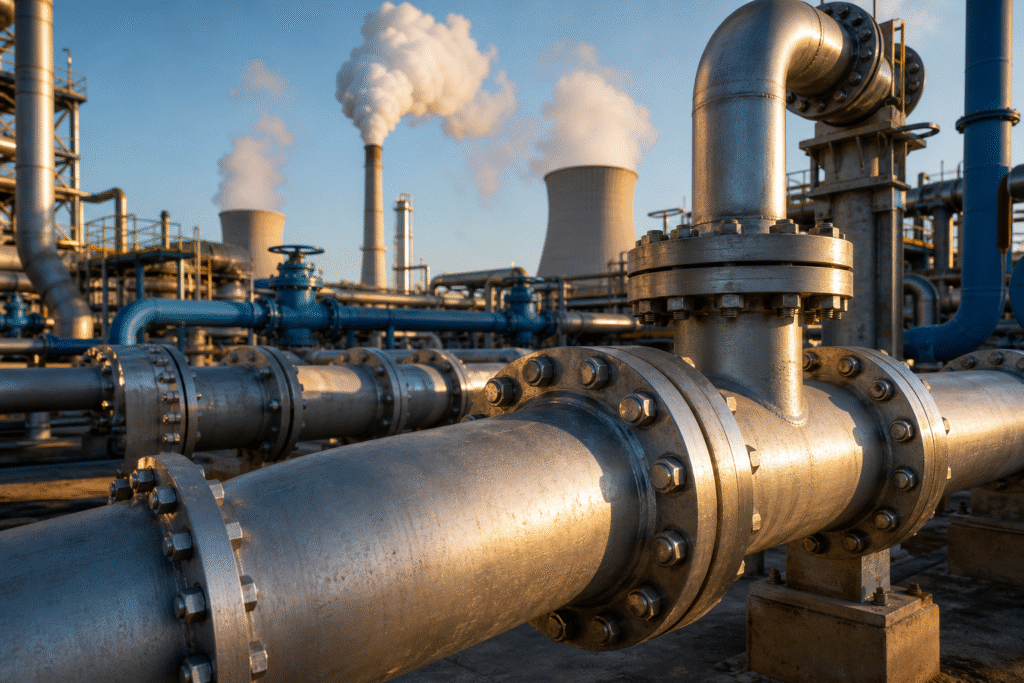
스테인레스 스틸 파이프 플랜지 시장은 72억 달러에 달할 것입니다. 2030: 숨겨진 장점, 유형, 용도 및 ASME B16.5 선택 가이드
그만큼 스테인레스 스틸 파이프 플랜지 market is expanding as process industries demand higher corrosion resistance, 더 긴 서비스 수명, 더욱 엄격한 규정 준수. 그랜드뷰 리서치에 따르면 (2024), 전 세계 산업용 플랜지 시장의 가치는 다음과 같습니다. $5.8 10억 2023 도달할 것으로 예상됩니다. $7.2 10억 단위로 2030.
That growth reflects the Hidden Advantages of Stainless Steel Flanges in critical Pipe systems. 엔지니어 및 조달 팀용, the real decision is not only about price, but also about durability, 수명주기 가치, 재료 등급, 그리고 ASME B16.5 규정 준수.
Market Drivers Behind Stainless Steel Pipe Flange Demand
Industrial buyers are increasingly shifting from commodity carbon steel options to higher-performance stainless solutions. IBISWorld에 따르면 (2024), 아시아 태평양 계정은 이상입니다. 45% 글로벌 플랜지 생산량의, 중국이 가장 큰 제조사이기 때문에.
That regional concentration matters for supply chain planning. It affects lead times, mill availability, alloy sourcing, and factory-direct pricing for standard and custom forged products.
동시에, end-use demand remains strongly tied to energy and process sectors. 스태티스타에 따르면 (2024), 석유 및 가스 산업은 대략적으로 35% 글로벌 플랜지 소비량.
하지만, stainless steel pipe flange demand now extends well beyond upstream energy. 수처리, 해양 시스템, 제약 공장, 식품 가공, and power generation all require Stainless, 위생, and corrosion-resistant connection points.
This shift has increased interest in 304, 316, 316엘, 904엘, 2205, 그리고 2507 성적. In aggressive chloride service, buyers often move from 304 to molybdenum-bearing 316L or duplex grades to improve pitting resistance.
모르도르 정보국에 따르면 (2024), industrial infrastructure spending in emerging markets continues to support demand for pipe connection components with longer design life. 그러므로, buyers increasingly evaluate total installed cost rather than only initial unit price.
That is one reason the keyword Intriguing appears in many online searches, even if engineers would describe the topic differently. The more practical point is that the Versatility and durability of stainless steel pipe flange products make them suitable for both general utility systems and severe process conditions.
처럼 SASA FLANGE supports buyers across Oil & 가스, 석유화학, 발전, 조선 & 선박, 수처리, 및 건설, material selection is treated as a project risk decision. 와 함께 ISO 9001:2015 및 PED 2014/68/EU 인증, the company aligns manufacturing control with the documentation expectations of EPC contractors and global distributors.
Procurement managers also care about supply flexibility. 고급 CNC 가공 및 포괄적인 품질 테스트를 통해 뒷받침됨, SASA FLANGE 스테인레스 스틸 플랜지 공급, 탄소강 플랜지, 합금 플랜지, 엘보와 같은 파이프 피팅, 티셔츠, 감속기, 그리고 모자.
시장 조사 미래에 따르면 (2024), demand for corrosion-resistant piping components is growing faster in desalination, 난바다 쪽으로 부는, and chemical processing segments than in general industrial applications. 결과적으로, stainless steel flange types with tighter metallurgy control and traceable certification are gaining share.
For project buyers, that means a stainless steel pipe flange is no longer a generic commodity. It is a specification-driven component linked to pressure class, 직면 유형, 부식 허용량, 용접 절차, 및 검사 요구 사항.
Technical Advantages, 유형, Uses and Material Selection Criteria
The Hidden Advantages of a stainless steel pipe flange start with corrosion resistance, but they do not end there. Stainless materials also support cleaner service conditions, better oxidation resistance, and more stable long-term sealing performance in many systems.
According to ASTM and ASME material practice, forged stainless flanges are commonly supplied under ASTM A182 with dimensions governed by ASME B16.5 및 ASME B16.47 해당되는 경우. 그러므로, a buyer must match chemistry, forging quality, 플랜지 클래스, and dimensional standard together.
As John Butterfield, 수석 배관 엔지니어, 주: “A flange failure rarely starts at the drawing stage alone; 일반적으로 재료 등급 간의 불일치로 시작됩니다., 공정화학, and bolt load assumptions.” That is why experienced sourcing teams review service media, 온도, 압력 사이클링, and maintenance access before they Choose a flange type.
According to NACE guidance for sour and corrosive environments, alloy selection must consider chlorides, H2S, CO2, 온도, 틈새 노출. 대조적으로, many low-risk water or air systems can use 304 or 304L economically when contamination and corrosion loads remain moderate.
The most common Stainless grades for a stainless steel pipe flange include the following:
- 304 and 304L for general industrial service, clean water, 공조, 및 가벼운 화학물질 의무.
- 316 and 316L for chloride-bearing service, 해양 대기, and more aggressive chemical lines.
- 904L for strong corrosion resistance in severe acidic environments.
- 2205 duplex for higher strength and improved chloride stress corrosion resistance.
- 2507 해양용 슈퍼 듀플렉스, 담수화, and highly corrosive process systems.
- 인코넬과 같은 니켈 합금, 모넬, and Hastelloy for specialized high-temperature or corrosive duties.
Material selection also depends on flange Types. Each design offers different fabrication, 점검, and service advantages.
- Weld neck flanges support high pressure, 순환 로딩, 및 중요 공정 라인.
- Slip on flanges reduce fabrication cost for lower-pressure service and easier fit-up.
- Blind flanges terminate lines, 장비를 분리하다, and support hydrotest activities.
- Socket weld flanges suit smaller bore high-pressure piping.
- Threaded flanges work where welding is restricted or undesirable.
- Lapped joint flanges help systems that require frequent dismantling and alignment flexibility.
에 따르면 ASME B16.5, standard flange pressure-temperature ratings vary by material group and class designation. 그러므로, 수업 150, 300, 600, 900, 1500, 그리고 2500 selection must always be verified against operating temperature.
Engineers also evaluate facing style because gasket interaction drives sealing performance. 올려진 얼굴, 평평한 얼굴, and ring type joint options each serve different service levels and bolting requirements.
박사로서. Emily Carver, 재료 과학자, 주: “The best stainless choice is rarely the highest alloy by default; it is the grade that delivers the required corrosion margin at the lowest total lifecycle cost.” That principle is especially important when comparing 304 대 316L, or 316L versus duplex grades.
예를 들어, 304 remains widely used because it offers a strong cost-to-performance balance. 하지만, 316L often becomes the better option in marine, 화학적인, and higher chloride environments because molybdenum improves pitting resistance.
In practical B2B sourcing, buyers should compare these technical factors:
- Material standard such as ASTM A182 F304, F304L, F316, F316L, F51, or F53.
- Dimensional standard such as ANSI B16.5, ANSI B16.47, DIN, JIS, 고스트, 또는 EN 1092.
- 파이프 일정 및 보어 일치, Sch 10S 포함, 40에스, and heavier wall combinations.
- RF를 포함한 페이싱 유형, FF, RTJ, or custom machined facings.
- Testing documents such as EN 10204 3.1, PMI, 수압시험, 경도, and ultrasonic inspection.
- 추적성, 열수 제어, 및 마킹 요구 사항.
According to ISO manufacturing quality practice, process repeatability strongly influences sealing reliability and fit-up accuracy. 그러므로, CNC machining quality, forging control, and final inspection matter as much as raw material chemistry.
SASA FLANGE 플랜지를 제조합니다. 304, 316, 904엘, 2205, 2507 그리고 다른 프리미엄 등급. 1/2부터 맞춤형 크기 제공" 60까지" 경쟁력 있는 공장 직거래 가격으로, the company supports project and distributor requirements across standard and non-standard dimensions.
Buyers looking for stainless steel pipe flange products often search by size, ~와 같은 2 인치 또는 4 인치 스테인레스 스틸 파이프 플랜지, or by application, such as marine, API 플랜지, and water treatment service. In each case, the engineering answer depends on media composition, 플랜지 클래스, corrosion margin, 개스킷 디자인, 및 제작방법.
For deeper project support or quotations, engineering and procurement teams can 연락하다 SASA FLANGE for material recommendations and technical documentation. This is particularly useful when a project requires mixed standards, custom drilling, or urgent replacement parts.
ASME B16.5, ASTM A182, DIN and EN Compliance Requirements
Standards compliance is one of the most important buying criteria for any stainless steel pipe flange. A flange may appear dimensionally correct, yet fail project acceptance if documentation, 마킹, 야금, or testing does not align with contract requirements.
ASME B16.5 차원을 관리합니다., 공차, 압력 온도 등급, 마킹, and materials references for pipe flanges and flanged fittings up to NPS 24. 더 큰 직경의 경우, ASME B16.47 typically applies, especially in heavy industrial and pipeline projects.
ASTM A182 단조 또는 압연 합금 및 스테인리스강 파이프 플랜지를 덮습니다., 단조 피팅, 밸브, 및 고온 서비스용 부품. 실제로, buyers frequently specify ASTM A182 F304/F304L, F316/F316L, F904L, F51, or F53 depending on process duty.
European projects may instead call for EN 1092 flanges and PED documentation. 그러므로, suppliers must understand both dimensional differences and documentation differences across ASME, DIN, EN 시스템.
Key standards and compliance points include:
- ASME B16.5 for dimensions and pressure classes up to NPS 24.
- ASME B16.47 더 큰 직경의 플랜지용.
- ASME B16.9 for stainless steel butt weld fittings used with flange assemblies.
- ASTM A182 단조 스테인리스 및 합금 플랜지 재료용.
- EN 1092 유럽 플랜지 치수 및 압력 지정용.
- PED 2014/68/EU for pressure equipment compliance in applicable EU projects.
- NACE MR0175 for sour service material selection in oil and gas environments.
The following comparison helps procurement teams align specifications:
- ASME systems commonly use NPS sizing and pressure classes such as 150 그리고 300.
- EN and DIN systems often use DN sizing and PN designations such as PN16 or PN40.
- Facing dimensions, 볼트 패턴, and drilling can vary between ASME and EN standards.
- Material naming can differ even when corrosion performance is similar.
PED에 대한 유럽 위원회 프레임워크에 따르면, pressure equipment supplied into the EU often requires traceable technical files and conformity procedures. 그러므로, exporters must coordinate material certificates, 치수 검사 보고서, and marking records from the start of production.
As Mark Jensen, Global Procurement Analyst, 주: “The most expensive flange in a project is the one that arrives without acceptable certification.” That observation reflects a common reality in EPC sourcing, where missing EN 10204 3.1 certificates or incomplete heat traceability can delay site release.
SASA FLANGE supports these compliance needs with ISO 9001:2015, PED 2014/68/EU, 그리고 광고 2000 인증. 피복재 50+ 석유를 건너는 나라들 & 가스, 석유화학, 힘, 해양산업, the company integrates quality documentation into the manufacturing workflow instead of treating it as an afterthought.
게다가, buyers should verify inspection scope before ordering. Typical requirements may include PMI for alloy confirmation, 경도 테스트, ferrite testing for duplex grades, 초음파 검사, and dimensional inspection against approved drawings.
For special service, gasket compatibility also deserves attention. Even a correctly manufactured stainless steel pipe flange can underperform if the gasket material, 표면 마무리, or bolt load is unsuitable for process conditions.
According to DNV and offshore project practice, marine and offshore systems often impose stricter documentation and corrosion requirements than general industrial installations. 결과적으로, duplex and super duplex flange packages often include more extensive testing and traceability than standard 304 또는 316 utility flanges.
How to Choose Stainless Steel Pipe Flange Products for Oil, 가스, Power and Marine Service
Application-based selection is the fastest way to reduce procurement risk. Instead of starting with a catalog alone, engineers should begin with service conditions, 검사 요구 사항, and lifecycle expectations.
석유 및 가스 시스템, stainless steel pipe flange selection often depends on chlorides, sour service exposure, 및 압력 등급. 스태티스타에 따르면 (2024), this sector accounts for approximately 35% 글로벌 플랜지 소비량, so reliability expectations are high.
For upstream and petrochemical service, common selection rules include:
- Use weld neck flanges for high-pressure and cyclic service.
- 검토 NACE MR0175 where H2S or sour conditions exist.
- Consider duplex grades where chlorides and strength demands exceed 316L capability.
- 요구 EN 10204 3.1 certification and PMI for critical alloys.
화학 처리 중, the main concern is media compatibility. A strong acid, chloride-rich stream, or oxidizing environment may require 316L, 904엘, 하스텔로이, or another corrosion-resistant alloy instead of standard 304.
발전에 있어서, steam conditions and thermal cycling often drive the design choice. 그러므로, weld neck and socket weld configurations frequently offer better long-term integrity than lower-cost alternatives in critical lines.
Marine and shipbuilding applications demand resistance to salt spray, 바닷물 노출, and difficult maintenance conditions. For these Uses, 316L and duplex grades are commonly preferred because they provide a stronger corrosion margin.
Water treatment and desalination projects add another layer of complexity. 시장 조사 미래에 따르면 (2024), corrosion-resistant piping components show stronger growth in desalination infrastructure than in many general industrial segments.
When buyers compare suppliers, they should use a structured checklist:
- Confirm material grade and forging standard.
- Confirm dimensional standard such as ASME B16.5 또는 EN 1092.
- Match pressure class to design temperature.
- Check face type, 지루한 일정, and wall thickness.
- Verify testing scope and certificate package.
- 리드타임 검토, 포장, 및 수출 문서.
- Ask about custom drilling, special machining, and non-standard sizes.
Stainless steel pipe flange price also varies for practical reasons. 니켈 함량, forging size, machining time, 테스트 범위, and certificate requirements all influence landed cost.
그러므로, the lowest quoted price may not represent the best commercial option. A competitively priced flange without proper PMI, 치수 정확도, or packing protection can create much higher downstream cost.
SASA FLANGE supports custom manufacturing for standard and special projects, including stainless steel flanges and fittings for multi-industry installations. Buyers can also review broader capabilities through the product portfolio and discuss project details through the 연락처 페이지.
혼합 패키지의 경우, coordination between flanges and fittings is essential. Pipe elbows, 티셔츠, 감속기, and caps must align with the same metallurgy, 일정, and documentation level as the mating flange assembly.
That is why many B2B buyers prefer a supplier that can support both flange and fitting requirements. It simplifies inspection, export paperwork, and technical communication across the full package.
미래 전망, Procurement Strategy and Long-Term Value
The flange market outlook remains positive because process industries continue investing in replacement, expansion, and reliability upgrades. 그랜드뷰 리서치에 따르면 (2024), the market is expected to reach $7.2 10억 단위로 2030, reflecting sustained demand across energy, 물, 산업 인프라.
동시에, buyers face tighter control on total cost, not just purchase cost. 그러므로, procurement strategy must balance raw material volatility, fabrication lead times, and compliance documentation.
Several trends will shape stainless steel pipe flange buying decisions over the next five years:
- Greater demand for duplex and high-alloy materials in corrosive environments.
- More documentation requirements for export and EPC projects.
- Shorter project schedules and stronger preference for reliable factory-direct partners.
- Higher use of digital traceability, PMI, and quality reporting.
IBISWorld에 따르면 (2024), China remains the largest manufacturing base within a region that accounts for over 45% 글로벌 플랜지 생산량의. 결과적으로, strategic sourcing from qualified Chinese manufacturers can offer both scale and cost efficiency when quality systems are verified.
조달팀용, the best practice is clear. Standardize approved flange specifications, qualify suppliers by certification and inspection capability, and compare total delivered value instead of nominal unit price alone.
Engineers should also avoid overspecification where it adds no measurable benefit. 거꾸로, they should not underspecify corrosion resistance, 선적 서류 비치, or machining quality in critical systems.
That balanced approach reveals the real Hidden Advantages of using a well-selected stainless steel pipe flange. Better durability, 가동 중단 횟수 감소, easier compliance, and lower maintenance often outweigh a modest upfront premium.
For organizations seeking dependable supply, 맞춤 크기, and technical support across ASME, DIN, JIS, 고스트, 및 EN 표준, a discussion with SASA FLANGE can help align specification, 예산, and lead-time targets. In competitive project environments, that kind of early technical coordination often creates the strongest commercial result.
자주 묻는 질문
스테인레스 스틸 플랜지는 무엇에 사용됩니까??
●Stainless steel flanges are used to connect Pipe sections, 밸브, 슬리퍼, and equipment in systems that require corrosion resistance, clean service, 압력 하에서도 안정적인 밀봉.
●스태티스타에 따르면 (2024), 석유 및 가스 산업은 대략적으로 35% 글로벌 플랜지 소비량, which shows how critical flanges are in energy infrastructure.
●They are also widely used in chemical processing, 해양 시스템, 수처리, 발전소, 의약품, and food-grade installations because stainless materials resist rust, 스케일링, and contamination better than many carbon steel options.
●일반적인 용도에는 라인 조립이 포함됩니다., 장비 격리, 유지 보수 액세스, and pressure boundary integrity in both low-pressure utility systems and high-pressure process lines.
●For best results, buyers should match material grade, 플랜지 클래스, 직면 유형, 그리고 다음과 같은 표준 ASME B16.5 to the actual service environment.
그들은 스테인레스 스틸 파이프 피팅을 만드나요??
●예, 제조업체는 엘보우와 같은 스테인레스 스틸 파이프 피팅을 생산합니다., 티셔츠, 감속기, 모자, and stub ends to work with flange and welded piping systems.
●에 따르면 ASME B16.9, butt weld fittings are standardized for dimensions and tolerances, which helps engineers maintain fit-up consistency across piping assemblies.
●These fittings are commonly available in 304, 316, 316엘, 904엘, 2205, 그리고 2507 depending on corrosion risk, 압력 등급, and process media.
●많은 프로젝트에서, flanges and fittings should be sourced with the same metallurgy and certification level to simplify inspection and avoid mixed-documentation issues.
●For projects requiring stainless steel flanges and Fittings with EN 10204 3.1 certificates or custom dimensions, 다음과 같은 기존 제조업체와 협력 SASA FLANGE helps reduce procurement risk.
다양한 유형의 스테인레스 스틸 플랜지는 무엇입니까?
●The main stainless steel flange Types are weld neck, 미끄러지다, 눈이 먼, 소켓 용접, 스레드, 그리고 랩 조인트, and each one suits different pressure, 제작, and maintenance conditions.
●ASME B16.5 covers most common flange dimensions and pressure classes up to NPS 24, making it the core standard for many industrial buyers.
●Weld neck flanges are preferred for severe service and cyclic loading, while slip on flanges are often selected for easier alignment and lower fabrication cost in moderate duty.
●Blind flanges close line ends, threaded flanges help where welding is restricted, and lap joint flanges support systems that need frequent dismantling.
●The right choice depends on pressure rating, 온도, media corrosivity, 파이프 일정, 검사 범위, 유지관리 전략.
세 가지 유형의 플랜지는 무엇입니까?
●The three most commonly referenced flange types in general industrial discussion are weld neck, 미끄러지다, 및 블라인드 플랜지.
●These three cover many typical applications because weld neck supports critical service, slip on offers economical installation, and blind provides positive line closure.
●에 따르면 ASME B16.5, each type must still be selected by matching pressure-temperature rating, facing style, and material group rather than by shape alone.
●실제로, engineers may also use socket weld, 스레드, and lap joint flanges where project conditions require them.
●중요한 시스템의 경우, the safest approach is to review piping stress, service chemistry, and gasket design before final selection.
스테인레스 스틸 플랜지에 대한 ASME 코드는 무엇입니까?
●The primary ASME dimensional standard for a stainless steel pipe flange is ASME B16.5, ~하는 동안 ASME B16.47 is commonly used for larger diameters.
●Material requirements are often linked to ASTM A182 for forged stainless steel grades such as F304, F304L, F316, and F316L.
●ASME 관행에 따르면, 압력 온도 등급, 치수, 공차, 마킹, and flange classes must all be checked together during specification review.
●Buyers should also note that European projects may call for EN 1092 instead of ASME dimensions, so interchangeability is not automatic.
●For export or EPC projects, always request dimensional compliance records and material certificates before shipment release.
다음 중에서 어떻게 선택하나요? 304 그리고 316 스테인레스 스틸 플랜지?
●선택하다 304 stainless steel flanges for general service and lower-corrosion environments, 그리고 선택 316 또는 염화물의 경우 316L, marine exposure, or harsher chemicals are present.
●The key difference is molybdenum content in 316 성적, which improves resistance to pitting and crevice corrosion in aggressive media.
●According to corrosion engineering practice and common ASTM A182 재료 선택, 316L is frequently preferred for marine, 화학적인, and higher-purity process systems.
●하지만, 304 often remains the more economical solution when service conditions do not justify the added alloy cost.
●When the application is uncertain, a supplier with technical experience and documented quality systems such as SASA FLANGE can help evaluate the most cost-effective grade.
관련 게시물

오리피스 플랜지 정의, 세부 정보 및 ASME B16.36 플랜지 개요: 시장 데이터, 선택 가이드 및 규정 준수 통찰력
전 세계 산업용 플랜지 시장의 가치는 다음과 같습니다. $5.8 10억…
