
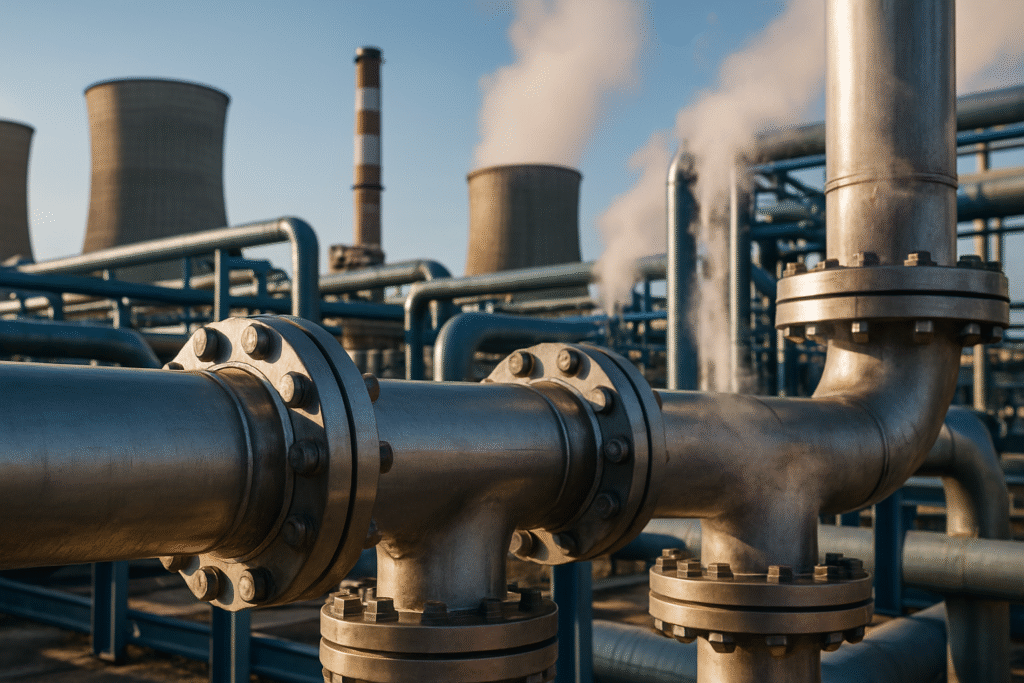
스테인레스 스틸 플랜지 테스트 및 규정 준수 요구 사항
그랜드뷰 리서치에 따르면 (2024), 전 세계 산업용 플랜지 시장의 가치는 다음과 같습니다. $5.8 10억 2023 도달할 것으로 예상됩니다. $7.2 10억 단위로 2030. That growth highlights why the stainless steel pipe flange has become a critical component for reliability, 부식 제어, and lifecycle cost management across industrial applications.
조달 관리자 및 배관 엔지니어용, the real value is not only in material grade selection. It also lies in understanding the hidden advantages, 압력 등급, 표준 준수, and manufacturing quality behind every flange used in demanding pipe systems.
Stainless Steel Pipe Flange Demand Is Rising Across Global Industrial Applications
IBISWorld에 따르면 (2024), 아시아 태평양 계정은 이상입니다. 45% 글로벌 플랜지 생산량의, 중국이 가장 큰 제조사이기 때문에. 그러므로, buyers increasingly evaluate not just product type, 뿐만 아니라 공장 능력, 수출 규정 준수, and supply chain resilience.
스태티스타에 따르면 (2024), 석유 및 가스 산업은 대략적으로 35% 글로벌 플랜지 소비량. This concentration explains why stainless steel pipe flange procurement often prioritizes corrosion resistance, 압력 무결성, and full traceability for upstream, 내의 한복판, and downstream applications.
게다가, stainless steel continues to gain share in projects where maintenance costs are under scrutiny. 결과적으로, engineers often choose 304, 316, and duplex grades for systems exposed to chlorides, 온도 사이클링, or aggressive media.
Competitor pages in this segment often focus heavily on material lists. 하지만, buyers usually need more practical guidance on pressure class, 직면 유형, dimensional standards, 검사 서류, and long-term service performance.
That gap matters because flange failure rarely comes from a single factor. 많은 경우, leakage or cracking results from a mismatch between material grade, 개스킷 선택, 볼트 하중, 부식 허용량, 및 작동 온도.
모르도르 정보국에 따르면 (2024), process industry capital spending remains strong in energy, 약, and water infrastructure. 따라서, demand for stainless steel pipe flange assemblies is expanding in both replacement projects and new-build plants.
글로벌 바이어를 위한, supplier qualification has become more technical. They want EN 10204 3.1 인증, PMI 기능, hydrostatic or pneumatic test coordination, ASME 준수, ASTM, DIN, JIS, 고스트, and EN dimensional systems.
SASA FLANGE 이 환경에서 작동 ISO 9001:2015 및 PED 2014/68/EU 인증. The company manufactures stainless steel flanges, 탄소강 플랜지, 합금 플랜지, 그리고 파이프 피팅 304, 316, 316엘, 904엘, 2205, 2507, A105, A182, 인코넬, 모넬, 하스텔로이, 및 티타늄 등급.
추가적으로, purchasing teams increasingly compare total installed cost instead of only unit price. A lower-cost flange can become expensive if machining tolerance, 마무리를 향함, or material verification is inconsistent.
시장 조사 미래에 따르면 (2024), industrial flow-control and piping component demand is supported by expansion in water treatment and power generation. 그러므로, stainless steel pipe flange products are now specified well beyond traditional petrochemical use.
실용적인 측면에서, this means buyers should assess more than the catalog description. They should review flange type, 공칭 크기, 압력 등급, 일정 호환성, 용접 준비, and end-user documentation before issuing a purchase order.
숨겨진 장점, 유형, and Uses of Stainless Steel Pipe Flange Systems
The hidden advantages of a stainless steel pipe flange are often economic as well as technical. Stainless grades can reduce unplanned shutdowns, support easier maintenance access, and maintain mechanical integrity in corrosive pipe services.
존 브린으로서, 수석 배관 엔지니어, 주: “Flange selection is never just about pressure class; it is about the interaction of metallurgy, 탈당, 개스킷 응력, and service environment.” That observation reflects why engineered flange selection delivers better plant reliability than commodity-based purchasing.
According to ASTM material specifications such as ASTM A182, forged stainless flanges are widely used for high-pressure and high-temperature service (ASTM, 2024). 게다가, ASME B16.5 remains the primary dimensional standard for NPS 1/2 ~을 통해 24, ~하는 동안 ASME B16.47 더 큰 직경을 커버 (ASME, 2023).
Different flange types serve different mechanical and operational purposes. 그러므로, understanding the main types helps buyers choose flanges that balance installation speed, 피로 저항, and maintenance accessibility.
- 웰드 넥 플랜지: 고압에 선호, 순환, or elevated-temperature service because the tapered hub reduces stress concentration.
- 슬립온 플랜지: common in lower-pressure systems where easier alignment and lower initial cost matter.
- 블라인드 플랜지: used to terminate a pipe line, valve outlet, or equipment nozzle for testing or future expansion.
- 소켓 용접 플랜지: suited for smaller bore, high-pressure lines where internal leakage paths must be minimized.
- 스레드 플랜지: useful where welding is not practical, especially in utility or hazardous areas with installation constraints.
- 랩 조인트 플랜지: selected when frequent dismantling or alloy stub-end optimization improves maintenance economics.
The most common stainless grades each offer distinct performance advantages. 예를 들어, 304 and 304L provide broad corrosion resistance and good formability, ~하는 동안 316 and 316L improve pitting resistance in chloride-bearing services.
For severe environments, engineers often move to 904L, 듀플렉스 2205, 또는 슈퍼 듀플렉스 2507. These grades improve resistance to pitting, 틈새 부식, and stress corrosion cracking in many offshore, 화학적인, and seawater applications.
박사로서. 엘레나 모리스, 재료 과학자, 주: “The correct stainless flange grade can extend service life by years, but only when the metallurgy matches the chloride level, 온도, and process chemistry.” That point is especially important in marine and petrochemical applications.
NACE 지침에 따르면, chloride concentration and temperature strongly influence stainless steel corrosion behavior in sour and saline environments (NACE, 2023). 그러므로, 316L may perform well in mild plant water systems, while duplex grades are often chosen for offshore skids and desalination units.
Procurement teams also ask how to choose flanges by pressure class. 실제로, ASME 클래스 150, 300, 600, 900, 1500, 그리고 2500 ratings determine the pressure-temperature envelope, but the allowable service depends on material group and design temperature under ASME rules.
- Low to moderate pressure utility service often uses Class 150 또는 300.
- Refining and process lines frequently specify Class 300 에게 900.
- Critical high-pressure systems may require Class 1500 또는 2500 with tighter QA controls.
Facing type also affects sealing performance. Raised face flanges are the most common for process plants, while ring type joint flanges are favored for high-pressure hydrocarbon service because they provide a metal-to-metal sealing configuration with RTJ gaskets.
표면 마무리, bolt torque, and gasket compatibility are equally important. Even a premium stainless steel pipe flange can leak if the serration finish does not match gasket type or if bolt stress is not applied evenly.
According to ISO-aligned quality studies in industrial manufacturing, dimensional consistency and material traceability significantly reduce field rejection rates (ISO, 2023). 결과적으로, factory machining capability now matters as much as raw material origin.
고급 CNC 가공 및 포괄적인 품질 테스트를 통해 뒷받침됨, SASA FLANGE 사용자 정의 크기를 제공합니다 1/2 인치에서 60 경쟁력 있는 공장 직접 가격의 인치. The company supports oil and gas, 석유화학, 발전, 조선, 선박, 수처리, and construction projects in more than 50 국가.
Buyers looking at stainless steel flanges and fittings should also align the flange bore with the mating pipe schedule. A mismatch between Schedule 40, 80, or XXS wall thickness and flange bore can create flow disruption or welding complications.
그러므로, technical review should include these details before order release.
- 재질 등급 및 열처리 조건.
- 다음과 같은 적용 가능한 표준 ASME B16.5, ASME B16.47, DIN, JIS, 또는 EN 1092.
- 압력 등급 또는 PN 등급.
- RF와 같은 외장형, RTJ, 또는 FF.
- Bore to match pipe schedule.
- Inspection requirements including PMI, 유타, PT, 그리고 EN 10204 3.1 서류.
표준, 규정 준수, and Testing Requirements for Stainless Steel Pipe Flange Supply
Standards compliance is one of the most important differentiators in B2B flange sourcing. Engineers need proof that dimensions, 재료화학, 압력 온도 등급, and marking all align with project specifications.
ASME B16.5 covers dimensions, 공차, 압력 등급, and marking for pipe flanges and flanged fittings from NPS 1/2 에게 24. ASME B16.47 extends coverage to larger diameters, which is essential for tank farms, 파이프라인, and major utility headers (ASME, 2023).
재료 표준도 똑같이 중요합니다. ASTM A182 일반적으로 단조 스테인레스 및 합금강 플랜지를 관리합니다., ~하는 동안 ASTM A240 applies to plate products used in some flange-related fabrication contexts (ASTM, 2024).
유럽 프로젝트에는 EN이 필요한 경우가 많습니다. 1092 dimensional compliance and PED 2014/68/EU documentation. 대조적으로, German or broader EU customers may also request AD 2000 alignment depending on end-use equipment classification.
For corrosion-sensitive service, specifications may also refer to NACE MR0175 또는 ISO 15156. These requirements matter where sour service or sulfide stress cracking risks affect metallurgy selection.
- ASME B16.5: flange dimensions and ratings for common sizes.
- ASME B16.47: larger diameter flange standards.
- ASTM A182: 단조 또는 압연 합금 및 스테인레스 스틸 파이프 플랜지.
- ASME B16.9: factory-made wrought buttwelding fittings that often mate with flange systems.
- EN 1092: 유럽 플랜지 치수 및 압력 지정.
- PED 2014/68/EU: regulatory compliance for pressure equipment in the EU.
Inspection and documentation are where many suppliers either build trust or lose it. 그러므로, serious buyers usually require positive material identification, 치수검사, visual examination, marking verification, and full mill traceability.
Typical quality documents requested in industrial flange orders include the following.
- EN 10204 3.1 재료 테스트 인증서.
- PMI reports for stainless, 듀플렉스, 및 니켈 합금.
- Hardness or ferrite measurements where applicable.
- Dimensional inspection reports for bore, 두께, and bolt circle accuracy.
- Surface finish verification for serrated raised face or RTJ groove profiles.
해양 및 해양 부품에 대한 DNV 지침에 따름, documented material traceability and inspection control are critical for safety-related pressure parts (DNV, 2023). 따라서, marine buyers often scrutinize marking, 부식 허용량, and certificate completeness before shipment approval.
There is also a commercial advantage to dealing with a supplier that understands both global and regional standards. A flange manufactured to ASME dimensions may not automatically satisfy EN project expectations unless the documentation and design basis are aligned from the start.
ASME publishes the principal dimensional framework used in many international projects. 하지만, project specifications may also override default tolerances, 테스트 범위, or marking details, so quote review should always include the final client datasheet.
와 함께 ISO 9001:2015, PED 2014/68/EU, 그리고 광고 2000 인증, SASA FLANGE supports documentation-driven procurement for export projects. 이 회사는 팔꿈치도 공급합니다., 티셔츠, 감속기, 그리고 밑에 모자 ASME B16.9, which helps buyers consolidate sourcing for complete pipe system packages.
In high-value orders, compliance should be verified before production starts. This approach reduces NCRs, shipping delays, and costly field modifications after the flanges arrive on site.
오일용 플랜지를 선택하는 방법, 가스, 화학적인, 힘, and Marine Pipe Systems
To choose flanges correctly, engineers must start with service conditions rather than catalog familiarity. 중간, 온도, 압력, corrosion potential, assembly frequency, and inspection class all influence the right configuration.
석유 및 가스 응용 분야, 316L의 용접 넥 플랜지, 듀플렉스 2205, or alloy grades are often selected for pressure cycling and corrosive fluids. 스태티스타에 따르면 (2024), 석유와 가스는 약 35% 글로벌 플랜지 소비량, so this sector strongly shapes design preferences.
For petrochemical units, stainless steel pipe flange assemblies are commonly specified where organic acids, 용매, or chloride-bearing streams threaten carbon steel performance. 이러한 경우, 316L or 904L may offer lower lifecycle cost despite a higher initial purchase price.
Power generation projects create a different selection challenge. 열 순환, 스팀 서비스, and larger nominal diameters often push buyers toward stronger forged materials, precise machining, and tighter dimensional control.
Marine and shipbuilding applications demand close attention to salt exposure and crevice corrosion. 그러므로, 316엘, 듀플렉스 2205, 그리고 슈퍼 듀플렉스 2507 are regularly evaluated for ballast, 바닷물, 화주, 및 담수화 시스템.
Water treatment plants also benefit from stainless solutions, especially where chloride content, disinfection chemicals, or maintenance access matter. 게다가, corrosion-resistant flanges can reduce leakage risk and support cleaner long-term operation.
These selection criteria help procurement teams compare options more accurately.
- Material grade based on corrosion mechanism and media composition.
- Pressure class or PN rating based on design pressure and temperature.
- Flange type based on welding method, 유지 관리 필요, and pipe stress.
- Facing type based on gasket compatibility and leak-tightness requirement.
- Size and bore based on nominal pipe size and schedule.
- Certification and testing based on project specification and destination market.
- Lead time and lot traceability based on shutdown or construction schedule.
A practical example illustrates the difference. 에이 4 인치 스테인레스 스틸 파이프 플랜지 304 may be acceptable for general water service, but the same size in offshore chloride exposure could require 316L or 2205 to avoid premature corrosion.
비슷하게, stainless steel threaded pipe flange products may suit utility systems where welding is difficult. 하지만, for vibration-prone or high-temperature lines, weld neck or socket weld configurations generally provide better structural integrity.
마이클 트렌트 역, 산업 시장 분석가, 주: “Procurement performance improves when buyers compare total cost of ownership rather than headline price per flange.” That means freight, 테스트, 선적 서류 비치, 재작업 위험, and service life all belong in the buying decision.
그랜드뷰 리서치에 따르면 (2024), industrial infrastructure expansion continues to support long-term demand for critical piping components. 그러므로, buyers should build qualified supplier relationships before urgent outages or project peaks occur.
맞춤형 프로젝트의 경우, dimensional flexibility can be decisive. SASA FLANGE manufactures standard and non-standard flanges in stainless steel, 탄소강, 합금강, 및 특수 합금, supporting custom drawings, 특수 드릴링, and multiple facing configurations.
That flexibility is especially useful when a project combines ASME lines with DIN or EN equipment nozzles. Instead of forcing field adaptation, buyers can source application-specific flanges that simplify fit-up and reduce installation labor.
추가적으로, factory coordination between flanges and fittings creates procurement efficiency. Buyers can combine elbows, 티셔츠, 감속기, 모자, and matching flanges into one quality-controlled package, which reduces vendor management complexity.
스테인레스 스틸 파이프 플랜지 조달에 대한 향후 전망 및 전략적 구매 권장 사항
The market outlook remains positive as industrial investment continues in energy, 약, 담수화, 인프라. 그랜드뷰 리서치에 따르면 (2024), the flange market is projected to reach $7.2 10억 단위로 2030, indicating stable long-term demand.
게다가, buyers are moving toward higher-specification procurement. Instead of ordering only by generic description, they increasingly request alloy verification, project-specific documentation, and manufacturer quality records.
Digital procurement is also changing buyer behavior. Engineers now expect quick access to drawings, pressure class information, MTC support, and response time that matches shutdown schedules.
결과적으로, suppliers that combine technical support with manufacturing discipline will win more global projects. This is especially true for stainless steel pipe flange orders tied to export documentation, PED requirements, or offshore service conditions.
전략적으로, 구매자는 네 가지 조치를 취해야 합니다.. 첫 번째, standardize approved grades for recurring applications so replacement purchases are faster and more consistent.
두번째, verify standards and documentation during quotation review rather than after production. 제삼, compare total installed cost, not just ex-works unit price.
네번째, qualify suppliers that can support both standard and custom requirements across flanges and fittings. 필요한 프로젝트의 경우 304, 316, 904엘, 2205, 2507, 또는 니켈 합금 용액, 함께 일하다 SASA FLANGE helps procurement teams secure factory-direct supply backed by advanced machining, 검사 통제, and export-ready certification.
자주 묻는 질문
어느 것이 더 낫습니까? 304 또는 420 스테인레스 스틸?
●304 stainless steel is generally better for stainless steel pipe flange applications because it offers stronger corrosion resistance and broader industrial process compatibility than 420.
●According to ASTM and common industrial material practice, 420 is a martensitic stainless grade valued for hardness, ~하는 동안 304 is an austenitic grade preferred for weldability, 인성, and corrosion performance in pipe systems.
●For flange service, engineers usually choose 304 or 304L for general chemical, 물, and food-related applications, 반면 420 is more common in tools, blades, and wear components than pressure-retaining flanges.
스테인레스 스틸 플랜지에 대한 ASME 코드는 무엇입니까?
●The main ASME dimensional code for stainless steel pipe flange products is ASME B16.5 NPS용 1/2 ~을 통해 24 그리고 ASME B16.47 더 큰 크기의 경우.
●ASTM A182 commonly covers forged stainless flange material requirements, while pressure-temperature ratings and dimensions are controlled by the applicable ASME standard.
●Buyers should confirm both the ASME dimensional code and the ASTM material specification on every RFQ to avoid mismatched manufacturing, 점검, or documentation.
스테인레스 스틸 플랜지는 무엇에 사용됩니까??
●파이프 연결에는 스테인레스 스틸 플랜지가 사용됩니다., 밸브, 슬리퍼, and equipment nozzles in systems that require strength, 내식성, and maintainable joints.
●스태티스타에 따르면 (2024), 석유와 가스는 약 35% 글로벌 플랜지 소비량, but stainless flanges are also widely used in petrochemical, 선박, 수처리, 및 전력 애플리케이션.
●For chloride exposure, hygiene-sensitive service, or high-maintenance environments, stainless flange systems often provide better lifecycle value than carbon steel alternatives.
세 가지 유형의 플랜지는 무엇입니까?
●가장 일반적으로 참조되는 세 가지 플랜지 유형은 용접 넥입니다., 슬립온, 및 블라인드 플랜지, although many plants also use threaded, 소켓 용접, 및 랩 조인트 디자인.
●Weld neck flanges suit high-pressure and high-temperature service, slip-on flanges support easier installation in lower-pressure systems, and blind flanges close the end of a line or nozzle.
●Selection should always match the pipe schedule, 압력 등급, gasket arrangement, and maintenance condition rather than relying only on price.
스테인레스 스틸 파이프 플랜지 가격에 영향을 미치는 것은 무엇입니까??
●스테인레스 스틸 파이프 플랜지 가격은 주로 합금 등급에 따라 다릅니다., 크기, 압력 등급, 직면 유형, 테스트 범위, 및 인증 요구 사항.
●그랜드뷰 리서치에 따르면 (2024), 산업용 플랜지 시장 진출 $5.8 10억 2023, and that scale reflects ongoing demand pressure on raw materials, 가공능력, and supply lead times.
●To compare offers accurately, buyers should request a clear quotation covering material origin, EN 10204 3.1 인증, 점검, 포장, and delivery terms.
How do I choose the right flange diameter and size?
●Flange diameter and size must match the nominal pipe size, 벽 일정, 압력 등급, and the dimensional standard such as ASME B16.5 또는 EN 1092.
●에이 4 인치 스테인레스 스틸 파이프 플랜지, 예를 들어, can vary in bore and outside dimensions depending on schedule, 압력 등급, and facing design.
●중요한 프로젝트의 경우, buyers should send the pipe specification, 설계압력, and drawing to an experienced manufacturer like SASA FLANGE to confirm fit-up before production.
관련 게시물

오리피스 플랜지 정의, 세부 정보 및 ASME B16.36 플랜지 개요: 시장 데이터, 선택 가이드 및 규정 준수 통찰력
전 세계 산업용 플랜지 시장의 가치는 다음과 같습니다. $5.8 10억…
