
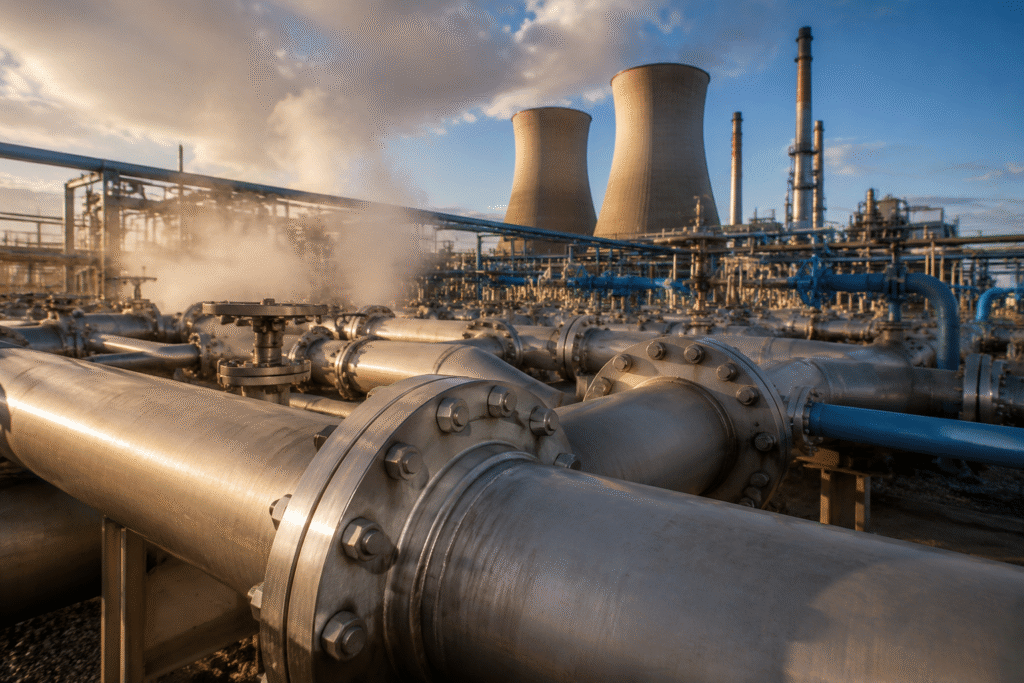
ASME 및 EN 스테인리스강 플랜지 규정 준수 가이드
그랜드뷰 리서치에 따르면 (2024), 전 세계 산업용 플랜지 시장의 가치는 다음과 같습니다. $5.8 10억 2023 도달할 것으로 예상됩니다. $7.2 10억 단위로 2030. 그 성장은 스테인레스 스틸 파이프 플랜지 selection more strategic for EPC contractors, OEM, and plant buyers who need corrosion resistance, 규정 준수, 및 수명주기 가치.
엔지니어용, the real decision is not only about price. It is about matching flange ratings, alloy grades, face types, and applicable standards such as ASME B16.5 그리고 ASME B16.47 to the service environment.
스테인레스 스틸 파이프 플랜지 수요를 뒷받침하는 산업 시장 동인
The global flange sector is expanding because energy, 물, and process industries continue to invest in new pipeline systems and maintenance programs. IBISWorld에 따르면 (2024), 아시아 태평양 계정은 이상입니다. 45% 글로벌 플랜지 생산량의, with China remaining the largest manufacturer.
조달팀에게는 지역적 집중이 중요합니다. 리드타임에 영향을 미칩니다, mill traceability, 수출 능력, and the availability of stainless, 합금, and carbon steel grades in both standard and custom dimensions.
스태티스타에 따르면 (2024), 석유 및 가스 산업은 대략적으로 35% 글로벌 플랜지 소비량. 그러므로, specifications for sour service, offshore corrosion, elevated temperature duty, and high-pressure piping continue to shape the global buying pattern for flange products.
병렬로, water treatment and marine sectors are raising demand for 316L, 듀플렉스, and higher-alloy materials. 게다가, stricter uptime targets are pushing buyers toward materials that reduce unplanned shutdowns and total installed cost.
모르도르 정보국에 따르면 (2024), industrial infrastructure modernization in Asia and the Middle East is accelerating demand for pressure-rated piping components. 결과적으로, buyers increasingly compare not only flange cost, but also documentation packages such as EN 10204 3.1, PMI, 수압시험 기록, 및 치수 검사 보고서.
The Hidden Advantages of stainless steel pipe flange products often appear after installation. Stainless grades can deliver better corrosion resistance, improved hygienic performance, stronger oxidation resistance, and lower maintenance frequency than many coated carbon steel alternatives.
하지만, not all Stainless Steel Flanges? are equal. Grade selection should consider chloride content, 공정 온도, 압력 등급, 개스킷 호환성, and whether welding will affect sensitization resistance.
존 레이놀즈처럼, a corrosion and materials engineer in the refining sector, 주: “A flange is never just a connector; it is a pressure boundary, and material mismatch is one of the fastest ways to create long-term reliability issues.” That view aligns with ASME and ASTM best practice, where system integrity depends on the combined performance of flange, 탈당, 틈 메우는 물건, and weld preparation.
For buyers evaluating dependable supply partners, SASA FLANGE brings relevant industrial credentials to the discussion. 와 함께 ISO 9001:2015 및 PED 2014/68/EU 인증, 이 회사는 스테인레스 스틸 플랜지를 제조합니다., 탄소강 플랜지, 합금 플랜지, 오일용 및 파이프 피팅 & 가스, 석유화학, 발전, 선박, 수처리, 및 건설 프로젝트.
SASA FLANGE also supports a wide range of grades, 포함 304, 316, 316엘, 904엘, 2205, 2507, A105, A182, 인코넬, 모넬, 하스텔로이, 그리고 티타늄. 추가적으로, it offers custom sizes from 1/2 인치에서 60 신장, backed by CNC machining and quality inspection for export markets.
Technical Comparison of Stainless Steel Pipe Flange Types, 용도, 그리고 숨겨진 장점
The most effective way to Choose a Flange is to evaluate service conditions first and geometry second. 실제로, 유형, 얼굴, schedule match, 압력 등급, and material grade must work together across the whole Pipe system.
시장 조사 미래에 따르면 (2024), industrial buyers increasingly prefer long-life piping components that lower maintenance intervals and downtime costs. 그러므로, Stainless flange demand is rising in chemical, 담수화, 식품 등급, and offshore systems where corrosion resistance drives total value.
박사로서. Elena Markovic, a materials scientist focused on process metallurgy, 주: “The hidden cost of a low-grade flange is rarely visible at purchase, but it becomes obvious when chloride attack, gasket leakage, or thermal cycling starts to compromise the joint.” Her comment is especially relevant when comparing 304, 316엘, 904엘, 듀플렉스 2205, 그리고 슈퍼 듀플렉스 2507.
The most common stainless steel pipe flange Types include weld neck, 미끄러지다, 눈이 먼, 소켓 용접, 스레드, 그리고 랩 조인트. Each design has different stress distribution, welding requirements, maintenance benefits, and installation economics.
- 웰드 넥 플랜지: Best for high pressure and cyclic service because the tapered hub improves stress transfer.
- 플랜지에 미끄러짐: Popular for moderate-pressure systems because installation is simpler and fabrication cost is often lower.
- 블라인드 플랜지: 줄 끝을 닫는 데 사용됩니다., 밸브, and vessel nozzles for testing or future expansion.
- 소켓 용접 플랜지: Common in smaller bore, high-pressure systems where alignment is important.
- 스레드 플랜지: 용접이 제한된 곳에 유용, although pressure and vibration limitations must be considered.
- 랩 조인트 플랜지: Preferred where frequent dismantling is required and stub ends simplify alignment.
When buyers compare 304 그리고 316 series stainless grades, molybdenum content is usually the dividing line. 등급 316 and 316L offer better resistance to chlorides and aggressive chemical media than 304 그리고 304L, which makes them common in marine, 제약, and coastal process applications.
For severe environments, higher alloys create measurable Hidden Advantages. Grades such as 904L, 듀플렉스 2205, 그리고 2507 improve pitting resistance, 응력 부식 균열 저항, and strength-to-weight performance, especially in brine, 바닷물, and sour service conditions.
According to NACE guidance for corrosion control and material selection, chloride content and temperature strongly influence stainless performance in process systems (NACE, 2024). 따라서, a 316L Flange may perform well in one unit, while duplex becomes the safer option in another.
Pressure class and standard are equally important. ASME B16.5 일반적으로 NPS를 다룹니다. 1/2 ~을 통해 24, ~하는 동안 ASME B16.47 addresses larger diameter flanges from NPS 26 ~을 통해 60, depending on Series A and Series B dimensions (ASME, 2023).
These distinctions affect bolt circle, 플랜지 두께, and weight. 그러므로, buyers should not assume interchangeability across B16.5, B16.47, DIN, JIS, EN 시스템.
- ASME B16.5: Standard for pipe flanges and flanged fittings, NPS 1/2 에게 24.
- ASME B16.47: Large diameter steel flanges, NPS 26 에게 60.
- ASTM A182: Common forged material specification for stainless and alloy flanges.
- EN 1092-1: Widely used European flange standard.
- DIN and JIS: Important for regional project specifications and replacement compatibility.
A technical purchasing review should also include facing type and sealing philosophy. 올려진 얼굴, 평평한 얼굴, 링형 조인트, and tongue-and-groove configurations all influence gasket seating stress and leak integrity.
According to API and ASME field data summarized by industry analysts, a significant share of bolted-joint leakage events trace back to installation issues rather than flange metallurgy alone. 결과적으로, even the best Stainless Steel Pipe Flange can underperform if bolt load, flange alignment, or gasket compression is incorrect.
고급 CNC 가공 및 포괄적인 품질 테스트를 통해 뒷받침됨, SASA FLANGE supplies weld neck, 미끄러지다, 눈이 먼, 스레드, 랩 조인트, and custom Flanges for multi-standard projects. Manufacturing in 304, 316, 904엘, 2205, 2507 그리고 다른 프리미엄 등급, the company supports both standard procurement and engineered replacements.
For project teams comparing suppliers, material traceability is often decisive. EN 10204 3.1 인증, PMI for alloy verification, 치수검사, and surface finish control help reduce receiving risk and site rework.
ASME B16.5, B16.47, ASTM, DIN, and EN Compliance for Stainless Steel Flange Procurement
Standards are the language of reliable flange procurement. They define dimensions, 압력 온도 등급, 공차, testing expectations, and material requirements across global projects.
For forged stainless Flange products, ASTM A182 remains one of the most referenced specifications. 게다가, ASME B16.5 그리고 ASME B16.47 establish dimensional and pressure class requirements that directly affect assembly compatibility.
ASME에 따르면 (2023), 압력-온도 등급은 재료 그룹 및 플랜지 등급에 따라 다릅니다., including Class 150, 300, 600, 900, 1500, 그리고 2500. 그러므로, buyers must verify not only nominal size, but also the exact standard, 깃 달기, 재료, and service temperature before issuing a purchase order.
European and international projects often specify EN 1092-1, DIN, or mixed-standard interfaces. 대조적으로, North American refinery and pipeline jobs often prioritize ASME, ASTM, and API references.
- ASME B16.5: Small and medium nominal sizes with established pressure classes.
- ASME B16.47: Large-diameter steel flanges with Series A and Series B variations.
- ASTM A182: Material properties for forged or rolled alloy and stainless steel flanges.
- EN 1092-1: European flange dimensions and pressure designations such as PN10, PN16, PN40.
- NACE MR0175: Material guidance for sour service environments where sulfide stress cracking is a concern.
Procurement managers should also ask about compliance packages. A strong documentation set typically includes MTC 3.1, 열수 추적성, 차원 보고서, 육안 검사, 필요한 경우 PMI, and packing controls for export shipment.
Inspection capability is a practical differentiator in global sourcing. According to ISO quality management guidance and PED requirements, 프로세스 제어, calibration discipline, and documented verification are central to pressure component compliance (ISO, 2015; 소아과, 2014/68/EU).
That is where supplier maturity matters. 와 함께 ISO 9001:2015, PED 2014/68/EU, 그리고 광고 2000 신임장, SASA FLANGE aligns manufacturing and quality control with project-driven documentation needs.
The company also serves 50+ 석유를 건너는 나라들 & 가스, 석유화학, 힘, 해양산업. 게다가, it offers export-oriented support for stainless steel flanges, 탄소강 플랜지, 합금 플랜지, 그리고 ASME B16.9 pipe fittings including elbows, 티셔츠, 감속기, 그리고 모자.
Buyers replacing imported components should pay attention to interchangeability limits. A nominal 4 inch stainless steel pipe flange under ASME may not match the drilling pattern or thickness of a DIN or EN equivalent.
For technical verification, engineers should consult the official standards publisher when preparing final specifications, ~와 같은 ASME.org. That extra step can prevent costly site mismatch, especially on revamp projects with mixed legacy systems.
게다가, pressure systems in corrosive duty may require more than dimensional compliance. Material hardness, ferrite balance in duplex grades, and surface finish can all affect long-term sealing reliability.
오일용 스테인레스 스틸 파이프 플랜지를 선택하는 방법, 가스, 힘, 선박, 및 물 시스템
The best stainless steel pipe flange choice depends on media, 온도, 압력, inspection class, 유지보수 철학. 하지만, many procurement delays happen because specifications focus only on size and omit service conditions.
기름에 & 가스, weld neck and RTJ configurations often dominate critical lines because they support higher pressure and better joint integrity. 스태티스타에 따르면 (2024), this sector alone consumes about 35% of all global flanges, which explains why hydrocarbon standards heavily influence product design and inventory planning.
석유화학 및 화학공장에서, alloy selection becomes the central issue. 316L may be adequate for general corrosion resistance, 904L 동안, 하스텔로이, or duplex can be required for chloride, 황산, or mixed-media conditions.
발전에 있어서, thermal cycling and pressure fluctuations shape Flange decisions. 그러므로, engineers often prioritize forged materials, controlled machining tolerances, and proven gasket compatibility over lowest initial cost.
Marine and shipbuilding applications add another layer of complexity. 소금 스프레이, 습기, splash zone exposure, and maintenance access frequently justify upgrading from 304 to 316L or duplex grades.
Water treatment systems often require a balance between cost and corrosion life. Stainless options can outperform coated carbon steel where disinfection chemistry, 기수, or intermittent wet-dry cycles accelerate surface degradation.
- Choose 304/304L for general industrial service with moderate corrosion exposure and good weldability.
- Choose 316/316L for chloride-bearing environments, marine exposure, and more aggressive process media.
- 선택하다 2205 듀플렉스 for stronger chloride resistance and higher mechanical strength.
- Choose 904L or nickel alloys for highly corrosive chemical duty.
- Choose weld neck for severe pressure, 진동, and thermal cycling.
- Choose slip on where fabrication simplicity and budget are priorities.
- Choose blind for isolation, 테스트, and future line expansion.
마이클 트렌트 역, a senior piping engineer for offshore EPC projects, 주: “The right flange is selected by the system, not by the catalog page.” That means engineers should review line class, 부식 허용량, 개스킷 스타일, bolting material, and fabrication method together.
Practical sourcing criteria should include more than material grade. Buyers should evaluate mill source, 가공능력, 차원 일관성, 수출 포장, response time, and whether the vendor can support non-standard drilling or thickness requirements.
For projects requiring custom manufacturing, SASA FLANGE supports a broad size range from 1/2 인치에서 60 inches with factory-direct pricing. 추가적으로, the company can produce stainless, 탄소, 합금, and special material Flanges for project-specific drawings and mixed-standard packages.
That flexibility is valuable when contractors need both flanges and fittings from one source. It reduces supplier fragmentation, simplifies quality review, and can improve logistics planning for shutdown and turnaround work.
스테인레스 스틸 파이프 플랜지 공급에 대한 향후 전망, 가격, and Strategic Sourcing
Market conditions indicate that industrial buyers will continue balancing cost control with reliability. 그랜드뷰 리서치에 따르면 (2024), the flange market is forecast to grow from $5.8 10억 2023 에게 $7.2 10억 단위로 2030, which signals sustained procurement activity across infrastructure and process industries.
동시에, material price volatility will remain a challenge. 니켈, 몰리브덴, energy costs, and freight conditions directly affect the selling price of stainless steel pipe flange products.
IBISWorld에 따르면 (2024), Asia-Pacific contributes more than 45% 글로벌 플랜지 생산량의. 그러므로, strategic buyers should secure qualified supply channels in advance rather than waiting for urgent project windows.
Three practical recommendations stand out for 2024 그리고 그 이상. 첫 번째, standardize approved material and documentation requirements early in the RFQ process.
두번째, compare suppliers on delivered value rather than piece price alone. That includes machining quality, test capability, 리드타임 신뢰성, and export experience.
제삼, build flexibility into sourcing plans for both ASME and international projects. Mixed-standard environments are increasingly common, and they require technical review before release to production.
For companies planning new projects or replacement programs, a technically capable manufacturer can reduce commercial and operational risk. 그런 맥락에서, 함께 일하다 SASA FLANGE offers buyers access to certified manufacturing, broad material coverage, and responsive support for industrial flange and fitting requirements.
자주 묻는 질문
다양한 유형의 스테인레스 스틸 플랜지는 무엇입니까?
●주요 스테인레스 스틸 플랜지 유형은 용접 넥입니다., 미끄러지다, 눈이 먼, 스레드, 소켓 용접, 그리고 랩 조인트, 그리고 ASME B16.5 covers most standard sizes from NPS 1/2 에게 24.
●Each type serves a different function because weld neck flanges handle high stress well, while slip on flanges reduce fabrication complexity in moderate-pressure systems.
●For projects requiring correct type selection, 압력 등급 검증, 및 재료 추적성, 다음과 같은 기존 제조업체와 협력 SASA FLANGE helps ensure better fit-up and documentation.
어느 것이 더 낫습니까? 304 또는 420 스테인레스 스틸?
●등급 304 is generally better for stainless steel pipe flange service because it offers stronger corrosion resistance and better weldability than 420 in most industrial piping applications.
●등급 420 is a martensitic stainless steel with higher hardness, but it is less suitable for corrosive flange duty where sealing reliability and weld performance matter.
●For most process, 선박, 및 물 시스템, buyers should prioritize 304, 316, or duplex grades and confirm ASTM A182 compliance before ordering.
세 가지 유형의 플랜지는 무엇입니까?
●The three most commonly specified flange types in industrial projects are weld neck, 미끄러지다, and blind flanges because they cover most connection, 이행, 그리고 격리 요구.
●Weld neck is preferred for severe pressure and temperature cycles, slip on is common for economy and ease of installation, and blind flanges are used to close line ends or test sections.
●Engineers should still review service conditions, because threaded or lap joint flanges may be more suitable in small bore or frequent maintenance applications.
스테인레스 스틸 플랜지에 대한 ASME 코드는 무엇입니까?
●The primary ASME dimensional standards for stainless steel flanges are ASME B16.5 그리고 ASME B16.47, ~하는 동안 ASTM A182 commonly defines forged stainless material requirements.
●ASME B16.5 applies to NPS 1/2 ~을 통해 24, 그리고 ASME B16.47 addresses large-diameter flanges from NPS 26 ~을 통해 60 with Series A and Series B differences.
●Buyers should specify both the ASME standard and the ASTM material grade on purchase documents to avoid dimensional or metallurgical mismatch.
How do I evaluate stainless steel pipe flange price?
●스테인레스 스틸 파이프 플랜지 가격은 재료 등급에 따라 다릅니다., 압력 등급, 플랜지형, raw material costs, 가공 복잡성, 그리고 인증 요구사항은 다음과 같습니다. EN 10204 3.1.
●그랜드뷰 리서치에 따르면 (2024), the global flange market reached $5.8 10억 2023, and that scale reflects ongoing cost pressure from alloy metals, 에너지, and logistics.
●견적을 정확하게 비교하려면, buyers should request matched specifications for standard, 크기, 얼굴형, 수업, test documents, and delivery terms before making a decision.
신뢰할 수 있는 플랜지 제조업체 또는 플랜지 공급업체를 선택하는 방법?
●A reliable flange manufacturer should have relevant certifications, documented quality systems, 수출 경험, and the ability to supply ASME, ASTM, DIN, and EN compliant products.
●IBISWorld에 따르면 (2024), 아시아 태평양 지역은 다음을 대표합니다. 45% 글로벌 플랜지 생산량의, so supplier qualification should include traceability, 검사능력, and shipment performance.
●For buyers needing stainless steel flanges and fittings from one source, partnering with qualified producers such as SASA FLANGE can reduce sourcing risk and improve project coordination.
관련 게시물

오리피스 플랜지 정의, 세부 정보 및 ASME B16.36 플랜지 개요: 시장 데이터, 선택 가이드 및 규정 준수 통찰력
전 세계 산업용 플랜지 시장의 가치는 다음과 같습니다. $5.8 10억…
