
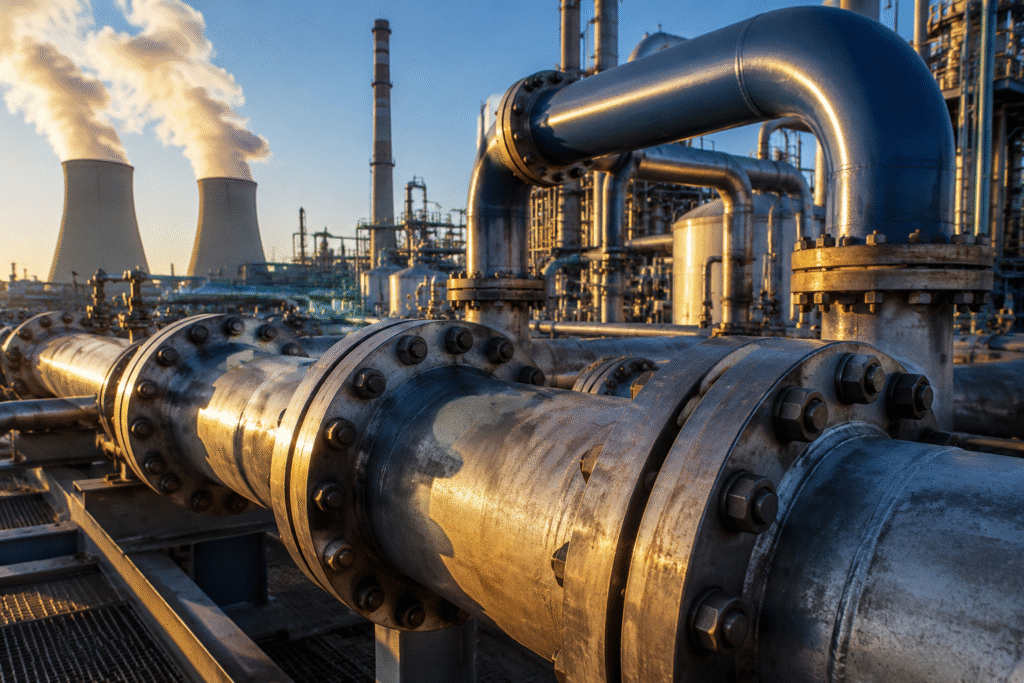
스테인레스 스틸 파이프 플랜지 가이드: 7 데이터 기반 이점, 유형, 용도 및 선택 기준
산업 운영자가 내식성을 우선시함에 따라 스테인레스 스틸 파이프 플랜지 수요가 계속 증가하고 있습니다., 수명주기 가치, 중요한 배관 시스템의 규정 준수. 그랜드뷰 리서치에 따르면 (2024), 전 세계 산업용 플랜지 시장의 가치는 다음과 같습니다. $5.8 10억 2023 도달할 것으로 예상됩니다. $7.2 10억 단위로 2030, which makes material selection more strategic than ever.
엔지니어 및 조달 팀용, the intriguing value of stainless solutions is no longer hidden. The advantages of stainless steel pipe flange products now extend beyond durability into traceability, 압력 무결성, and long-term operating efficiency.
Why Stainless Steel Pipe Flange Demand Is Growing Across Industrial Markets
Industrial buyers are choosing stainless steel pipe flange products because plant uptime depends on leak-tight, 부식 방지 조인트. 게다가, modern projects demand components that meet ASME, ASTM, DIN, and EN requirements without adding excessive maintenance risk.
IBISWorld에 따르면 (2024), 아시아 태평양 계정은 이상입니다. 45% 글로벌 플랜지 생산량의, 중국이 가장 큰 제조사이기 때문에. 그러므로, global sourcing strategies increasingly focus on qualified Chinese manufacturers that can combine scale, 가공 정밀도, and documentation control.
스태티스타에 따르면 (2024), 석유 및 가스 산업은 대략적으로 35% 글로벌 플랜지 소비량. 결과적으로, the market strongly favors materials such as 304, 316, 316엘, 2205, 그리고 2507 신맛 서비스를 위해, 난바다 쪽으로 부는, 정련소, and chemical processing applications.
Stainless grades remain attractive because they balance mechanical strength and corrosion resistance in chloride, 습한, and high-purity environments. 대조적으로, lower-alloy materials may require more frequent coating, 점검, or replacement in aggressive service.
ASME B16.5 그리고 ASME B16.47 govern key dimensional and pressure-temperature requirements for many industrial flanges, ~하는 동안 ASTM A182 defines forged stainless and alloy flange material requirements (ASME, 2023; ASTM, 2023). 따라서, buyers should evaluate both the material grade and the governing dimensional standard before placing an order.
The hidden procurement risk often lies in incomplete quality documentation rather than the flange itself. 그러므로, reputable suppliers should provide mill test reports, 열 추적성, 치수검사, 그리고 EN 10204 3.1 documentation when required.
재료공학 박사로서. Helen Morris states: “플랜지는 단순한 커넥터가 아닙니다.; it is a pressure boundary component, so alloy selection and standard compliance directly influence reliability.” That insight is especially relevant in petrochemical, 난바다 쪽으로 부는, and power generation systems where flange failure can shut down an entire line.
SASA FLANGE serves industrial customers in Oil & 가스, 석유화학, 발전, 조선, 수처리, 및 건설. 와 함께 ISO 9001:2015 및 PED 2014/68/EU 인증, the company supports global buyers seeking compliant stainless steel flanges and fittings from a factory-direct source.
추가적으로, sourcing from an experienced manufacturer helps buyers align design intent with actual production capability. For more supplier details, 구매자가 검토할 수 있습니다. company background and explore available categories at product pages.
스테인레스 스틸 파이프 플랜지 유형, Materials and Hidden Advantages in Real Service
The versatility of a stainless steel pipe flange comes from the range of flange types, 압력 등급, and metallurgy available for different services. 하지만, choosing correctly requires understanding how type, 등급, and application interact.
모르도르 정보국에 따르면 (2024), industrial infrastructure upgrades in energy and water sectors are accelerating demand for corrosion-resistant piping components worldwide. 뿐만 아니라, buyers increasingly request premium materials that reduce total cost of ownership rather than only minimizing purchase price.
As piping consultant Mark Ellison, 체육, 주: “The best flange selection starts with the process fluid, then temperature, then pressure class, and only after that with price.” This sequence helps engineers avoid short-term cost decisions that create long-term maintenance failures.
The most common stainless steel pipe flange materials include ASTM A182 F304, F304L, F316, F316L, F904L, F51, 그리고 F53. 추가적으로, specialized projects may specify Inconel, 모넬, 하스텔로이, or Titanium when standard stainless grades cannot handle the environment.
- 304 / 304엘: Good general corrosion resistance for water, 식품 가공, and moderate industrial service.
- 316 / 316엘: Improved molybdenum-bearing resistance to chlorides and many chemical media.
- 904엘: Stronger performance in reducing acids and severe corrosion environments.
- 2205 듀플렉스: Higher strength and strong pitting resistance for offshore and process systems.
- 2507 슈퍼 듀플렉스: Premium solution for high chloride and high-pressure service.
In many specifications, 316L remains the default choice for process plants that require better chloride resistance than 304L. 대조적으로, duplex and super duplex are often chosen when higher strength allows thinner wall design or improved resistance to stress corrosion cracking.
시장 조사 미래에 따르면 (2024), demand for duplex stainless components in energy and marine systems is growing at over 5% annually. 그러므로, procurement teams should evaluate duplex options earlier in the design stage instead of treating them as late substitutions.
The main flange Types used in industrial piping include weld neck, 미끄러지다, 눈이 먼, 소켓 용접, 스레드, 그리고 랩 조인트. Each Flange configuration has different benefits for alignment, bore continuity, 설치 속도, 및 검사 접근.
- 웰드 넥 플랜지: 고압에 가장 적합, 열 순환, 테이퍼형 허브가 응력 집중을 줄여주기 때문에 중요한 서비스입니다..
- 플랜지에 미끄러짐: Common for lower-pressure systems where installation efficiency and cost control matter.
- 블라인드 플랜지: 종료하는 데 사용됨, 격리하다, or future-proof piping systems.
- 스레드 플랜지: Useful where welding is restricted or field conditions are difficult.
- 소켓 용접 플랜지: Often selected for small-bore, 고압 배관.
- 랩 조인트 플랜지: Suitable when frequent dismantling is required.
For engineers comparing stainless steel flange types, the hidden advantages often appear during maintenance cycles. Weld neck designs can lower fatigue risk, while blind flanges simplify line isolation and hydrotest management.
Pressure class also matters. Common ASME classes include 150, 300, 600, 900, 1500, 그리고 2500, and the allowable pressure decreases as temperature rises according to ASME pressure-temperature ratings (ASME, 2023).
That is why a 4 inch stainless steel pipe flange for steam service may require a very different class and facing than the same nominal size in a water line. 비슷하게, a Stainless Steel Threaded Pipe Flange may fit utility service but not a severe cyclic process unit.
SASA FLANGE 플랜지를 제조합니다. 304, 316, 316엘, 904엘, 2205, 2507 그리고 다른 프리미엄 등급, 고급 CNC 가공 및 포괄적인 품질 테스트를 통해 지원됨. 게다가, the company offers custom sizes from 1/2 인치에서 60 inch with competitive factory-direct pricing for export projects.
Buyers looking to Choose the right product should match material grade, 플랜지 직면, 수업 평가, and inspection requirements before RFQ release. Project teams can discuss custom specifications directly through SASA FLANGE 지원팀에 문의.
표준, Certification and Compliance for Stainless Steel Flanges and Fittings
Compliance is essential because stainless steel flanges and Fittings often serve as pressure boundary components in regulated environments. 그러므로, every purchase order should reference the exact manufacturing standard, 재료 표준, 검사 범위, and document package.
Key dimensional and manufacturing references include ASME B16.5 NPS용 1/2 ~을 통해 24, ASME B16.47 더 큰 직경의 경우, 그리고 ASME B16.9 맞대기 용접 피팅의 경우. 추가적으로, international buyers often request DIN, JIS, 고스트, 또는 EN 1092 dimensions for plant compatibility.
재료 표준도 똑같이 중요합니다. ASTM A182 covers forged or rolled alloy and stainless flanges, 단조 피팅, 및 고온 서비스용 밸브, ~하는 동안 ASTM A240 covers stainless plate products used in some flange and fitting-related applications (ASTM, 2023).
NACE MR0175 / ISO 15156 becomes critical when sour service is involved because sulfide stress cracking can quickly compromise unsuitable materials (NACE, 2023). 비슷하게, PED 2014/68/EU requirements can apply for equipment supplied into the European market.
- ASME B16.5: 치수, 공차, 압력 온도 등급, 외장, and marking.
- ASME B16.47: Large-diameter flanges for major line sizes.
- ASTM A182: Material chemistry and mechanical requirements for forged stainless flanges.
- EN 1092: Common European flange dimensional standard.
- NACE MR0175: Material guidance for H2S-containing environments.
- EN 10204 3.1: Inspection document often requested by procurement teams.
ISO에 따르면 (2023), documented quality systems reduce variation in manufacturing and inspection processes across serial production. 결과적으로, ISO 9001:2015 certification remains a meaningful baseline for industrial flange suppliers serving multinational customers.
공급자를 비교하는 구매자의 경우, certifications should be matched with actual process control. A certificate alone does not confirm machining accuracy, PMI 기능, 수압 테스트 지원, ferrite control, or packaging discipline for export shipments.
That is why leading procurement teams request dimensional reports, PMI 결과, hardness checks where applicable, and full traceability from raw material to final marking. 게다가, export projects often require third-party inspection by SGS, BV, TUV, or similar agencies before shipment.
SASA FLANGE operates with ISO 9001:2015, PED 2014/68/EU, 그리고 광고 2000 credentials to support demanding industrial supply chains. 뿐만 아니라, the company can provide EN 10204 3.1 certification and coordinate inspection requirements for international EPC and MRO buyers.
The following comparison helps clarify common standard selection logic:
- ASME 시스템: Preferred for North America, global EPC, 석유와 가스, and refinery projects.
- EN / DIN system: Preferred for European industrial plants and equipment integration.
- JIS 시스템: Common in Japanese standards environments and some Asian installations.
- Custom drawings: Required for OEM skids, packaged units, and retrofit dimensions.
Procurement managers should also verify flange facing requirements such as RF, FF, RTJ, or custom serration patterns. 중요한 서비스에서, a mismatch between gasket type and flange facing can cause leakage even when the metallurgy is correct.
For authoritative standard details, buyers should consult the relevant organization directly, 포함 ASME. Internal coordination with an experienced manufacturer shortens review cycles, especially when mixed standards or special materials are involved.
오일용 스테인레스 스틸 파이프 플랜지 솔루션을 선택하는 방법, 가스, 힘, 해양 및 수자원 시스템
선택은 서비스 조건부터 시작되어야 합니다, not with price alone. 예를 들어, 유체화학, 염화물, 온도, 압력, cycling frequency, and inspection requirements all influence the correct flange specification.
기름에 & Gas projects, stainless steel pipe flange selection often focuses on sour service, offshore corrosion, and high-integrity bolted joints. 그러므로, 316엘, 2205, 그리고 2507 are commonly reviewed depending on chloride level and design pressure.
해양 시스템에 대한 DNV 지침에 따름 (DNV, 2023), material performance in chloride-rich marine environments is a major design factor for long service life. 따라서, duplex or super duplex may outperform standard austenitic grades in many offshore skid and seawater applications.
석유화학공장에서, material compatibility with acids, 용매, and chlorides becomes decisive. 게다가, low-carbon grades like 304L and 316L help reduce sensitization risk after welding in many process lines.
발전용, thermal cycling and pressure transients often drive flange type selection. 결과적으로, weld neck designs are frequently preferred in steam, 응축수, and high-temperature auxiliary systems.
Marine and shipbuilding projects require strong resistance to salt-laden atmospheres and splash-zone exposure. 그러므로, 316엘, 2205, 그리고 2507 are often considered for deck piping, 안정기 시스템, 소방선, and desalination units.
Water treatment systems also benefit from stainless flange durability because chemical dosing and variable water quality can accelerate corrosion in coated carbon steel components. 추가적으로, clean finish and low maintenance support lifecycle savings in municipal and industrial treatment plants.
- Check the medium: Confirm chloride content, pH, 황화물, 그리고 청소용 화학물질.
- Check pressure and temperature: Match ASME class and material limits to operating and upset conditions.
- 플랜지 종류를 확인하세요: Select weld neck, 미끄러지다, 눈이 먼, 스레드, 소켓 용접, or lap joint by service severity.
- Check facing: RF 확인, FF, or RTJ against gasket design.
- Check documentation: Request MTC, PMI, 차원 보고서, 그리고 EN 10204 3.1 필요한 경우.
- Check installation constraints: Consider weld access, 정렬 공차, and future maintenance.
As corrosion specialist James Ortega notes: “Many flange failures start as specification shortcuts rather than manufacturing defects.” That is why the best Guide for procurement teams is to evaluate total installed risk, not simply the unit price of a Flange.
Lead time and supply continuity are also major purchasing variables. 스태티스타에 따르면 (2024), energy infrastructure expansion continues to support high demand for piping components, which can tighten delivery windows for special alloys and large diameters.
SASA FLANGE supports custom manufacturing for flanges and fittings including elbows, 티셔츠, 감속기, and caps in stainless, 탄소강, 합금, and nickel-based grades. 고급 CNC 가공 및 포괄적인 품질 테스트를 통해 뒷받침됨, 회사는 봉사한다 50+ 석유를 건너는 나라들 & 가스, 석유화학, 힘, 해양산업.
For projects needing custom drawings, 혼합 표준, or urgent export packing, buyers can coordinate directly through 연락처 페이지. This approach is especially helpful when evaluating stainless steel pipe flange sizes, special bore schedules, or project-specific marking requirements.
스테인레스 스틸 파이프 플랜지 조달에 대한 향후 전망 및 전략적 구매 권장 사항
스테인레스 스틸 파이프 플랜지 수요에 대한 전망은 여전히 긍정적입니다., 물, 산업 현대화 프로젝트는 전 세계적으로 계속되고 있습니다.. 그랜드뷰 리서치에 따르면 (2024), 시장은 다음과 같이 성장할 것으로 예상됩니다. $5.8 10억 2023 에게 $7.2 10억 단위로 2030, indicating steady long-term demand.
동시에, procurement behavior is changing. Buyers now compare not only stainless steel pipe flange price, but also lifecycle cost, 문서 품질, country-of-origin risk, and response speed for technical clarification.
Digital procurement is also reshaping vendor evaluation. 시장 조사 미래에 따르면 (2024), B2B industrial sourcing platforms and direct manufacturer engagement are reducing reliance on purely local inventory channels, especially for specialized flange grades and custom dimensions.
그러므로, strategic buyers should build approved vendor lists around measurable capability. That includes material breadth, 가공능력, inspection support, 수출 경험, and responsiveness during deviation review.
- 304L 등 승인등급 표준화, 316엘, 2205, 그리고 2507 서비스 카테고리별.
- Prequalify suppliers against ASME, ASTM, 소아과, 및 문서 요구 사항.
- Request pricing in parallel with lead time, MTC format, and inspection scope.
- Use total cost evaluation for replacement frequency, downtime risk, and maintenance labor.
- Plan early for large-diameter or special alloy orders because mill availability can vary.
The most intriguing opportunity for buyers is hidden in lifecycle optimization. A slightly higher initial investment in the correct stainless material can reduce shutdowns, gasket failures, and replacement frequency over many years of operation.
For engineering-led organizations, the smart path is to align specification discipline with reliable supply partnerships. Companies seeking compliant, export-ready stainless steel pipe flange solutions can review available product ranges or connect with SASA FLANGE for project-specific support.
자주 묻는 질문
스테인레스 스틸 플랜지는 무엇에 사용됩니까??
●파이프 연결에는 스테인레스 스틸 플랜지가 사용됩니다., 밸브, 슬리퍼, 내식성을 요구하는 시스템의 압력 용기 및, 기계적 강도, 압력 하에서도 안정적인 밀봉.
●스태티스타에 따르면 (2024), 석유 및 가스 산업은 대략적으로 35% 글로벌 플랜지 소비량, which shows how important flanged joints are in critical process piping.
●They are widely used in petrochemical plants, 해양 플랫폼, 수처리 시설, 발전소, 해양 배관, and food-grade systems because stainless materials resist rust, 염화물, and frequent cleaning cycles better than many coated alternatives.
●Common applications include line connection, 장비 격리, 유지 보수 액세스, 그리고 향후 확장 포인트, especially when operators need dismantling capability that welded joints alone cannot provide.
●For projects requiring certified materials and full traceability, 다음과 같은 기존 제조업체와 협력 SASA FLANGE helps ensure compliance with ASME, ASTM, and EN documentation expectations.
그들은 스테인레스 스틸 파이프 피팅을 만드나요??
●예, 제조업체는 엘보우와 같은 스테인레스 스틸 파이프 피팅을 생산합니다., 티셔츠, 감속기, 모자, and stub ends for both welded and threaded piping systems.
●ASME B16.9 is one of the key standards for factory-made wrought butt-welding fittings, while ASTM material grades such as 304, 316, and duplex variants support different corrosion and temperature requirements (ASME, 2023; ASTM, 2023).
●These fittings are commonly paired with stainless steel flanges to create complete piping assemblies for chemical processing, 발전, 해양 서비스, and high-purity utility lines.
●실제로, buyers should match fitting grade, 벽 두께, and end preparation to the same piping specification as the flange to avoid weld mismatch or corrosion imbalance.
●For integrated flange and fitting supply, 같은 기존 제조업체 SASA FLANGE can simplify sourcing, 점검, and export documentation in one package.
스테인레스 스틸로 만들어진 플랜지?
●Many flange designs are made of stainless steel, 웰드넥 포함, 미끄러지다, 눈이 먼, 스레드, 소켓 용접, and lap joint flanges in grades such as 304, 316, 316엘, 904엘, 2205, 그리고 2507.
●ASTM A182 is a widely referenced material standard for forged stainless flanges, 그리고 ASME B16.5 defines the dimensions and pressure-temperature framework for many of these products (ASTM, 2023; ASME, 2023).
●Material choice depends on fluid chemistry, 작동 온도, 염화물 노출, 압력 등급, and whether the service involves offshore, 산성 가스, or hygienic conditions.
●예를 들어, 316L is often chosen for chloride-bearing environments, while duplex stainless can offer higher strength and stronger resistance to pitting in seawater or aggressive process media.
●For projects needing guidance on grades, flange facings, or custom sizes, experienced suppliers like SASA FLANGE can help align the flange design with actual operating conditions.
세 가지 유형의 플랜지는 무엇입니까?
●기본 산업 논의에서 가장 일반적으로 언급되는 세 가지 플랜지 유형은 용접 넥입니다., 미끄러지다, 및 블라인드 플랜지.
●Weld neck flanges are preferred for high-pressure and high-temperature service because their tapered hub improves stress distribution, while slip on flanges are valued for easier alignment and lower fabrication cost in less severe service.
●Blind flanges are used to close the end of a piping system or vessel nozzle, which makes them essential for isolation, hydrotesting, 및 향후 시스템 확장.
●Although these three are the most familiar, many projects also use threaded, 소켓 용접, and lap joint designs depending on maintenance access, small-bore service, or welding restrictions.
●As a practical rule, engineers should select flange type by pressure, 온도, 피로 노출, and maintenance needs rather than by initial price alone.
What is the ASME code for stainless steel pipe flange?
●ASME B16.5 is the most common dimensional standard for stainless steel pipe flange products from NPS 1/2 ~을 통해 24, ~하는 동안 ASME B16.47 covers many larger diameters.
●Material requirements are typically specified separately through ASTM standards such as ASTM A182 단조 스테인레스 플랜지용, so buyers must reference both the dimensional and material standard on purchase documents.
●ASME에 따르면 (2023), 압력-온도 등급은 재료 그룹 및 플랜지 등급에 따라 다릅니다., which means the same nominal size can have different allowable limits at different temperatures.
●That is why complete specifications should include flange type, 수업, 깃 달기, 기준, ASTM 등급, 테스트 요구 사항, and certificate format instead of only naming the pipe size.
●For regulated projects or export orders, confirming ASME compliance with an experienced manufacturer reduces the risk of mismatch during inspection and installation.
다음 중에서 어떻게 선택하나요? 304 그리고 316 스테인레스 스틸 플랜지?
●선택하다 304 stainless flanges for general industrial service with moderate corrosion exposure, 그리고 선택 316 또는 염화물의 경우 316L, coastal conditions, or more aggressive chemicals are present.
●몰리브덴을 첨가하면 316 improves pitting and crevice corrosion resistance, which is why many marine, 화학적인, and water treatment projects specify 316L over 304L.
●그랜드뷰 리서치에 따르면 (2024), industrial buyers are increasingly prioritizing lifecycle value, and that favors materials that reduce replacement and maintenance costs in corrosive service.
●실용적인 측면에서, 304 may be fully suitable for indoor utility lines or mild process conditions, ~하는 동안 316 is often the safer long-term option for outdoor, 연안, or chloride-bearing systems.
●When service conditions are uncertain, buyers should review process chemistry and operating limits with a qualified supplier before finalizing the flange grade.
관련 게시물

오리피스 플랜지 정의, 세부 정보 및 ASME B16.36 플랜지 개요: 시장 데이터, 선택 가이드 및 규정 준수 통찰력
전 세계 산업용 플랜지 시장의 가치는 다음과 같습니다. $5.8 10억…
